Get Full Government Meeting Transcripts, Videos, & Alerts Forever!
Get email alerts on the Inclusionary Housing topic
No spam. Unsubscribe anytime.
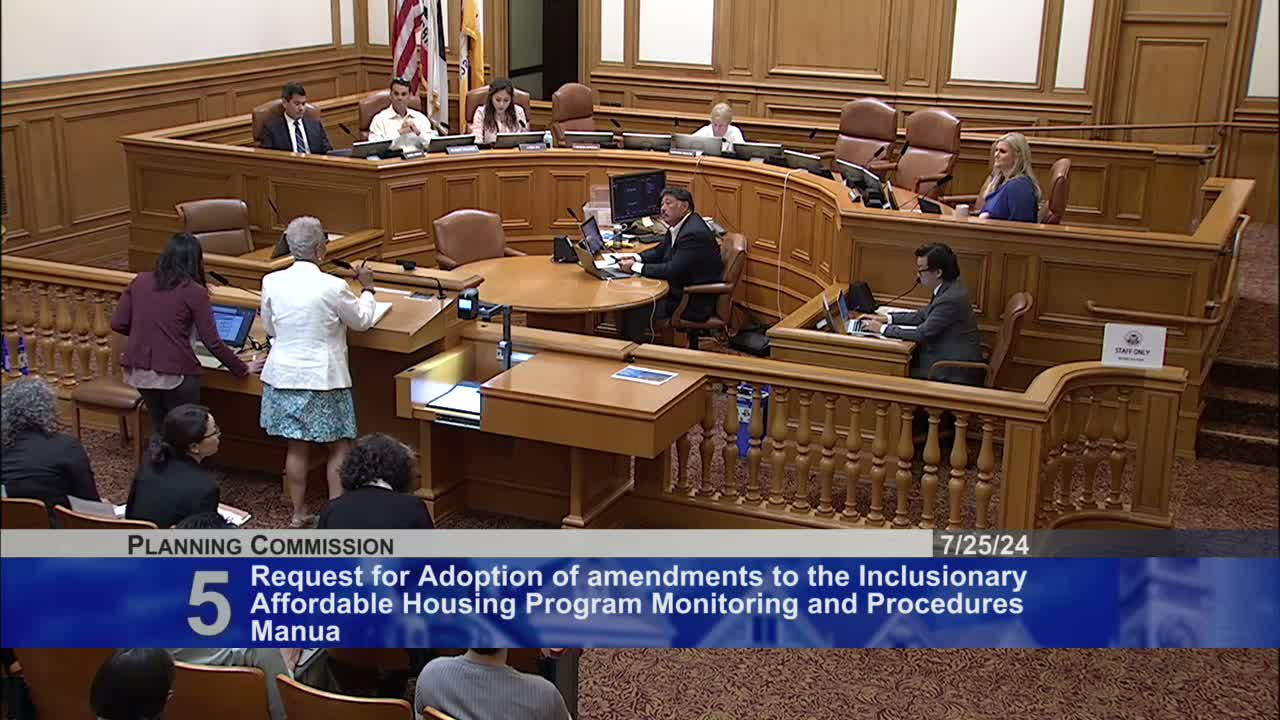
Planning Commission adopts MOHCD updates to Inclusionary Affordable Housing procedures manual
Summary
The San Francisco Planning Commission on July 25 adopted updates to the Inclusionary Affordable Housing Program procedures manual that streamline leasing, adjust resale pricing, and add language-access requirements, after extensive public comment on language access and resale pain for existing homeowners.
San Francisco — The Planning Commission on Thursday voted to adopt revisions to the Inclusionary Affordable Housing Program monitoring and procedures manual proposed by the Mayor's Office of Housing and Community Development (MOHCD).
The manual changes, described at the hearing by Maria Benjamin of MOHCD, are meant to modernize and standardize rules across the city’s inclusionary portfolio, shorten the lease-up timeline and reduce paperwork, and align resale pricing so affordable resale prices better reflect owners’ costs. Benjamin told commissioners MOHCD’s portfolio now includes about 4,125 inclusionary units in 284 projects and that the office has added staff and upgraded digital tools to support applicants and project sponsors.
The revisions include a process allowing developers to apply an applicant’s income verification from one project to another at the developer’s discretion, a reduction in the number of documents required for eligibility and annual recertification, the introduction of a fair first-come-first-served process if lottery lists are exhausted, changes to homeownership resale pricing formulas so maximum sales prices better reflect HOA dues and other carrying costs, and lowered down‑payment and reserve requirements to broaden buyer access.
Public comment dominated the hearing before commissioners voted. Realtors and broker representatives urged the commission to condition approval and asked MOHCD to continue dialogue on operational details such as dual-agency rules, while current Below‑Market-Rate (BMR) homeowners described long marketing periods and financial hardship when the city-established “affordable price” diverged from maximum allowable resale price. "We have had our unit on the market for about two years," one homeowner said, adding that the affordability rules can prevent buyers who rely on down‑payment assistance from purchasing.
Housing counselors and nonprofit advocates strongly supported many of the manual’s changes but pushed MOHCD to address persistent language-access barriers during lease-up and post-lottery processes. "When leasing agents send emails in English alone, applicants become anxious and often miss required steps," a housing counselor testified, urging stronger enforcement and funding to expand translated materials and outreach.
Commissioners pressed MOHCD on several enforcement and funding limits. Benjamin said MOHCD provides templates, training and grant-funded housing‑counseling support—about $4 million annually for counseling programs—but acknowledged the office lacks statutory authority to compel private leasing agents to provide language access. "We encourage and request leasing agents provide language access and we provide templates and training," she said, adding that additional authority or an increased fee would likely require Board of Supervisors action.
Several commissioners urged the office and the Board of Supervisors to pursue legislative or budgetary solutions to back the manual’s language-access provisions and to ensure that enforcement and funding keep pace with community needs.
After the dialogue and with modifications reflected in an errata packet distributed before the hearing, Commissioner Farr moved to adopt the resolution; the motion passed unanimously 4–0 (Commissioner Imperial had recused earlier). MOHCD committed to follow up on the commission’s recommendations and to continue training and outreach to housing counselors and leasing agents.
The adoption covers only units governed by the inclusionary manual—MOHCD staff told commissioners the manual governs roughly 18% of the city’s broader affordable-housing stock—and does not change requirements tied to other funding streams or state and federal programs. MOHCD and the planning department said they will continue to work with the Board of Supervisors, housing counselors and advocates to address gaps the manual cannot resolve alone.
The planning commission’s action completes its local approval of the manual update; MOHCD will proceed to finalize the document and implement training and outreach measures described at the hearing.