Get Full Government Meeting Transcripts, Videos, & Alerts Forever!
Get email alerts on the Bart Fair Gates topic
No spam. Unsubscribe anytime.
BART outlines Civic Center fare-gate rollout, safety steps and outreach to arts institutions
Summary
BART officials briefed the Arts Commission on a Civic Center fare-gate pilot, the 'safe and clean' plan, and related downtown transit projects including traction power upgrades, escalator and canopy work, and outreach to disability and neighborhood groups.
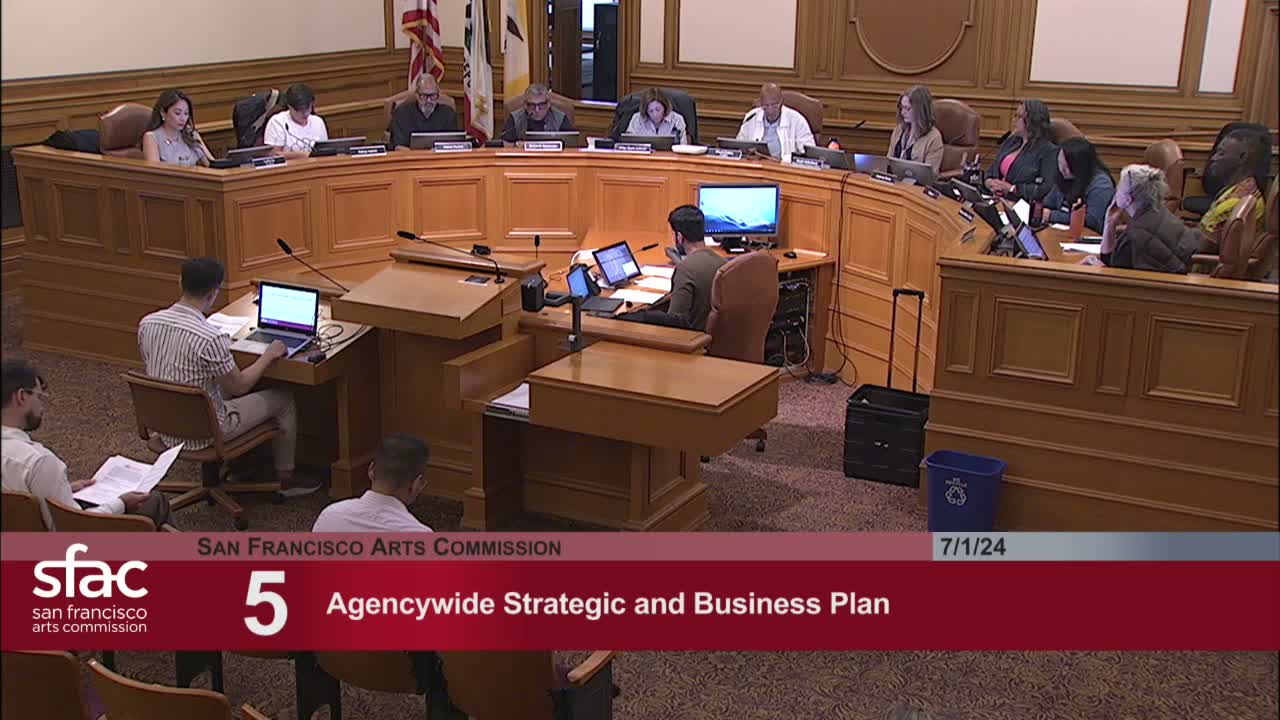
Bridal Dunn, BART manager of local government and community relations, and Molly Burke, outreach lead for San Francisco and San Mateo County projects, presented BART’s Civic Center initiatives to the Arts Commission on July 1.
Dunn described the 'safe and clean' plan and the fare-gate pilot at Civic Center Station. She said prototypes were installed and the full Civic Center arrays would begin installation in late July; one accessible gate prototype has already been installed on the platform level. Dunn emphasized that fare gates are intended both to modernize the system and to reduce interactions between fare evaders and police by providing a physical barrier.
Burke detailed downtown infrastructure projects that intersect Market Street and Civic Center: five traction power substations across the BART district (two in San Francisco, including Civic Center), a 41-escalator renovation program (12 escalators complete, four under construction, 24 remaining) and a 21-canopy program along Market Street (11 canopies complete, three under construction, seven to go). She said the traction power work will allow BART to raise Transbay Tube throughput from about 23 trains per hour to roughly 30.
Dunn also described safety measures including increased cleaning cadence, doubling systemwide police presence, deployment of transit ambassadors and crisis intervention specialists who connected 288 people to services last quarter, and outreach efforts with disability organizations for the accessible gate. Molly Burke noted vandalism and acid etching to canopy glass panels and explained that BART has contracted glass polishing and is testing anti-etch films to mitigate damage.
Commissioners asked about community outreach, impacts on nearby businesses, canopy vandalism mitigation, and police training. Dunn and Burke said they have conducted extensive briefings (more than 100 presentations since launch) and would continue targeted outreach to cultural institutions, neighborhood organizations and the Board of Supervisors.