Get Full Government Meeting Transcripts, Videos, & Alerts Forever!
Get email alerts on the Steiner Lombard topic
No spam. Unsubscribe anytime.
Commission authorizes cannabis retailer at Lombard/Steiner and punts contested residential conversion for further review
Summary
The commission approved a cannabis retail conditional use at 2205–2207 Lombard with conditions (remove curb cut, close garage parking, allow garage as storage and require staff‑approved door design). The related request to convert upper‑floor residential units to commercial drew divided views; commissioners issued a motion of intent to approve the conversion and continued it to May 12 to let staff craft findings.
San Francisco — In a split decision Thursday, the Planning Commission approved a cannabis retail use at 2205–2207 Lombard Street but delayed a companion request to formalize conversion of two upper‑floor residential flats to commercial office uses.
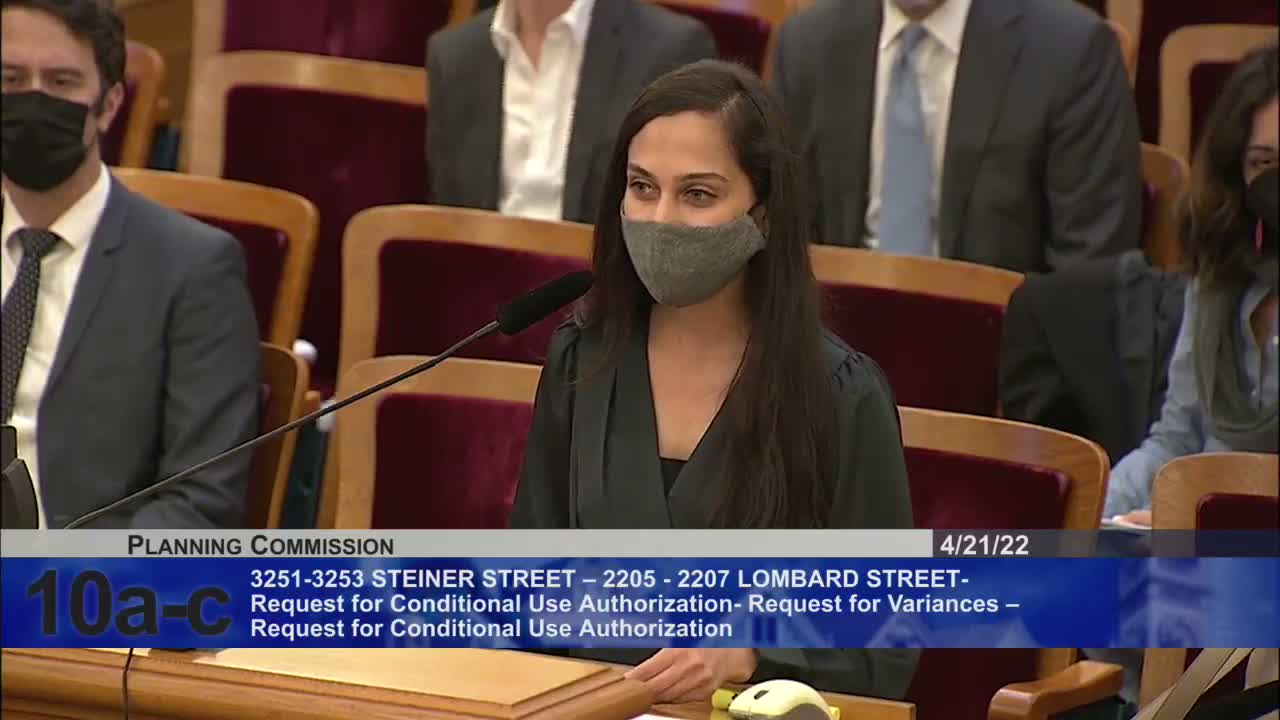
After staff flagged a complicated permitting history for 3251–3253 Steiner / 2205–2207 Lombard and recommended disapproval of the residential conversion to preserve housing stock, commissioners heard lengthy public comment both opposing and supporting the cannabis applicant (Rosemary Jane). Opponents cited saturation of dispensaries on Lombard, proximity to schools, parking and public‑safety concerns; supporters and nonprofit partners emphasized equity commitments and hiring of people affected by the criminal justice system.
The commission voted 5–2 to approve the cannabis conditional use with conditions: removal of the curb cut at the Steiner garage, a prohibition on returning the garage to residential parking, and a requirement that the applicant work with staff on an appropriate door/design for the former garage opening; the garage may be used for non‑parking storage by the retail operator. Commissioners Imperial and Moore voted against the cannabis approval.
On the linked residential conversion question — whether the two upper‑floor flats should be restored as residential or allowed to remain commercial — commissioners were split. Given ambiguous historical records, the commission made a motion of intent to approve the conversion (contrary to staff’s disapproval recommendation) and continued the matter to May 12 so staff can prepare formal findings and draft conditions. Zoning staff agreed to continue the related variance on the same schedule and said the zoning administrator could grant the variance if the CU to remove residential units is later authorized.
The combined outcome leaves the cannabis operator clear to proceed under the planning conditions while commissioners and staff take additional time to resolve the disputed residential conversion, enforcement timing and any required abatements.