Get Full Government Meeting Transcripts, Videos, & Alerts Forever!
Get email alerts on the Adus Housing Services topic
No spam. Unsubscribe anytime.
Planning Commission backs local ADU rule to protect tenants’ parking, storage and laundry
Summary
The San Francisco Planning Commission on Sept. 9 approved a local ordinance from Supervisor Mandelmann to clarify that building permits for accessory dwelling units do not, by themselves, justify removing tenant housing services. The rule creates a landlord declaration, tenant notice and a Rent Board petition pathway before planning can approve certain ADUs.
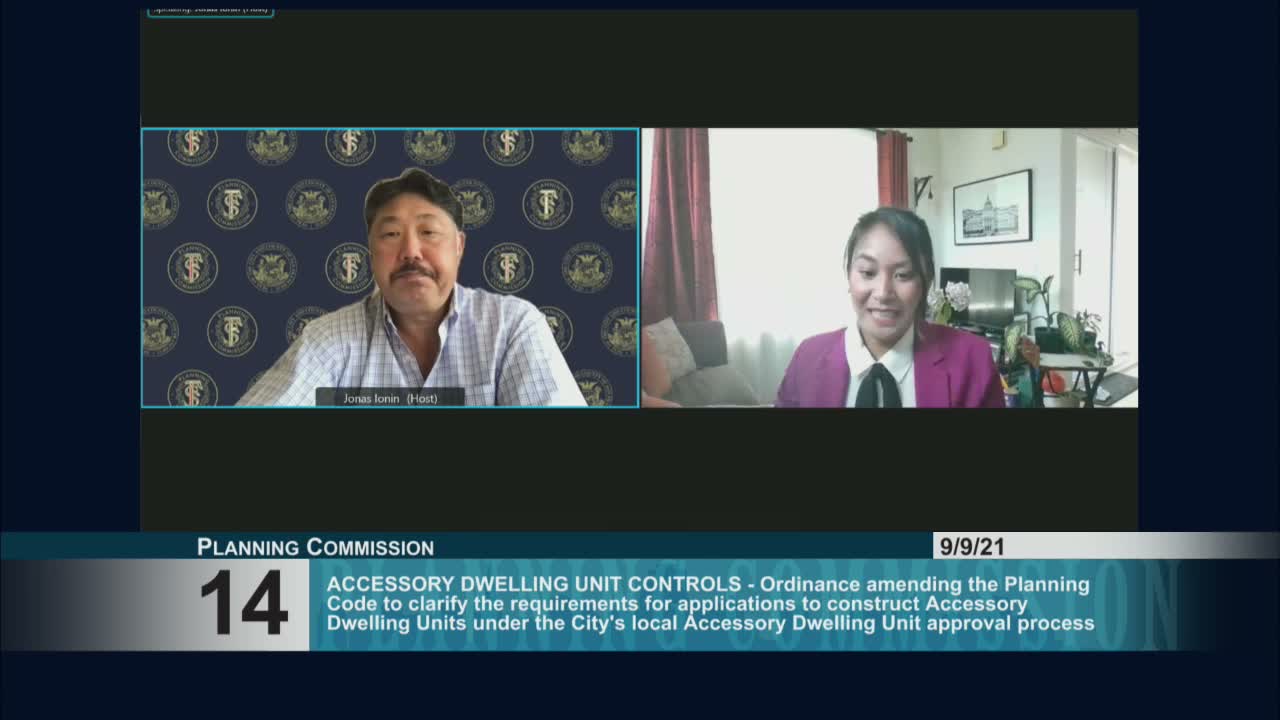
The San Francisco Planning Commission voted unanimously Sept. 9 to recommend city code changes that bar landlords from using accessory dwelling unit (ADU) permits as an automatic justification to remove tenant housing services such as parking, storage and laundry. The ordinance was introduced by Supervisor Ahsha Safai’s colleague (Supervisor Mandelmann’s office was represented by Jacob Bintliff) and was supported by tenant advocates.
The ordinance requires property owners to post a written declaration and tenant notice describing where ADUs would be located and whether the work will sever, substantially reduce or remove any housing services. Tenants would then have a defined window to petition the Rent Board for a written determination; the Rent Board would investigate and convey its findings to Planning before Planning may issue approval in cases where a petition is filed.
The measure builds on San Francisco's existing rent ordinance protections. Joseph Kumas of the Rent Board told the commission that under current law tenants may petition for a rent reduction when a housing service is substantially decreased, but there is no clear, pre‑application process that requires interagency coordination. "This legislation attempts to harmonize the process so planning cannot proceed without clarity about housing services," Kumas said.
Sponsor Jacob Bintliff said the ordinance would put wrongful loss of housing services "on the same legal footing as a wrongful eviction," including remedies that may include treble damages and attorneys' fees. The city attorney's office clarified the change would apply only to the city's discretionary ADU pathway and not to state‑mandated ADU approval tracks.
Planning staff had proposed two modifications: (1) allowing certain local ADU applicants to submit proof of notice directly to Planning when there appear to be no affected tenants, and (2) permitting Planning to approve ADUs where only parking is affected. Many tenant advocates and commissioners opposed those staff modifications, arguing they would weaken tenant protections. After deliberation the commission adopted the ordinance without Planning's modifications.
The commission's final action directs a substitute ordinance that lengthens the tenant petition period to 30 days and formalizes a Rent Board review and transmission requirement to Planning. Planning staff and Rent Board representatives said they will work together on implementation, including the declaration form and timelines. The sponsor said he will file the substitute ordinance with the City Attorney.
The commission's approval sends the measure along the legislative track for adoption and implementation; proponents said their next step is finalizing the substitute ordinance language with the City Attorney and then advancing it to the Board of Supervisors.
Ending: The commission recorded its vote on the ordinance after extensive public testimony from tenants and tenant advocates and approved the change unanimously, directing staff to coordinate with the Rent Board on forms and timelines.