Get Full Government Meeting Transcripts, Videos, & Alerts Forever!
Get email alerts on the Zoning Chinatown topic
No spam. Unsubscribe anytime.
Planning Commission backs zoning changes to protect Chinatown businesses, keeps 3‑year abandonment rule
Summary
The Planning Commission on Aug. 26 approved targeted zoning and map amendments for Chinatown, North Beach and Polk Street to protect small and legacy businesses; the commission retained a 3‑year abandonment period and asked staff to review recent late modifications from Supervisor Peskin’s office.
The San Francisco Planning Commission approved targeted zoning changes on Aug. 26 intended to preserve Chinatown’s small‑business character and give conditional relief for certain community‑serving uses, while retaining a three‑year abandonment period for nonconforming use‑size protections.
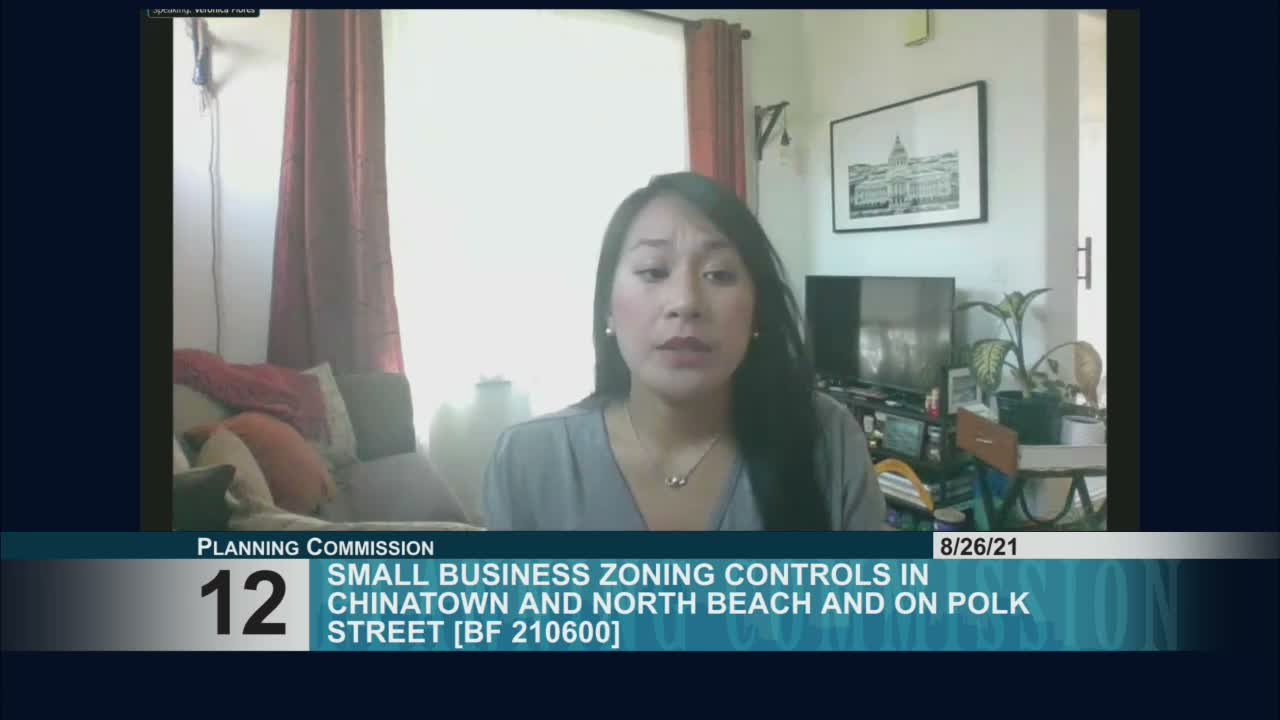
Veronica Flores, planning department staff, told the commission the Small Business Zoning Controls ordinance — sponsored by Supervisor Aaron Peskin’s office — would allow social service and philanthropic facilities to exceed Chinatown use‑size maximums with a conditional use authorization if the commission finds the proposed use ‘‘primarily serves Chinatown’’ and is appropriate for the parcel. Flores said staff recommended technical corrections and to retain the standard three‑year abandonment period used elsewhere in the code.
Lee Hepner, representing Supervisor Peskin, described the package as ‘‘targeted amendments’’ aimed at preserving legacy uses such as banquet halls and community‑serving enterprises and preventing encroachment by the financial district into Chinatown. ‘‘These changes will encourage community uses and help revitalize the Chinatown neighborhood,’’ Hepner said.
Public commenters were split. Alan Lowe, pro bono counsel for Chinatown Community Development Center, voiced full support, saying the changes will ‘‘preserve Chinatown and ensure that there’s not an encroachment of the financial district into Chinatown’’ and help revitalize commercial corridors. A building‑owner representative asked the commission to consider a narrower tweak that would allow nonprofits that ‘‘include Chinatown’’ among their service areas — rather than require they ‘‘primarily serve Chinatown’’ — to seek conditional relief.
Commissioners debated that proposed narrowing and the broader policy tradeoffs. Staff and the zoning administrator cautioned that terms like ‘‘includes Chinatown’’ can be ambiguous to apply; they noted conditional use authorization remains the commission’s tool to judge whether an applicant meets any service‑area standard. Several commissioners said they favored keeping the three‑year abandonment period to avoid disadvantaging owners and tenants during a difficult leasing market, while others said staff should consider drafting clearer language if the nonprofit‑exception change is pursued.
A motion by Commissioner Gordon Fung to approve the planning code and zoning map amendments with staff’s recommended modifications — including retaining the three‑year abandonment clause — passed 4–1, with Commissioner Tanner dissenting. Commissioners also asked staff to review the late modifications submitted by Supervisor Peskin’s office and provide analysis to the supervisor’s staff before the Board of Supervisors hearing; that research request was treated as a follow‑up rather than a change to the ordinance language.
What’s next: The commission’s approval forwards the ordinance and staff recommendations to the Board of Supervisors for further consideration; staff will review the suggested late modifications and advise the supervisor’s office as requested.
Who spoke (first reference with role): Veronica Flores, Planning Department staff; Lee Hepner, representative of Supervisor Peskin’s office; Alan Lowe, pro bono counsel for Chinatown Community Development Center; Commissioner Gordon Fung; Commissioner Tanner; Commission President Koppel.
Ending: The motion passed on a 4–1 vote; the commission recorded the decision and moved on to subsequent agenda items.