Get Full Government Meeting Transcripts, Videos, & Alerts Forever!
Get email alerts on the Racial Equity topic
No spam. Unsubscribe anytime.
Community groups press Planning Department for stronger, community‑led implementation of racial and social equity plan
Summary
Planning staff presented Phase 1 updates and Phase 2 scoping for the racial and social equity action plan; many community groups urged faster, community‑driven implementation, clearer accountability and resources to prevent displacement.
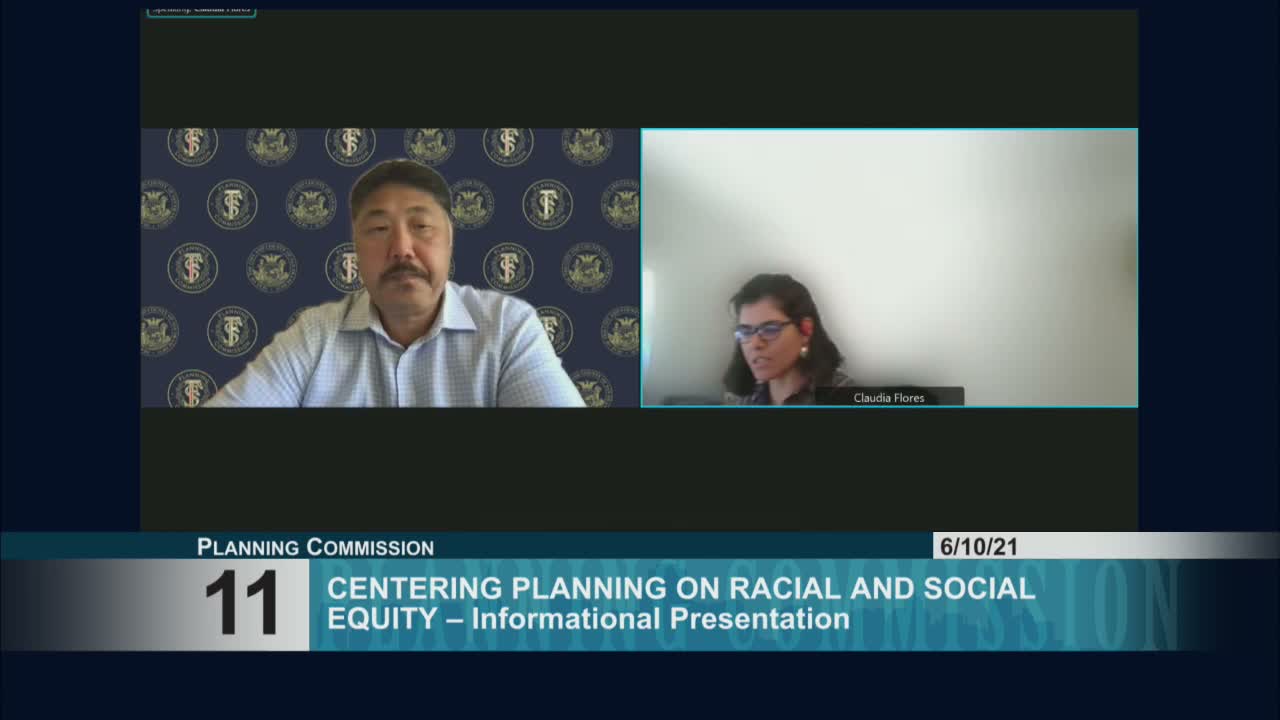
Claudia Flores and planning staff presented an update on the department's racial and social equity action plan, describing Phase 1 accomplishments (internal hiring and training, an equity budget tool, an internship program) and the proposed scope for Phase 2 (community engagement, environmental justice mapping, performance metrics and a Community Equity Advisory Council). Staff said Phase 2 community engagement had been delayed by the pandemic and that the Office of Racial Equity would issue further direction before a final Phase 2 plan.
Public comment was extensive. Members and partner organizations of the Race and Equity in Planning (REP) Coalition — including Richmond District Rising, Filipino Cultural Heritage District, Mission Historical Collaborative, Mission SRO Collaborative, Westside Tenants Association and others — thanked staff for progress but urged deeper, community‑led changes and faster implementation. Common criticisms included that internal staff training alone is insufficient, that planning remains oriented toward for‑profit development, and that the department must invest resources, transfer decisionmaking power and adopt measurable benchmarks to prevent displacement.
Speakers emphasized specific requests: move beyond internal culture change to policy and budget shifts; prioritize anti‑gentrification measures; provide translation and outreach to multilingual populations; ensure community advisory bodies have clear mandates and influence; and incorporate cannabis social equity and workforce programs into Phase 2. Staff described the Community Equity Advisory Council as an advisory group to staff (18–24 months, meeting monthly) and said an environmental justice working group will develop mapping and policy recommendations in line with Senate Bill 1000 requirements.
Commissioners asked about sequencing, accountability and how the advisory council and EJ working group will interact with broader city efforts. Staff said they will return with a clarified scope, a public web dashboard with quarterly updates, and ongoing coordination with the Office of Racial Equity and other departments.
Next steps: staff will refine Phase 2 scope and timelines, coordinate with the Office of Racial Equity, and present further materials and public engagement plans to the commission.