Get Full Government Meeting Transcripts, Videos, & Alerts Forever!
Get email alerts on the Density Bonus topic
No spam. Unsubscribe anytime.
Planning staff outlines limits of state density bonus; commissioners push for standards to protect light, air and open space
Summary
Planning Department staff briefed the commission on California's state density bonus law and its limited local discretion; commissioners asked staff to work with DBI and return with objective standards to safeguard light, air and open space for residents.
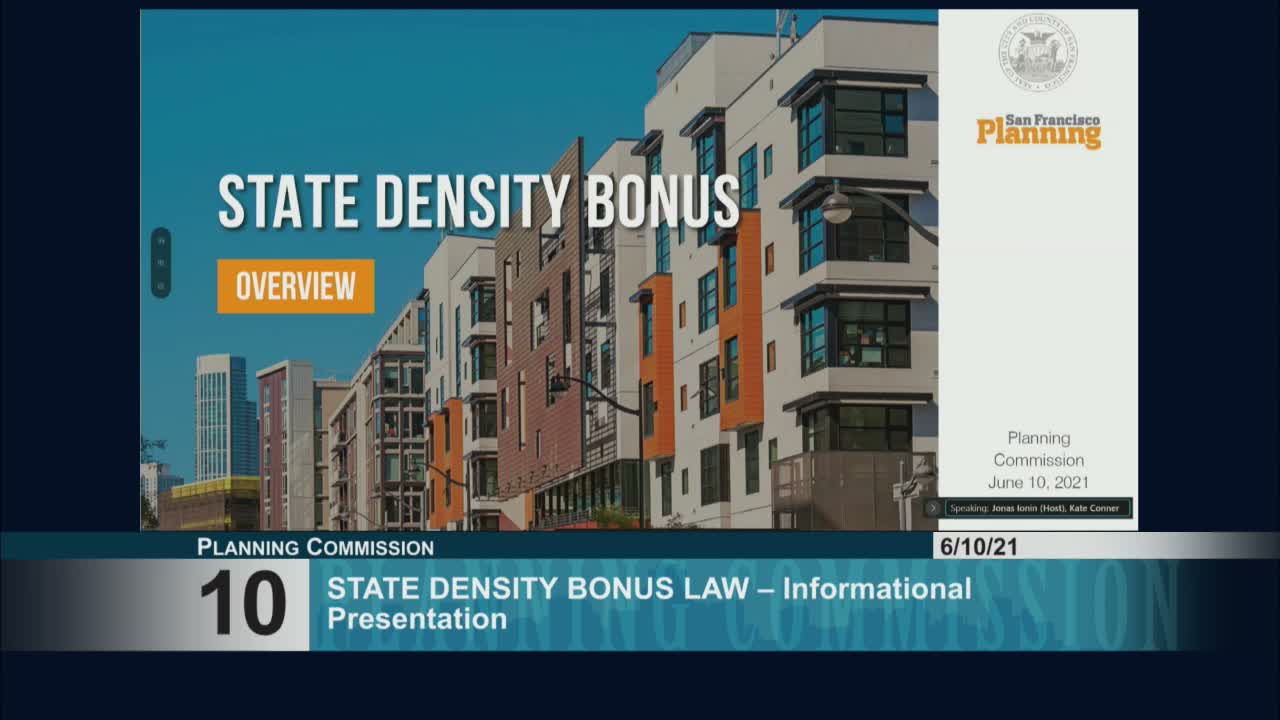
Kate Connor, a Planning Department staffer, gave an overview of California's state density bonus law and explained how it constrains local review. She said the law (adopted in 1979) grants additional development capacity when projects provide on-site affordable units and that local jurisdictions may only deny incentives, concessions or waivers when there is a "specific adverse impact on public health, safety, or a property listed on the California Register of Historic Resources." Connor noted projects subject to the Housing Accountability Act are largely treated as code‑complying even when they request waivers and incentives, limiting city discretion.
Commissioners raised practical concerns about how waivers and incentives can reduce private and shared open space and the amount of light and air available to units. Commissioner Tanner asked whether features tied to health and safety — for example, minimum window size for bedrooms and life‑safety elements enforced by the building code — can be protected; Connor said building code requirements for light and egress cannot be waived under the state density bonus, but some planning code standards (exposure, open space) can be requested as waivers or incentives and must be evaluated project‑by‑project.
Commissioner Diamond and others urged the department to work with the Department of Building Inspection to identify objective standards that anchor light, air and open‑space requirements to public‑health and safety thresholds. Director Hillis said staff can scope a focused task to return with options and a timeline, and the commission asked staff to come back with a proposal on how to create enforceable, objective standards that would apply when projects seek waivers or incentives under the state program.
The presentation included discussion of how San Francisco applies the affordable housing fee to bonus (market‑rate) units while crediting on‑site affordable units; staff also referenced Planning Director Bulletin 6, which documents local interpretations and procedures for processing state density bonus projects. Commissioners and several public commenters urged clearer materials and additional public outreach so neighborhood stakeholders can review how fee calculations and inclusionary requirements will interact with bonus units.
Next steps: staff said it will return with a scoped approach and potential objective standards to address the commission's concerns, and the department plans additional briefings tied to the open‑space review scheduled in early July.