Get Full Government Meeting Transcripts, Videos, & Alerts Forever!
Get email alerts on the Transportation topic
No spam. Unsubscribe anytime.
Planning Commission adopts substantive amendments to TDM standards to tighten parking and boost bike parking
Summary
The San Francisco Planning Commission unanimously approved substantive changes to the Transportation Demand Management (TDM) program on March 11, 2021, including a limited plan for low‑density residential projects, removal of unbundled parking as a nonresidential measure, a minimum short‑term parking price floor, and clearer bike‑parking scaling.
The San Francisco Planning Commission on March 11 adopted substantive amendments to the city’s Transportation Demand Management (TDM) program aimed at strengthening measures to reduce vehicle miles traveled and clarifying how the program applies to certain project types. The vote was unanimous, 7–0.
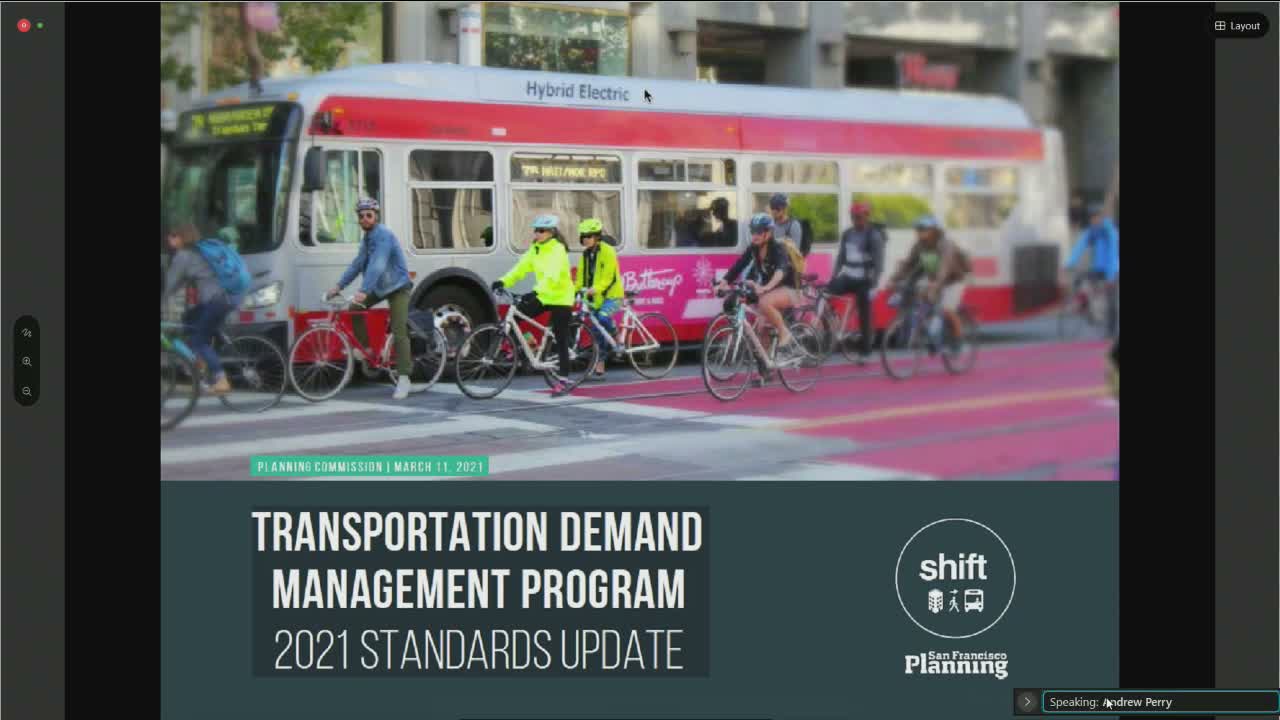
Staff framed the changes as updates to a program first adopted in March 2017 that now covers more than 200 projects. Andrew Perry of the Planning Department told commissioners the TDM program was designed to be nimble and that today’s changes would become the third version of program standards. “The TDM program first became effective almost 4 years ago in March 2017,” Perry said in his presentation, noting the department maintains a dashboard tracking 239 TDM cases.
The amendments include several substantive elements: a new “limited TDM plan” for low‑density residential sites that technically trigger the program but function like single‑family or duplex buildings (requiring higher bicycle parking than code and a transportation information packet to residents); removing the unbundled parking measure from the pool of options for nonresidential projects because of implementation challenges; establishing a minimum hourly/daily price floor for the Short‑Term Daily Parking measure pegged to prevailing rates in the project vicinity; formalizing how the TDM program applies to phased projects; more specific wayfinding signage requirements (areas, size, update frequency); and a fix to scale bicycle parking requirements consistently so larger projects are required to provide proportionally more bike parking (up to 2 spaces per dwelling in the highest‑point option).
Supporters and practitioners who called in during public comment said they welcomed the department’s emphasis on flexibility and tuning requirements based on implementation experience. Corey Smith of the Housing Action Coalition said the package struck a balance: “It really does seem to be emphasizing flexibility,” he said, while urging continued attention to feasibility under current market conditions.
Commissioners focused questions on grandfathering of older projects, how the department will track whether TDM measures actually reduce VMT, and e‑bike needs. Perry said grandfathering depends on whether a project’s application and environmental analysis are treated as new; he also said the department has set aside program fee revenue for longer‑term primary research to evaluate measures’ effectiveness once more projects reach occupancy.
The commission approved the resolution adopting the substantive amendments by roll call, with commissioners Tanner, Chan, Diamond, Fung, Imperial, Moore and President Koppel all voting “Aye.” The amendments will apply to projects that file after the effective date, though projects may voluntarily use the newer standards. Staff noted non‑substantive clarifications were also included in the packet to inform applicants and the public.
The department will post updated program materials and the TDM tool (used to calculate point targets and measures) on its website; Perry said staff and interagency partners at SFMTA and the County Transportation Authority participated in drafting the changes. Implementation questions raised at the hearing — including the new parking price floor and the removal of unbundled parking for nonresidential uses — will be monitored and re‑tuned as program data matures.
What’s next: the amendments become the latest version of the TDM standards; affected projects that have already filed may remain subject to the version in effect when they applied, while new filings will be subject to the updated rules. Staff said evaluation of measurable outcomes (VMT and GHG reductions) is planned as projects complete construction and occupancy.