Planning Commission approves Octavia Street addition despite library shading concerns; vote 5–2
Loading...
Summary
After public testimony from neighbors and library representatives warning that a fourth-floor addition at 2651–2653 Octavia Street would reduce natural light to the Golden Gate Valley branch reading room and affect solar panels, the Planning Commission voted 5–2 to approve the project and not take discretionary review, with commissioners split over the interpretation of the daylight study.
The San Francisco Planning Commission on Feb. 4 voted 5–2 to approve a vertical fourth-floor addition at 2651–2653 Octavia Street, concluding the project does not present "exceptional or extraordinary circumstances" that would require discretionary review, despite substantial public concern about impacts to the adjacent Golden Gate Valley branch library.
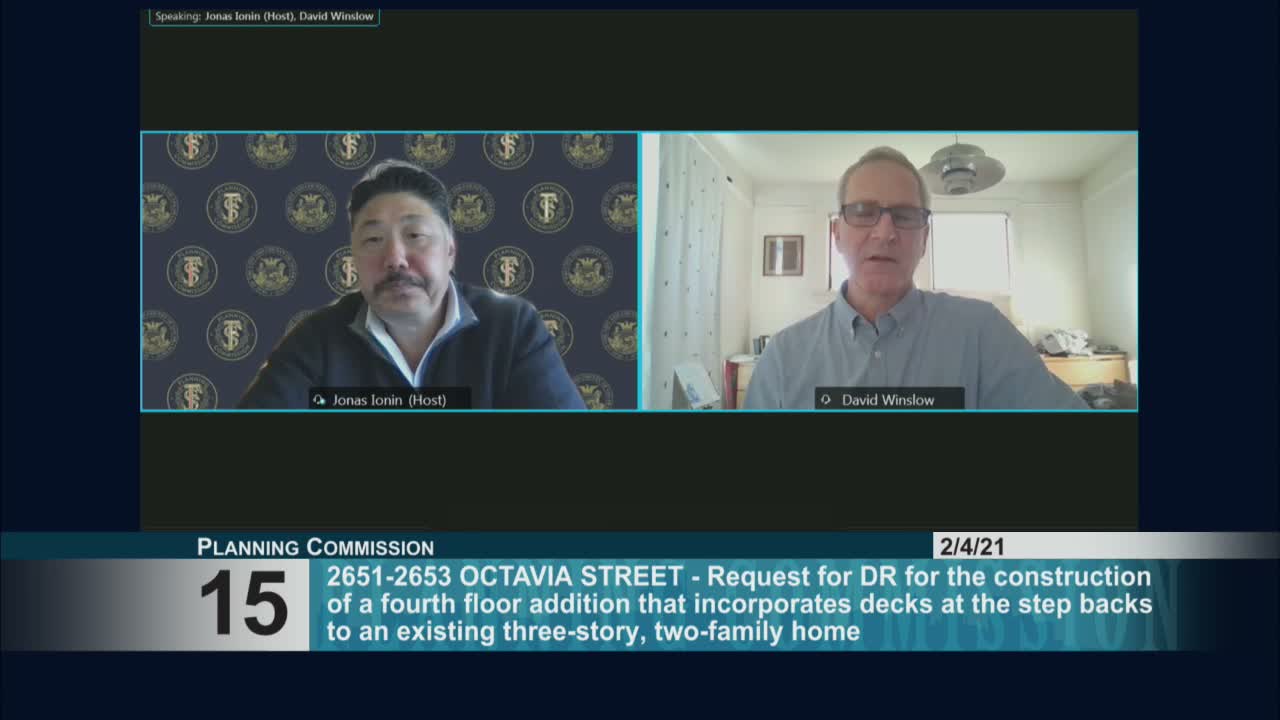
Staff architect David Winslow presented the department's additional review and a revised categorical exemption under CEQA, noting the Board of Supervisors had earlier directed a closer analysis of the project's effect on the library's character-defining reading room. Winslow summarized the department's daylight analysis and concluded it would result in only minimal reductions in natural light to the library's reading room and would not significantly impact the library's character-defining features.
Several neighbors and representatives of the library spoke in opposition. Maria Holt, representing a group concerned with the Golden Gate Valley branch, said the daylight-impact analysis arrived only about a week before the hearing and asked for more time to review the complex study; she argued natural light is integral to the reading-room experience. "No one can reasonably argue that natural light is not integral to a library experience," Holt said. Bridget Maley, author of the landmark designation report, emphasized the role of natural light in the library's spatial character and warned the addition would alter roofline articulations on Octavia Street.
The project sponsor presented a technical daylight autonomy analysis that found small average differences between existing and proposed conditions (examples cited in the presentation included "overcast -4%", "partly cloudy +11.1%", and "clear -1.8%"), and argued electric lighting supplements natural light during a sizable fraction of hours.
Commissioners split on whether the analysis supported denial or approval. Commissioner Tanner and others accepted staff's analysis and favored approval without discretionary review. Commissioner Moore and Commissioner Imperial dissented: Moore questioned whether private development should be allowed to impinge on a public asset and said the visualizations and simulated interiors did not fully capture the quality of light; Imperial worried that even small percentage changes to daylight autonomy could be significant for the compact library spaces. The motion to not take discretionary review and approve the project passed 5–2.
The department's record cites the Board of Supervisors' prior involvement (which overturned an earlier categorical exemption), the department's revised categorical exemption dated Jan. 27, 2021, and a daylight study prepared in response to the board's direction. Commissioners who supported approval noted staff conducted a site visit and preservation staff judged impacts minimal. Commissioners voting against called for more protective measures for a city public asset that is undergoing landmarking.