Get Full Government Meeting Transcripts, Videos, & Alerts Forever!
Get email alerts on the Planning Policy topic
No spam. Unsubscribe anytime.
Public speakers press planning staff for equity, value-capture analysis in Market Octavia plan amendment
Summary
Planning staff presented a Market Octavia plan amendment and draft EIR timetable; community groups urged an equity-first review, stronger value-capture and protections against displacement as staff outlined rezoning and revenue estimates.
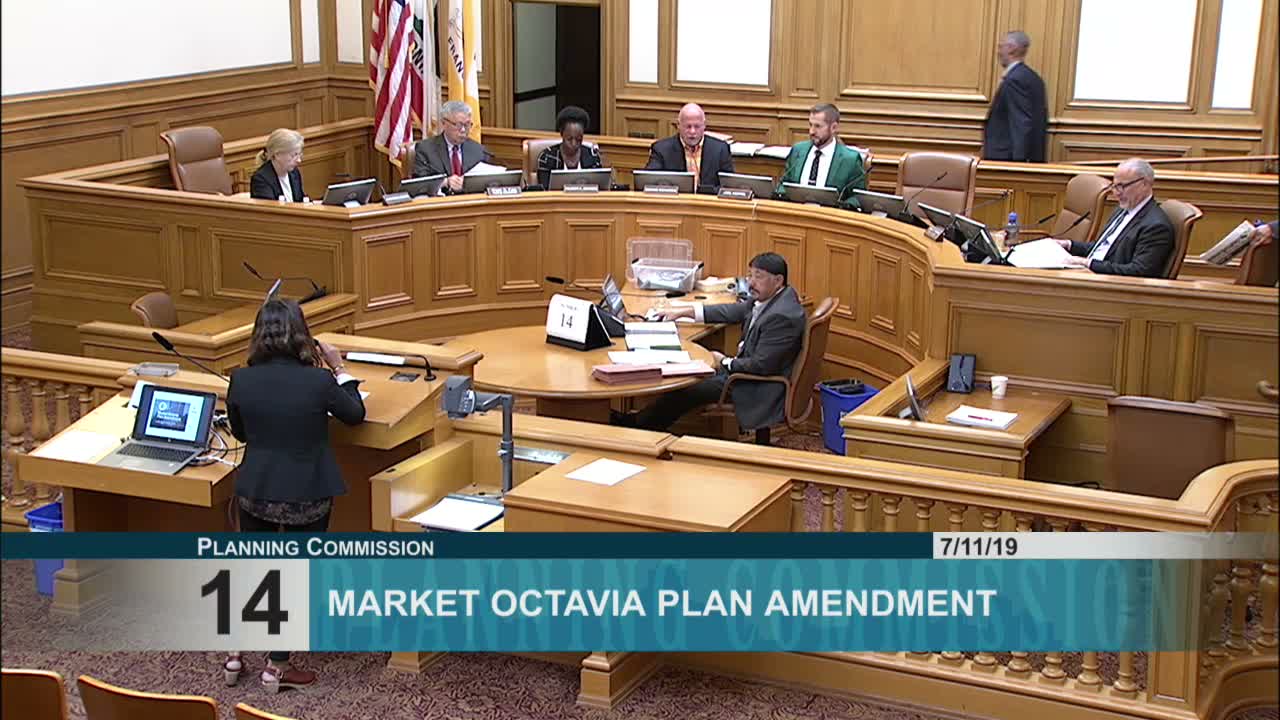
Planning Department staff presented an informational update on the Market Octavia plan amendment, explaining proposed rezoning, anticipated environmental review and projected public benefits. The presentation prompted extensive public comment urging an equity-focused review and stronger value-capture measures to limit displacement.
Planner Lily Langlois said the draft EIR would be released soon and that the amendment aims to increase housing and affordable units near transit, update zoning, and identify a package of public-realm and infrastructure projects. Langlois said rezoning 18 parcels and making modest height changes could increase total output in the plan area to roughly 9,700 units and, under the rezoning scenario, increase projected public-benefit revenue to about $946,000,000 (staff estimate includes $670,000,000 for on-site affordable units and $116,000,000 for transit improvements).
Public commenters, including Peter Papadopoulos of the Mission Economic Development Agency and community groups such as Mission No Eviction, asked staff to subject the plan to a racial-equity analysis and to prioritize strategies that preserve local small businesses and long-term residents rather than relying primarily on mitigation after upzoning. Papadopoulos said the process should be led with an “equity-first lens” and warned that rezoning NCT parcels to C3G risks regionalizing demand and accelerating gentrification.
Langlois and staff defended the process as building on a 2008 rezoning and said this amendment is intended to refine controls and extract additional public benefits, not to remake the area from scratch. Staff also noted that changes in citywide affordable-housing requirements (Prop C) and construction-cost pressures have affected feasibility and constrained capacity to add fees in some cases.
Commissioners asked detailed questions about how the draft EIR will handle traffic, utilities, sustainability, and the plan’s equity outcomes; staff said utilities and major infrastructure needs will be reviewed with agencies such as the SFPUC and that more work on community stabilization strategies is ongoing. Several commissioners urged clearer metrics tying stated goals (preserve, protect, produce) to measurable outcomes before broad upzoning.
The presentation remained informational; no entitlements were adopted at the meeting. Staff said the draft EIR and additional outreach will precede any formal vote on rezoning or plan adoption.