Get Full Government Meeting Transcripts, Videos, & Alerts Forever!
Get email alerts on the Adu Policy topic
No spam. Unsubscribe anytime.
Planning Commission adopts ordinance to implement state ADU rules, commissioners split on local impacts
Summary
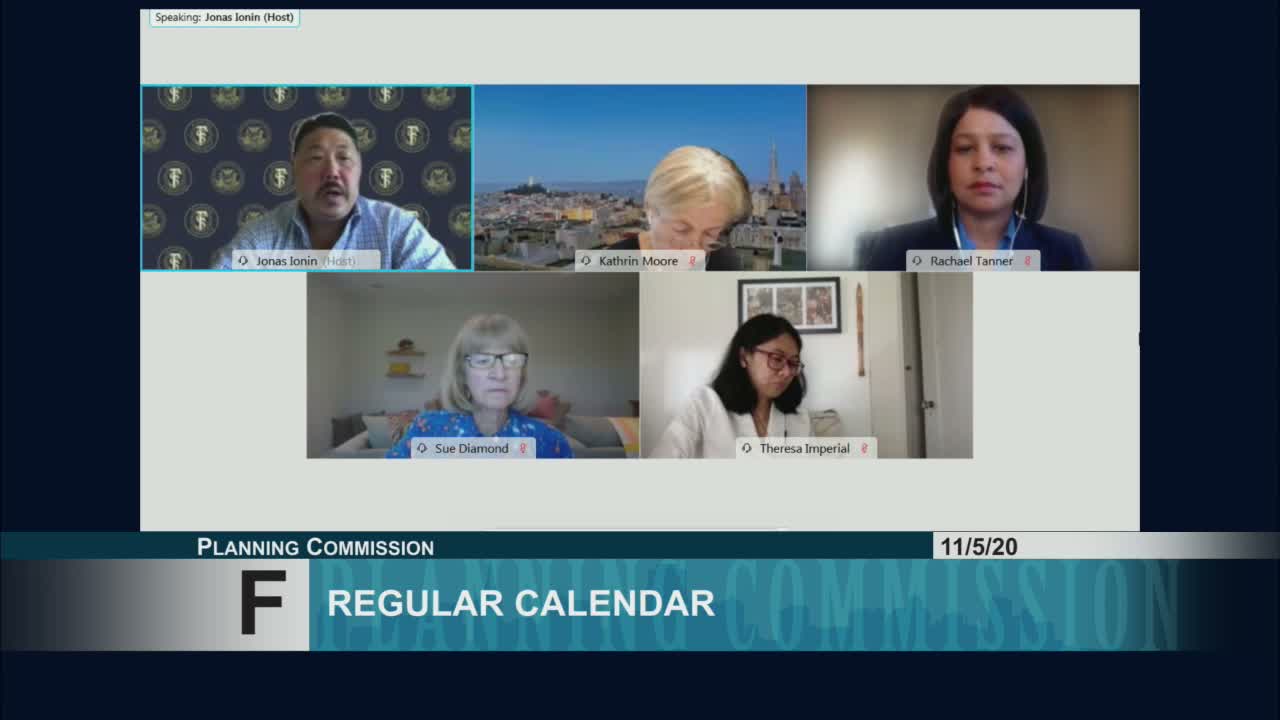
The Planning Commission voted 5–2 on Nov. 5, 2020 to adopt an ordinance aligning San Francisco code with recent state accessory dwelling unit (ADU) laws, prompting debate about CEQA, loss of mid‑block open space, rent‑control limits and tenant protections.
San Francisco’s Planning Commission on Nov. 5 adopted an ordinance to bring the city’s accessory dwelling unit rules into alignment with recent state laws, a move commissioners said was required by statute but which prompted sustained debate over local impacts.
The ordinance, intended to implement state changes that shorten review timelines and expand ministerial (non‑discretionary) ADU approvals, passed on a 5–2 vote after the commission accepted an amendment from the Historic Preservation Commission to retain reference to objective architectural review standards for landmark properties. Commissioners Imperial and Moore voted no.
Veronica Flores, Planning Department staff, told commissioners the package responds to state legislation (cited in the hearing as AB 68, AB 881 and SB 13) that creates two broad “state‑mandated” ADU categories — streamlined and ministerial — and requires permits to be issued within 60 days of a complete application. Flores said the city’s local program remains available and that the ordinance focuses on those changes the city must adopt to comply with state law. She also told the panel staff has posted a CEQA determination in the board file finding the ordinance itself is not a project for CEQA purposes. ‘‘The ordinance focuses on bringing our code in compliance with recent state law changes,’’ Flores said.
Deputy City Attorney Peter Mlynich explained why the city cannot require rent‑control restrictions on ADUs approved entirely under the state’s mandatory pathways: state law removes local discretion that the city would otherwise use as the basis for enforceable regulatory agreements under the Costa‑Hawkins framework. ‘‘If the city does not have the discretion either to deny approval of the ADU project or grant waivers of planning code standards, then there’s nothing that the city has to bargain with,’’ he said.
Public commenters were divided. Housing advocates and permit consultants urged the commission to adopt the ordinance to increase housing opportunities and to modernize outdated rules governing rooms‑down and density limits. Opponents — neighborhood groups, environmental commenters and tenants’ advocates — warned the ministerial route could reduce neighborhood review, shrink mid‑block open spaces and leave tenants exposed to displacement. One caller said streamlining could eliminate backyard trees and other private open spaces that contribute to urban canopy and quality of life.
Commissioners pressed staff for data on how many ADUs built under the city’s program have become rent‑controlled and on likely rent levels for ADUs approved under state rules. Staff said their monitoring shows roughly 380 ADUs have been built to date and about 331 of those are subject to rent control under prior local agreements; staff committed to compiling additional affordability and tenancy data as part of housing‑element work.
Commissioner Imperial and Commissioner Moore said they could not support adoption without more analysis of mid‑block open‑space impacts, CEQA implications and the potential loss of tenant protections. Commissioner Fung, who moved adoption with the HPC technical amendment, said the city must reconcile its code with state law whether or not it adopts the local ordinance; staff and the city attorney agreed that the state mandates are already in effect and that the city is required to administer those ministerial approvals regardless of whether the Planning Code is updated.
The ordinance as adopted includes: ministerial definitions for streamlined and ministerial ADUs; a 60‑day permit deadline for complete applications; impact‑fee waivers for ADUs under 750 square feet; adjusted noticing rules requiring DBI screening or equivalent when tenants may be affected; and a directive to retain or adapt objective architectural review standards to the extent state law permits for Article 10/11 properties.
The commission recorded the vote to adopt the ordinance with the HPC amendment as: Commissioners Tanner, Chan, Diamond, Fung and President (Chair) voted yes; Commissioners Imperial and Moore voted no. The commission’s staff file lists the ordinance and the CEQA determination in the board file.
What happens next: the ordinance will be forwarded to the Board of Supervisors (and other city processes as required) and staff said they will return with additional monitoring data and suggested clarifications to minimize unintended impacts in dense urban neighborhoods.