Get Full Government Meeting Transcripts, Videos, & Alerts Forever!
Get email alerts on the Large Scale Development topic
No spam. Unsubscribe anytime.
Commission certifies EIR and recommends approval of Potrero Power Station entitlements
Summary
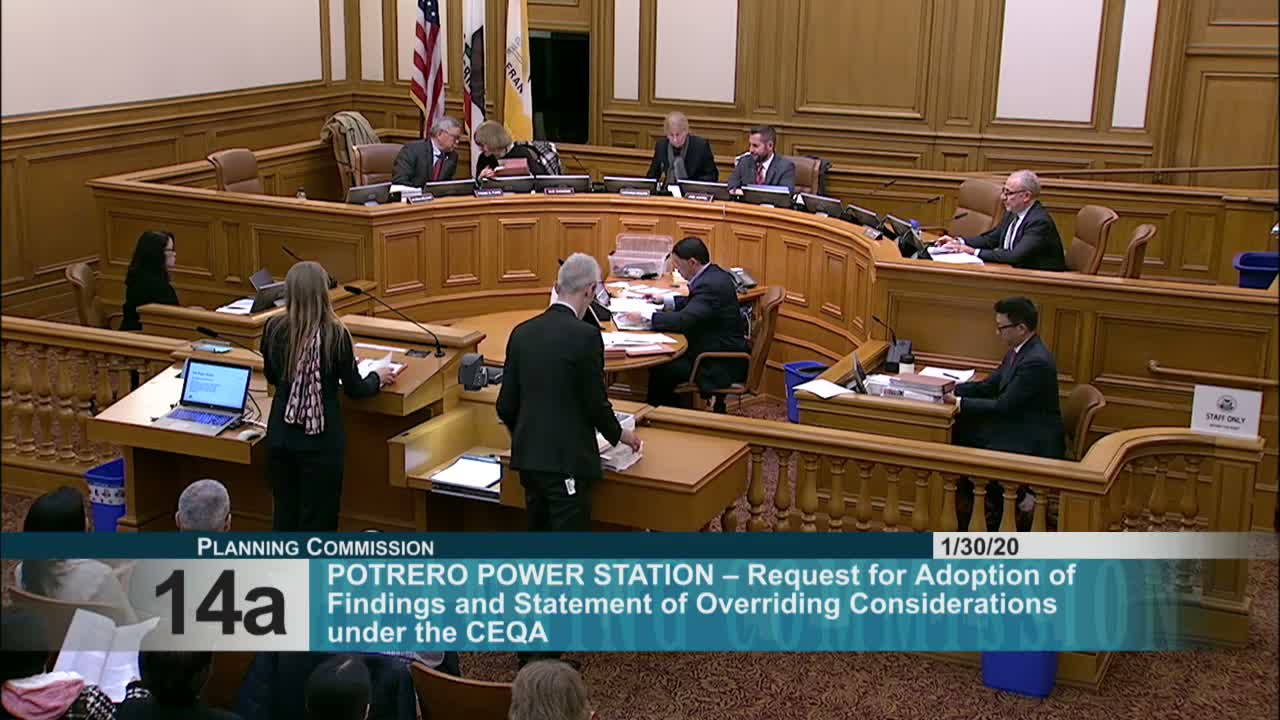
After multi-hour presentations and more than 70 public speakers, the commission certified the final EIR for the Potrero Power Station and voted to recommend approval of the project entitlements, including General Plan and planning code amendments, design-for-development and a Development Agreement.
The Planning Commission certified the final environmental impact report (EIR) for the Potrero Power Station Mixed-Use Development Project and voted to recommend approval of the project entitlements on Jan. 30, 2020.
Staff summarized the EIR findings, concluding that the project variant would produce several significant and unavoidable impacts, including demolition and partial retention of historic resources (Meter House, Compressor House, and partial treatment of Station A), construction and operational noise impacts, transit and Muni delays on several routes, air quality impacts, and temporary wind impacts during phased development. Staff and consultants described mitigation measures, but emphasized that some impacts would remain significant and unavoidable, requiring adoption of a statement of overriding considerations if the project is approved.
Sponsor Associate Capital presented the project program (up to ~2,600 units in full buildout; 30% below-market-rate units targeted across phases at defined AMIs; a mix of housing, 1.5M sf of commercial, 100k sf retail, community facilities, childcare and open space). The applicant and OEWD outlined a complex housing contribution structure (on-site inclusionary units, land conveyance to affordable developers, capped in-lieu fees payable to District 10), workforce and first-source hiring commitments, a TDM program, and funding for a water-transit pilot. Project counsel and sponsor also described remediation status (PG&E-led cleanup ~75–80% complete; sponsor plans to complete any additional residential-level remediation as part of the project) and indicated PG&E cooperation on parcel matters.
More than 70 community members, neighborhood groups, labor, and nonprofit organizations testified, with many endorsing the project's housing, open-space and preservation commitments and urging timely approval so benefits can be delivered. Community organizations and preservation advocates also urged protections and mitigation for historic Station A and early stewardship measures (Mills Act, stabilization). Commissioners questioned staff and sponsors closely on hazardous materials remediation, the EIR scope for lab uses (noting planning code permits BSL 1–3 lab use), the project's viability if PG&E-owned parcels are not acquired, and whether state density bonus programs could be invoked (staff said the Development Agreement is a negotiated package and unilateral invocation of state bonus rules would be incompatible without pre-baked provisions).
The commission voted 5–0 to certify the EIR and later voted 5–0 to adopt findings, include a statement of overriding considerations, and recommend approval of General Plan amendments, planning code/map amendments, the SUD and the Development Agreement (as amended and incorporating late modifications). Staff recorded the votes and directed that the associated exhibits and amendments be included with the recommendations to the Board of Supervisors.