Get Full Government Meeting Transcripts, Videos, & Alerts Forever!
Get email alerts on the 2417 Green Appeal topic
No spam. Unsubscribe anytime.
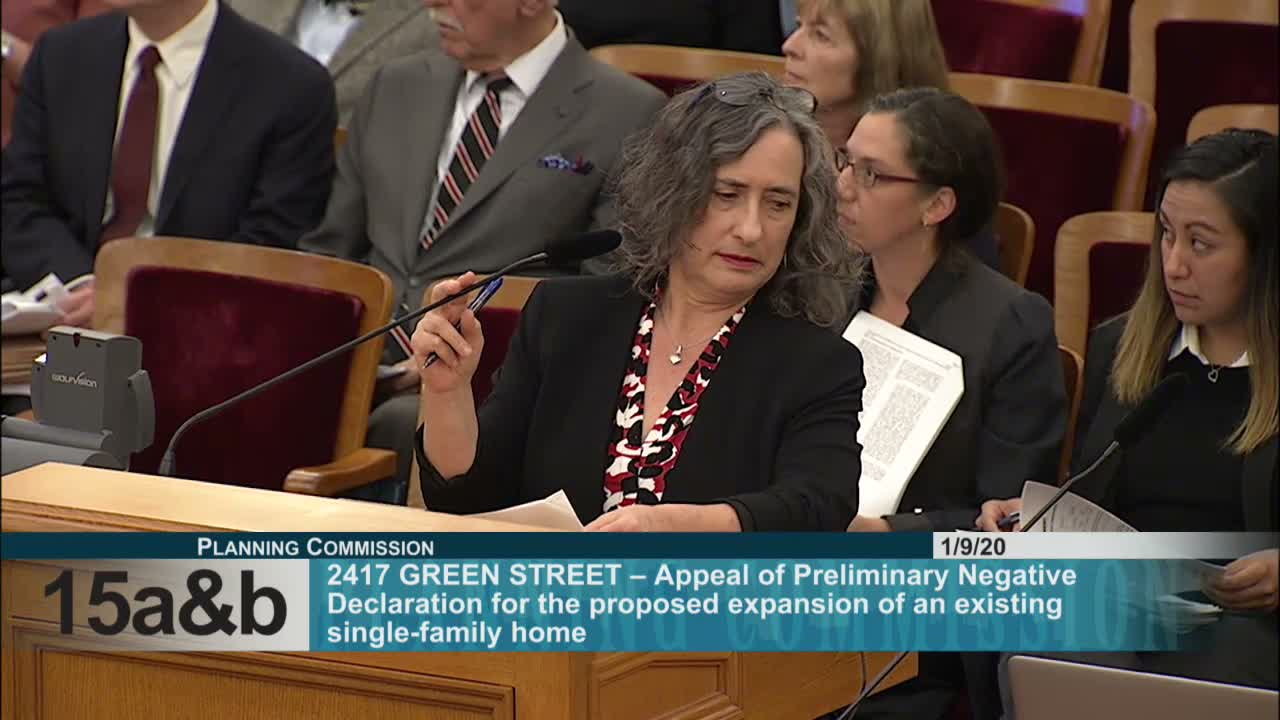
Contested addition at 2417 Green Street: commissioners uphold PMND but order redesign and neighbor talks
Summary
After hours of testimony and expert disagreement, the Planning Commission upheld a preliminary mitigated negative declaration for 2417 Green Street but continued the project to April 16 and directed a redesign with limits on excavation, stronger adherence to Cow Hollow guidelines, and staff‑facilitated meetings between sponsor and neighbors.
San Francisco — A contentious dispute over plans to add rear and vertical floors at 2417 Green Street — adjacent to the historic Coxhead House at 2421 Green — ended Thursday with commissioners upholding the Planning Department’s preliminary mitigated negative declaration (PMND) but sending the project back for redesign and further meetings.
The case drew packed public comment and expert testimony on both sides. Neighbors and experts for the Coxhead House argued that deep basement excavation, foundation work and back‑yard massing could damage the historic structure or undiscovered contaminated soils and demanded an environmental impact report. “The project presents unusual circumstances relating to historic resources and hazardous materials and may have a significant effect on the environment,” counsel Richard Drury said, citing the Board of Supervisors’ prior finding.
Project sponsor Chris Durkin and his technical team countered with geotechnical, vibration and soils testing and offered mitigation and monitoring measures during plan review. Durkin said the work proposed was a code‑compliant addition and noted he had spent several years and significant consultant resources preparing analyses. “This project is a small rear addition to an existing home,” Durkin said. “It has already been in front of a CEQA judge, and the complaint filed by the appellant was dismissed.”
Commissioners were split on the PMND itself. By a 5‑1 vote they sided with Planning staff that the department’s mitigation and monitoring package — which requires pre‑construction coordination, milestones, geotechnical oversight and sharing of reports with planning and DBI — reduced the potential impacts to a less‑than‑significant level. Commissioner Moore dissented on the PMND vote, saying the mitigation lacked sufficient teeth.
After sustained deliberation the commission declined a motion to take discretionary review and deny the project. Instead it continued the matter to April 16 and directed the sponsor to redesign the proposal with sensitivity to the historic Coxhead House, to avoid or minimize deep excavation (including reconsidering the proposed garage excavation and extra parking/ADU if it requires substantial earthwork), and to meet with neighbors and planning staff. The commission also directed stronger adherence to Cow Hollow residential design guidelines, including terracing/stepping and scale at the mid‑block open space.
The project’s continued status gives the sponsor two and a half months to revise plans and for staff and neighbors to attempt a negotiated outcome; commissioners stressed that sharing structural addenda and geotechnical milestones with planning and adjoining homeowners would be part of the follow‑up process.