Get Full Government Meeting Transcripts, Videos, & Alerts Forever!
Get email alerts on the Telecom topic
No spam. Unsubscribe anytime.
Neighbors press Planning Commission to halt proposed AT&T rooftop macro site near Webster Street historic district
Summary
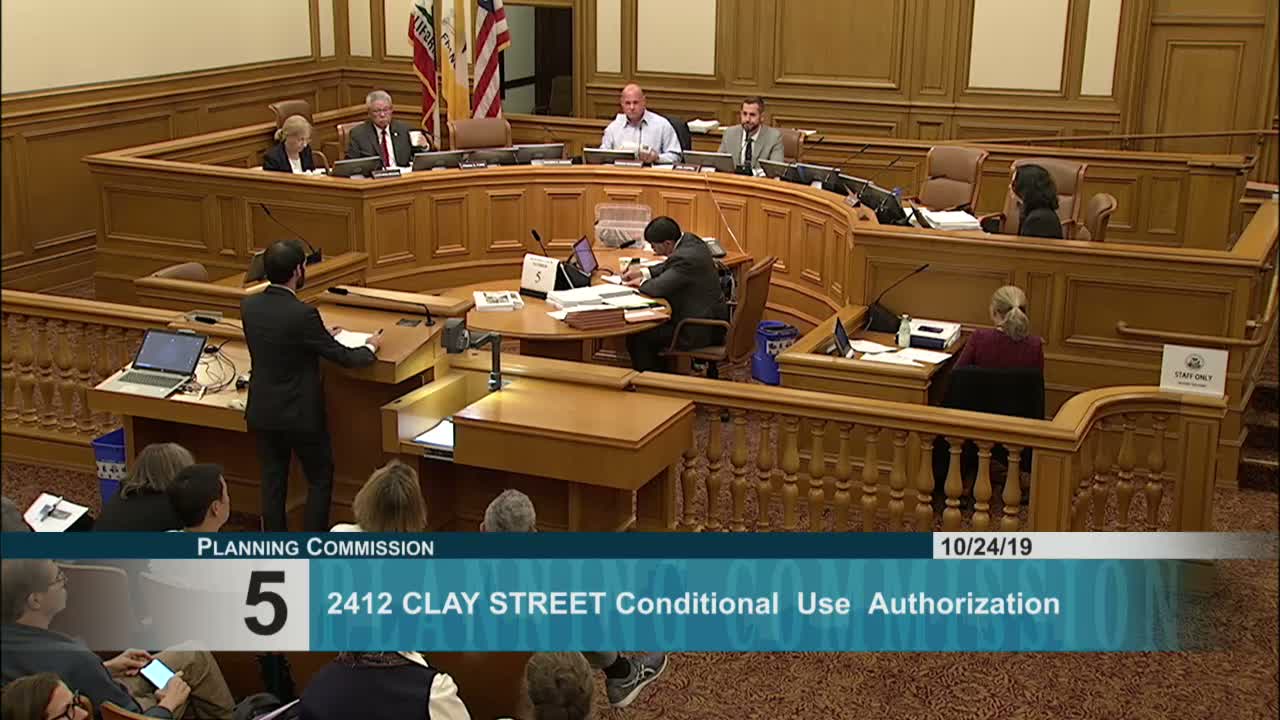
A widely attended hearing on AT&T’s proposed macro wireless facility at 2412 Clay Street focused on health, visual impacts and historic‑district concerns; the commission continued the application indefinitely to allow AT&T to pursue alternative sites after staff and DPH said the design met FCC exposure rules.
The commission considered a conditional‑use application from AT&T to install a macro wireless facility on a rooftop near the Webster Street Historic District. Staff recommended approval with conditions, citing the applicant’s site search and a Department of Public Health (DPH) finding that the proposed emissions comply with Federal Communications Commission (FCC) limits.
Opposition and technical review
Neighbors, historic‑preservation advocates and medical professionals spoke against the site, raising three main concerns: the visual intrusion of 10 screened antenna panels and enclosures on a low‑rise historic block; the concentration of RF sources near schools, medical facilities and residences; and what several speakers called insufficient public notice and inadequate alternatives analysis. Speakers presented photo simulations and described the Webster Street row of Italianate Victorian homes as particularly vulnerable to visual impacts.
AT&T and technical response
AT&T representatives said the proposal responds to a demonstrated coverage gap and noted the design had been reduced from earlier iterations (antenna count lowered, enclosure heights reduced). An independent RF engineering firm presented exposure calculations and explained that the calculated 51‑foot zone of occupational caution applies to workers directly in front of antennas; the consultant emphasized that FCC limits are set well below levels at which physiological effects have been demonstrated and that DPH issued an approval letter included in the staff report.
Commission action
Commissioners questioned the adequacy of AT&T’s alternative‑site outreach and whether locations such as nearby parking structures or Sutter Health properties had been fully explored. After extended public comment and technical back‑and‑forth, the commission voted to continue the matter indefinitely to allow AT&T to pursue and report back on alternative locations and provide more detailed good‑faith leasing outreach documentation. The procedural motion passed with the required majority; one commissioner dissented.
What this means
The continuation pauses entitlement for the proposed rooftop site pending additional site‑search work. The decision preserves the commission’s ability to require a different configuration or location if the applicant cannot locate a less‑impactful option. The broader debate at the hearing reflected a recurring tension in local land‑use reviews: federal limits on RF emissions constrain local discretion on safety grounds, but visual and neighborhood‑compatibility criteria remain in local purview.
Speakers quoted in this story spoke at the hearing on Oct. 24.