Get Full Government Meeting Transcripts, Videos, & Alerts Forever!
Get email alerts on the Housing Development topic
No spam. Unsubscribe anytime.
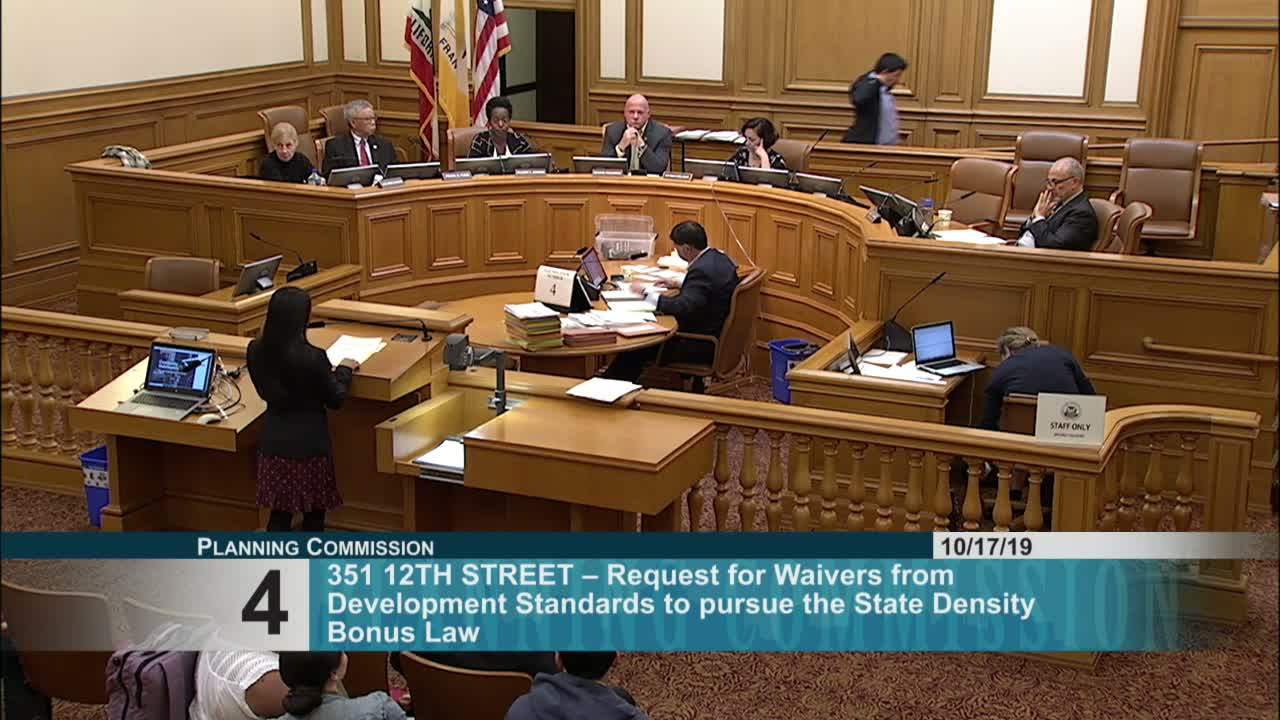
Commission approves density-bonus waivers for 351 Twelfth Street group housing, including eight on-site affordable rooms
Summary
The Planning Commission approved findings to allow incentives and waivers for a state density-bonus project at 351 Twelfth Street (48 group housing rooms) with eight inclusionary rooms on site; vote 4–1 with Commissioner Richards opposed.
The Planning Commission voted on Oct. 17 to adopt findings allowing incentives and waivers for a state density‑bonus group housing project at 351 Twelfth Street in Western SoMa.
Planning staff (Veronica Flores) said the project proposes a six‑story, 68‑foot building with 48 group‑housing rooms after applying a 20% density bonus; eight of those rooms would be affordable (four low‑income, two moderate, two middle income). The project requested waivers for rear yard exposure and a height increase to accommodate an extra story. Flores summarized that without the waivers the density bonus would not be feasible.
Project architect Keith Dobinski described the compact bedroom suites (about 180 sq ft) intended to make rent for an individual bedroom comparable to renting a room rather than an entire studio. He said the design includes communal kitchens, a rooftop solar array and is proposed as car‑free.
Speakers from the Leather and LGBTQ Cultural District and the Leather and Bay Area Leather Alliance (Paul Dally and David Hyman) urged more time to negotiate mitigation measures after raising concerns that the addition of residents could alter neighborhood character and reduce nonresidential community space. Commissioner Richards pressed the sponsor to clarify what is gained under the bonus versus the base project and sought a side‑by‑side livability comparison.
Commissioner Johnson moved to approve the requested findings and the motion passed 4–1 with Commissioner Richards voting against.
Staff and the project sponsor said the project will provide the statutory inclusionary units on site and that the incentive is intended to reduce the cost burden to deliver increased affordable capacity via a density bonus.