Get Full Government Meeting Transcripts, Videos, & Alerts Forever!
Get email alerts on the Healthcare Compliance topic
No spam. Unsubscribe anytime.
Staff finds CPMC generally in compliance with development agreement; community demands action on subacute beds and Tenderloin enrollment
Summary
City staff recommended that the directors of planning and public health find California Pacific Medical Center in compliance for its 2018 development-agreement obligations, citing payments, charity care and LBE targets met. Community members and clinicians pressed commissioners to address a shortage of subacute beds, reported patient deaths after transfers and low Tenderloin Medi-Cal enrollment.
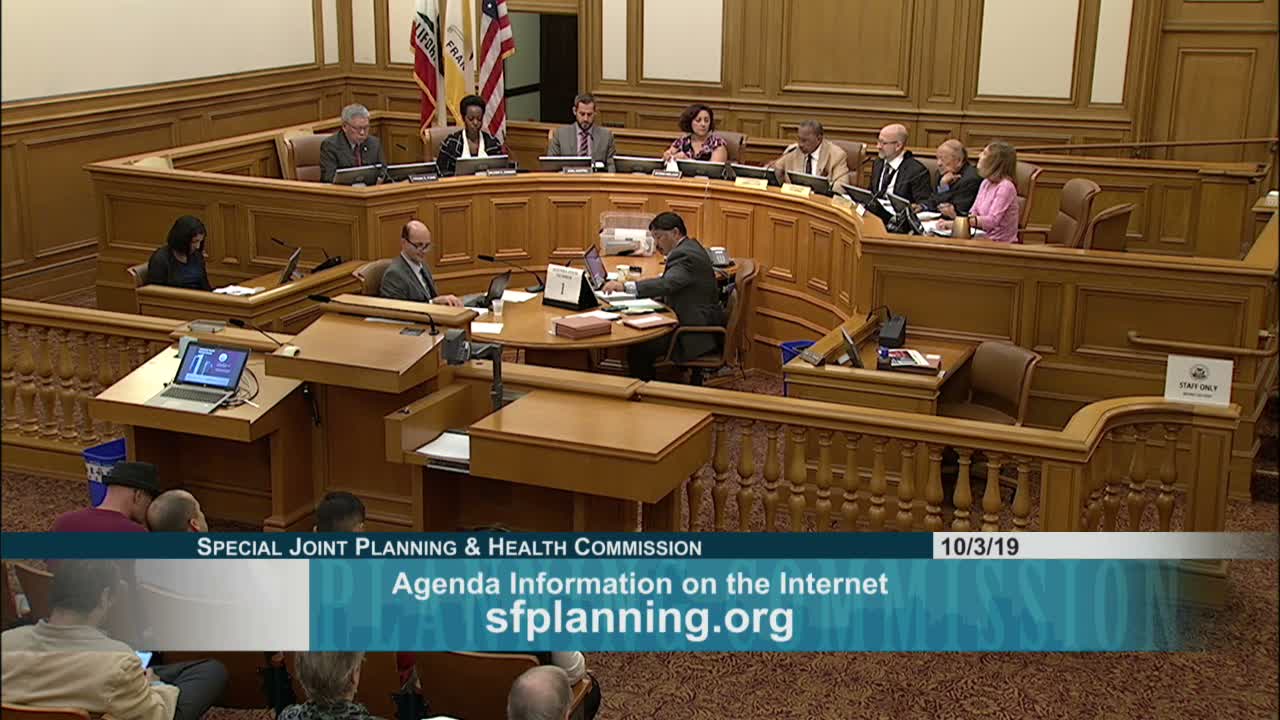
San Francisco planning and health commission staff told a joint hearing on Oct. 3, 2019, that California Pacific Medical Center has generally met its 2018 obligations under its development agreement, but residents, clinicians and union representatives pressed for stronger action on subacute capacity, Tenderloin Medi-Cal enrollment and culturally appropriate services.
Kate Connor of the Planning Department summarized the review required by the CPMC development agreement and said CPMC (Sutter Health) completed its payment obligations with "over $73,000,000." The Department of Public Health reported that CPMC provided about 38,210 unduplicated charity-care or medical patients in 2018 (exceeding the DA baseline of 30,345) and that community-benefit spending was roughly $15,100,000 versus an $8,000,000 DA requirement. DPH also said the Innovation Fund payments required by the DA totaled $8,600,000, with the final payment completed in 2017 and the fund administered by the San Francisco Foundation.
Ken Nim of the Office of Economic and Workforce Development (CityBuild) reviewed labor metrics tied to the project. CityBuild reported cumulative results since the project began in August 2013: roughly 5.6 million work hours, about 1.15 million of those classified as apprentice hours, and approximately 175 apprentices who worked on the project. Nim said CityBuild placed 32 of 38 new entry-level administrative hires through its program and that the internship program reached 57% of its 50% target (about 30 interns). He said local-business-enterprise (LBE) contracting reached 16% of project dollars, which he quantified in the presentation as about $227,000,000.
DPH called out ongoing concerns even as it concluded that many DA requirements were technically met: enrollment of Tenderloin Medi-Cal beneficiaries remains far short of the DAs 1,500-target pathway, commissioners and community members have raised questions about culturally and linguistically appropriate services, and the city continues to assess subacute-care proposals and needs. DPH reported that CPMC partnered with Northeast Medical Services (NEMS) and St. Anthony's clinic to serve Tenderloin enrollees; as of May 2019, that partnership had enrolled about 174 members through St. Anthony's and collectively served roughly 2,600 Tenderloin residents across the cooperating providers.
Public speakers told the commissions the reviews findings do not reflect serious, ongoing gaps. "When they die, CPMC will close the unit and there will be no subacute beds in San Francisco. This is a crisis now," said Mark Aronson, an emeritus law professor speaking for San Franciscans for Healthcare, Housing, Jobs and Justice, describing the transfer of subacute patients after St. Lukes closed. Family members said outcomes since transfers were poor: "Half of the 17 subacute patients that were transferred died within one year," said Raquel Rivera, whose sister was transferred, and she described slow responses to call lights, inexperienced float staff unfamiliar with suctioning equipment and other failings that she said endangered patients.
Clinicians and advocates urged the city to press CPMC to create permanent subacute capacity. Geriatrician Teresa Palmer said the city faces a shortfall of "50 to 80" subacute beds and asked that retrofit rooms be made permanent so experienced staff can be hired and retained. Union and worker representatives, including NUHWs Kijani Edwards, described short staffing across environmental services, food service and patient-care assistant roles and said reported hiring numbers did not match their experience on the floors.
CPMC and Sutter representatives disputed assertions of systemic noncompliance. Emily Webb, Sutters director of community health for the Bay Area, described partnerships and funding to support Tenderloin primary-care options, noted efforts to recruit and support Saint Anthony's as a partner and said Sutter has funded outreach and technical assistance. Jim Maxude, Sutters vice president of external affairs, emphasized that state-mandated staffing ratios are met and that California Department of Public Health audits found no regulatory violations; he said privacy rules limit disclosure of certain patient-level information.
Commissioners pressed for more and clearer data. Several members requested campus-level and zip-code-level demographic breakdowns, information on languages and insurance status of patients served at each campus, and outcomes that demonstrate whether Tenderloin residents are actually using Van Ness and Mission Bernal services. CityBuild said it would supply supplemental racial-demographic data for trainees; CityBuild reported a roughly 35% African American graduation rate from its academy across its program history and offered to provide more detail on placement and retention.
No formal action or vote was taken on the compliance report. Staff recommended that the directors of planning and public health find CPMC in compliance for the 2018 reporting year; commissioners and staff asked for a more detailed follow-up at next years review that includes demographic and outcome measures, evidence of sustained outreach and a clearer path to addressing subacute capacity and Tenderloin enrollment gaps.
What happens next: staff will forward the directors determinations into the DA review process and provide supplemental demographic and workforce data at the next annual review. Community groups and clinicians said they will continue to press the city and CPMC for concrete steps to reopen or replace subacute capacity and to increase Tenderloin enrollment and culturally appropriate services.