Get Full Government Meeting Transcripts, Videos, & Alerts Forever!
Get email alerts on the Enforcement And Compliance topic
No spam. Unsubscribe anytime.
Planning Commission orders further review after finding serial permitting and complex violations at 45 Culebra Terrace
Summary
After a lengthy hearing into years of incremental permits and a current Notice of Violation, the commission signaled intent to require restoration/review for 45 Culebra Terrace and continued the matter for follow‑up, directing staff and the city attorney to identify an enforceable path forward.
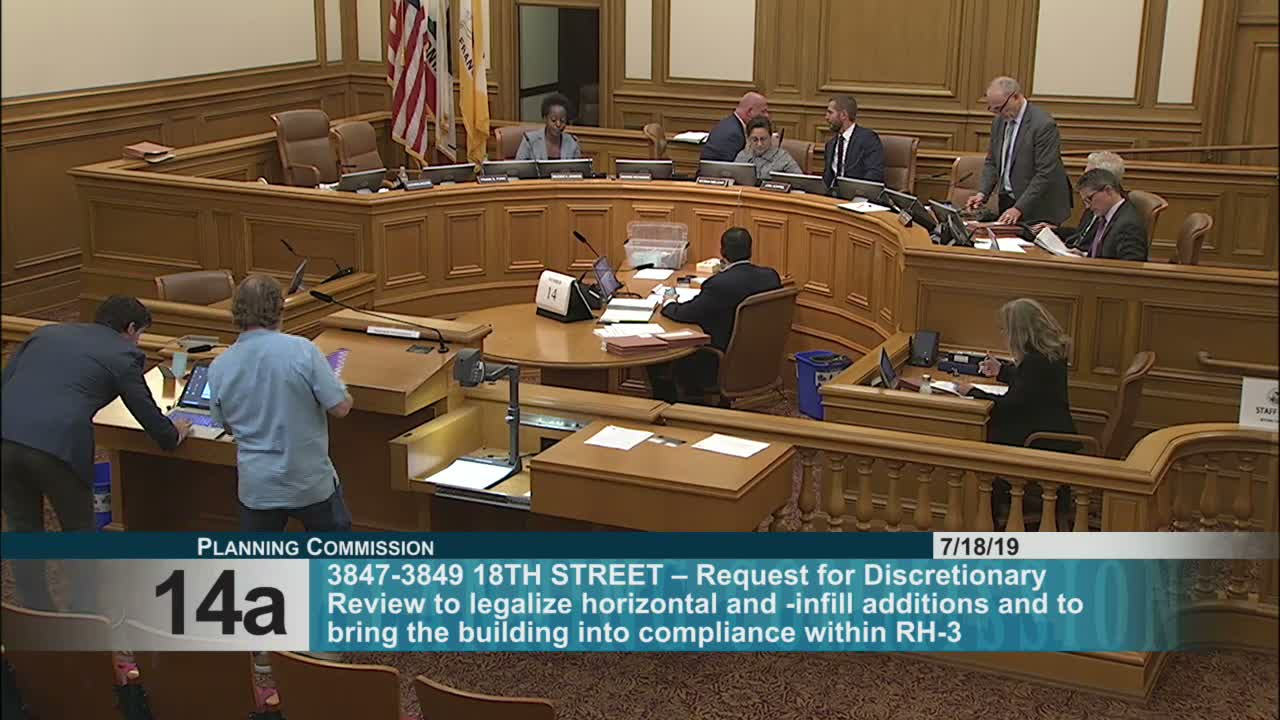
A contentious hearing on July 18 exposed a pattern of serial permitting, misrepresented existing conditions, and excavation beyond permitted scope at 45 Culebra Terrace. Planning and Building Inspection (DBI) staff summarized a long history of permits and multiple complaints that ultimately produced a Notice of Violation; neighbors described lost light, privacy and a fragile shared parking arrangement on the private easement street.
DBI Senior Inspector Bernie Curran and planning staff laid out the enforcement chronology, saying dozens of permits and many inspections were associated with work that, cumulatively, exceeded the scope originally represented to plan check and counter staff. Kevin Chang, the Doctor requester, said the as‑built condition included major below‑grade excavation and polished interior finish work inconsistent with the storage/‘crawlspace’ that earlier permits claimed.
Project sponsor Tim Clinton acknowledged responsibility and said the sponsor "screwed up," told the commission the company has incurred substantial carrying costs and proposed alternatives — including making a payment to an affordable‑housing fund instead of adding a third on‑site unit, which the sponsor said was financially infeasible ( "We screwed up," he said). Neighbors pushed back, arguing cash payments would amount to a pay‑to‑play fix and insisted on stronger remedies.
After deliberation the commission made an intent motion to take the item as a discretionary enforcement 'Doctor' matter, directing staff and the city attorney to work with the sponsor on a clear path to restore or otherwise resolve legal noncompliant work (the commission directed staff to explore restoring the previously existing three‑unit configuration). The commission continued the hearing to August 29 to allow the parties and staff to prepare the legal and factual path forward.
Why it matters: The case crystallizes a recurring enforcement problem — serial or incremental permits that mask larger scope changes — and pushes the city to clarify enforcement tools and cross‑departmental procedures to prevent similar cases. Commissioners emphasized both the need for robust remedies and the importance of principled, consistent enforcement.
Next step: The commission’s continuation to August 29 is intended to give planning, DBI and the City Attorney time to identify an implementable remedy, and for the sponsor to produce documentation or a settlement path acceptable to staff and affected neighbors.