Get Full Government Meeting Transcripts, Videos, & Alerts Forever!
Get email alerts on the State Housing Policy topic
No spam. Unsubscribe anytime.
Planning staff outlines SB 35 use in San Francisco; commissioners ask for comparative data
Summary
Planning Department summarized local use of Senate Bill 35 ministerial review for qualifying affordable housing: staff listed multiple SB 35 projects and faster timelines but commissioners asked for comparative figures showing whether SB 35 is materially increasing production relative to discretionary approvals.
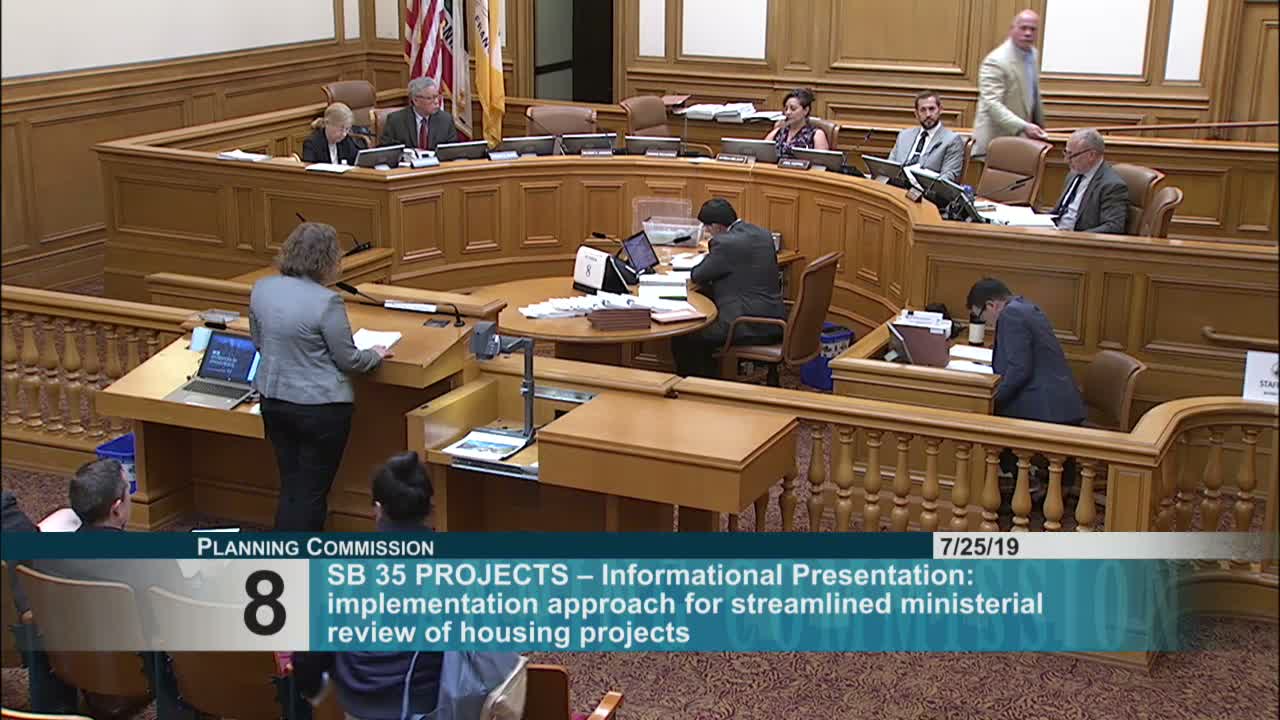
Planning Department staff presented an informational report on Senate Bill 35 at the July 25 hearing, explaining how SB 35 creates a ministerial pathway for projects that meet set affordable‑housing thresholds and objective development standards. Kate Connor told the commission SB 35 took effect in January 2018 and that jurisdictions can use it when they are underproducing on certain RHNA categories.
Connor outlined the two SB 35 tracks (projects providing a minimum of 10% affordable for above‑moderate shortfalls and 50% affordable for low‑income shortfalls). She explained ministerial review removes discretionary entitlements and CEQA review for qualifying projects and imposes strict state timelines for completeness and review (examples given: 60–90 days for completeness; 90–180 days for complete review depending on project size).
Staff summarized local results: since January 2018 the city has used SB 35 for a set of projects representing roughly 1,106 units in total, with 980 of those reported as deed‑restricted affordable. Presentations listed several SB 35 projects citywide, including 681 Florida (130 units, 100% affordable), Upper Yard (2340 San Jose; 129 units), and other deed‑restricted projects in Mission and the eastern side of the city.
Commissioners queried whether SB 35 is actually “turbocharging” production. They asked planning staff for side‑by‑side numbers comparing discretionary approvals and SB 35 outcomes for the same period; staff said they would provide those figures. Commissioners also asked about the risk that small two‑unit projects could be used to circumvent affordable housing intent; staff responded that SB 35 requires deed restriction and demolition controls that limit gaming but acknowledged some residual concerns for very small projects. Public commenters and housing advocates who spoke supported SB 35 as a useful tool to speed affordable housing production.
Planning staff offered to return with comparative production numbers (discretionary vs SB 35) and additional pipeline information to help the commission evaluate SB 35’s quantitative effect on the city’s RHNA progress.