Get Full Government Meeting Transcripts, Videos, & Alerts Forever!
Get email alerts on the SB 330 topic
No spam. Unsubscribe anytime.
Staff outlines likely effects of SB 330 on city review timelines, public testimony and tenant protections
Summary
Planning Department staff gave a detailed briefing on SB 330, the Housing Crisis Act of 2019, warning it would limit certain local down-zoning actions, create a 'law of the day' vesting rule for projects, and add replacement-unit and relocation protections; public commenters argued both that the bill would protect tenants and that it would curtail local control.
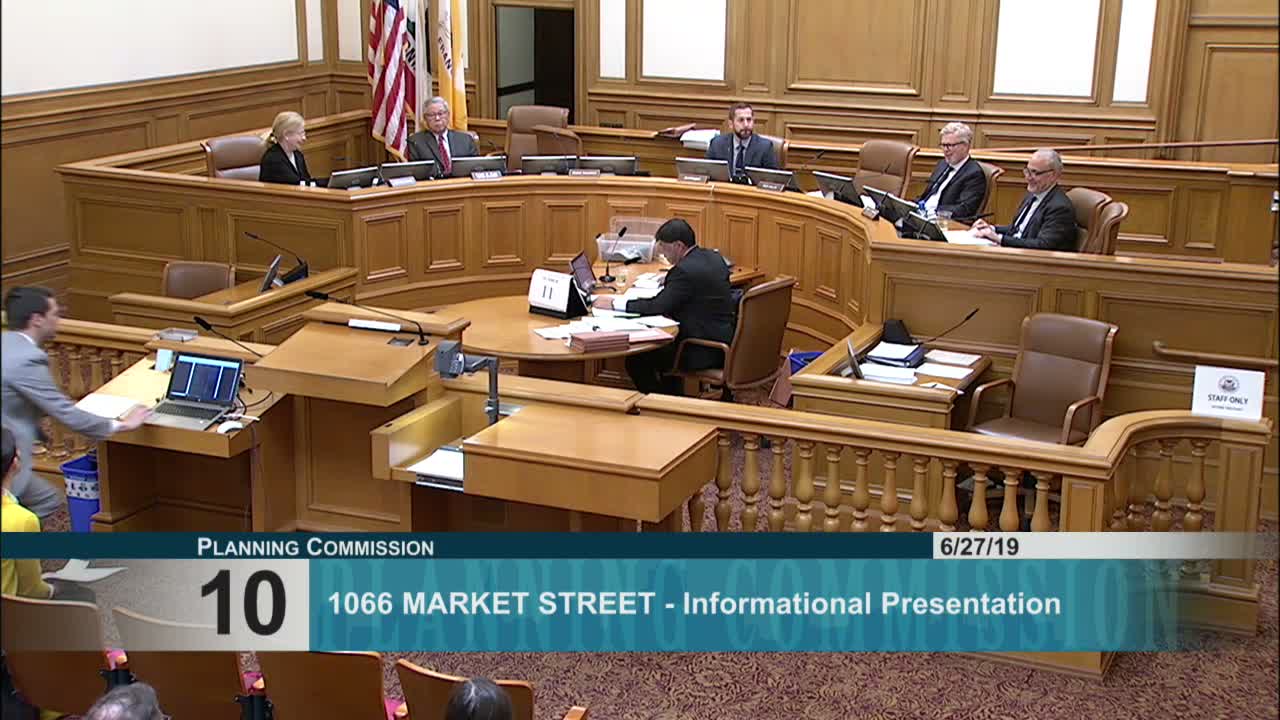
Jacob Bintliff, a planning department staffer, led an informational briefing on SB 330, telling the San Francisco Planning Commission that the bill "would be in effect for 5 years until January first of 2025" and outlining how it would constrain local actions to reduce housing capacity, limit the number of hearings on some projects and impose time frames for approvals. Bintliff said the measure would bar jurisdictions from adopting blanket downzonings compared with a January 1, 2018 baseline unless an offsetting upzoning preserves net housing capacity. He also described a vesting rule that would let projects rely on the "law of the day" when their application is deemed complete, subject to several caveats (loss of vesting if a project grows by more than 20% or if construction does not start within three years). Bintliff framed the bill as carrying both procedural and tenant-protection changes, including a requirement that a development proposing to remove existing units provide replacement units of comparable size and affordability, relocation assistance and a right of first refusal for displaced households.
Public commenters and commissioners pressed staff on specifics. Ben Libby of the California Renters Legal Advocacy and Education Fund told the commission the bill's demolition controls "would be a huge improvement on what San Francisco has currently," while Lorraine Petty, a tenant advocate, urged commissioners to oppose SB 330 and argued it would "silence community voice." Peter Papadopoulos of the Mission Economic Development Agency warned that the bill's fast-track features and limits on hearings could weaken community equity protections for area plans in neighborhoods such as the Mission. Staff repeatedly cautioned that amendments posted the day after the packet changed some details of their initial analysis and that some legal interpretations (for example, how historic-resource timing would be applied) could turn on future legal guidance.
Commissioners asked detailed implementation questions about 30-day historic-resource determinations, look-back periods for protected units (Bintliff noted a five-year look-back for household income and a 10-year look-back for Ellis Act evictions) and how replacement units would be priced and administered. Director Ram and Acting Zoning Administrator Ann Marie Rogers said the department would continue to provide close analysis and noted that state law interpretation could evolve.
The commission did not take a formal vote on SB 330 at the meeting; the session served as an informational briefing and public-comment opportunity.