Get Full Government Meeting Transcripts, Videos, & Alerts Forever!
Get email alerts on the Cannabis Policy topic
No spam. Unsubscribe anytime.
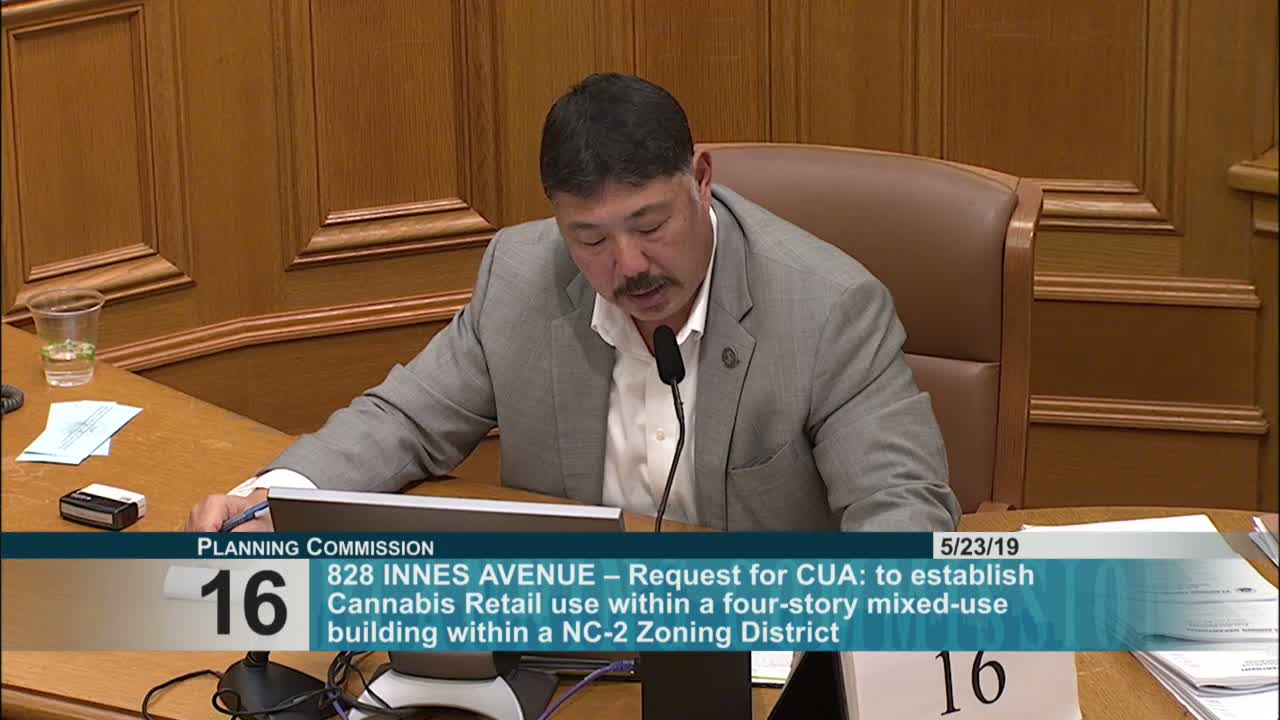
Commission approves cannabis shop at 828 Innis with no on‑site smoking and a one‑year review after neighborhood objections
Summary
The commission granted conditional use authorization for a cannabis retail business at 828 Innis Avenue after heavy opposition from the building’s HOA over CC&Rs and insurance; commissioners prohibited Type 8 (on‑site smoking) consumption and required an informational one‑year review, approving the permit 6‑1.
The Planning Commission granted conditional use authorization on May 23 for a cannabis retail business at 828 Innis Avenue, subject to conditions meant to address neighborhood concerns about on‑site consumption, security and insurance.
Planning staff confirmed the proposal met the city’s land‑use requirements and the planning code’s 600‑foot rule. Staff described outstanding issues raised by the HOA, including a recorded CC&R amendment that prohibits sale or distribution of marijuana from the property and concerns that the building’s master insurance policy could be voided if the business operated on site.
Multiple homeowners and HOA representatives told the commission they opposed the permit on legal and practical grounds: they said a CC&R provision forbids marijuana sales on the property, their insurer would cancel master building coverage, the building has numerous entrances and internal connections to residential common areas, and on‑site consumption or smoking posed second‑hand smoke and safety risks for upstairs residents.
The applicant (Posh Green) and project team said they had performed outreach, offered a security plan and claimed they could obtain business insurance; they emphasized they did not intend to pursue Type 8 (on‑site smoking) consumption and that demonstrations/demos would require appropriate DPH permits.
Commission discussion focused on building‑specific vulnerabilities (multiple entrances, shared HVAC), the three consumption permit types reviewed by the Department of Public Health (prepackaged edible consumption; prepared‑onsite limited non‑smoking; and Type 8 with on‑site smoking), and the limits of the commission’s authority concerning private CC&Rs. Several commissioners urged additional outreach and recommended conditions the Office of Cannabis and police would enforce at the next permitting stage.
The commission voted to approve the conditional use with two notable conditions: (1) the MCD may not obtain a Type‑8 on‑site smoking consumption license, and (2) the applicant must return with an informational presentation one year after opening to report on operations and neighborhood impacts. The motion passed 6‑1 with Commissioner Fung recorded as the sole no vote.
What happens next: The permit approval allows the applicant to proceed to state/city licensing and to submit the detailed security and HVAC/consumption engineering required by the Department of Public Health and the city's Office of Cannabis; the commission’s conditions will be enforced during the later stages of permitting and licensing.