Get Full Government Meeting Transcripts, Videos, & Alerts Forever!
Get email alerts on the Land Use Development topic
No spam. Unsubscribe anytime.
Planning staff urges phased Prop M allocations; commissioners and community debate housing-first priorities
Summary
Planning staff recommended phasing approvals of large Central SoMa office projects under Prop M, prioritizing projects that are ready in phases rather than using a cross-project benefits formula. Commissioners and public commenters debated whether to prioritize 'readiness' versus early delivery of affordable housing and parks.
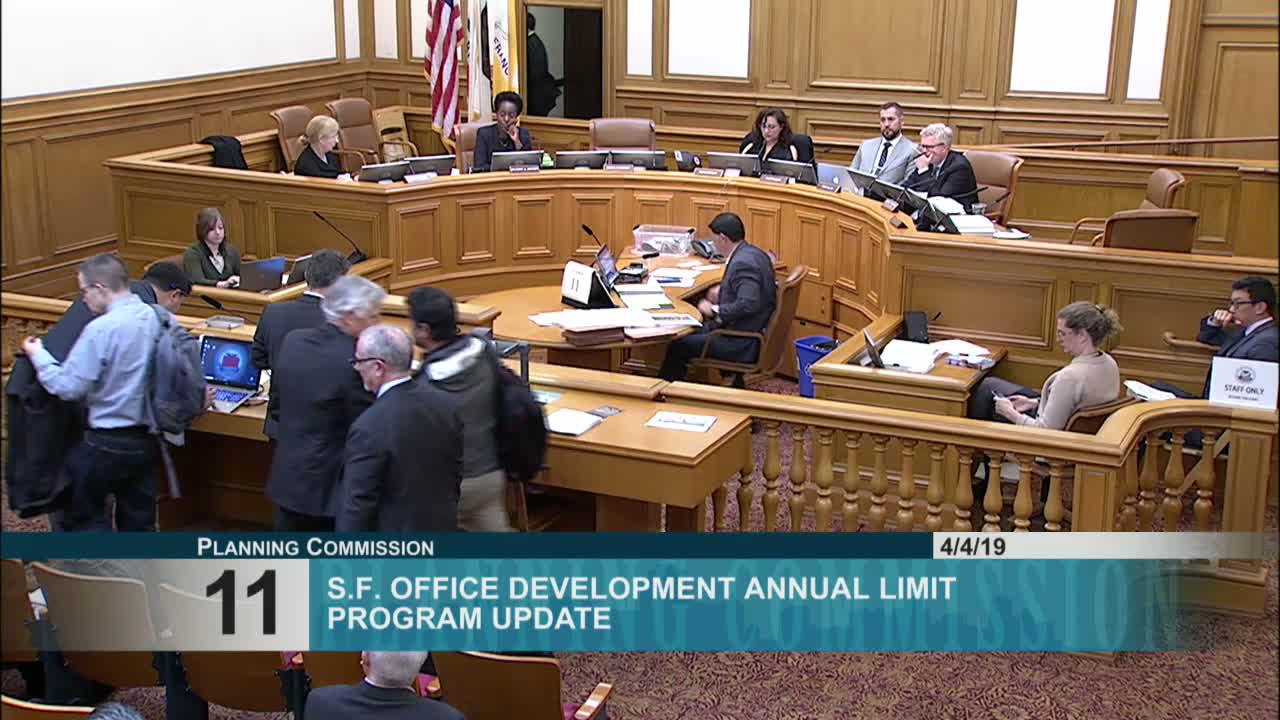
The Planning Department briefed the commission on the annual Prop M office allocation program and recommended a phased approach to allocating limited office square footage for several large Central SoMa projects.
Corey Teague and Rich Sucre described Prop M's mechanics (an annual allocation of 950,000 square feet, divided between small- and large-cap buckets) and summarized the pipeline: a long backlog of large-cap proposals means the city cannot grant all requests immediately. Staff's recommendation was procedural: to approve project phases in the order they become "ready for entitlement," beginning with initial phases of 598 Brannan (about 700,000 sq ft of 920,000 proposed), the 88 Bloxham tennis-club site (phase 1 about 470,000 of 840,000), and the Flower Mart (phase 1 roughly 1.4 million sq ft of 2.2 million).
Director Ram told the commission staff believed this approach best respected the Central SoMa plan's embedded public-benefit packages and avoided a "beauty contest" in which disparate benefits would be numerically ranked against each other.
Public commentators were sharply divided. Representatives for Transbay Parcel F (Hines/UrbanPacific) and Boston Properties (725 Harrison) argued their projects are shovel-ready, provide large tangible benefits (site dedications for affordable housing, PDR, childcare and public open space) and should be considered when they are ready. Mercy Housing described how Parcel F could cross-subsidize 683 affordable units at an adjacent Block 4 site with no public subsidy.
Neighborhood advocates and tenants expressed frustration that many promised public benefits are long-term land dedications rather than immediate housing construction and urged clearer assurance that land donations will be developed and funded. Mission-area speakers also warned that large office approvals will intensify gentrification without stronger guarantees for timely delivery of deeply affordable housing and preservation of PDR jobs.
Commission debate centered on two competing principles: staff's argument that projects that were planned alongside a specific area plan (and thus have embedded, plan-level benefits) should be prioritized by readiness; and commissioner and public calls for an objective, transparent prioritization that would explicitly weight early delivery of housing and parks. Several commissioners asked staff for follow-up materials describing pipeline timing, housing delivery schedules tied to land dedications, and the legal limits of Prop M review.
Director Ram acknowledged objections but said staff believed phasing projects by readiness was fair and reflected the Central SoMa plan's intent to embed a comprehensive public-benefit package in the plan, not to compare benefits project-by-project. The commission asked staff to return with more precise timelines and financing information for the affordable parcels and with an analysis of litigation risks and how they affect delivery schedules.
No final allocation vote was taken; staff described the recommendation as the approach staff would use when projects come back for entitlement approvals.