Get Full Government Meeting Transcripts, Videos, & Alerts Forever!
Get email alerts on the Wireless Siting topic
No spam. Unsubscribe anytime.
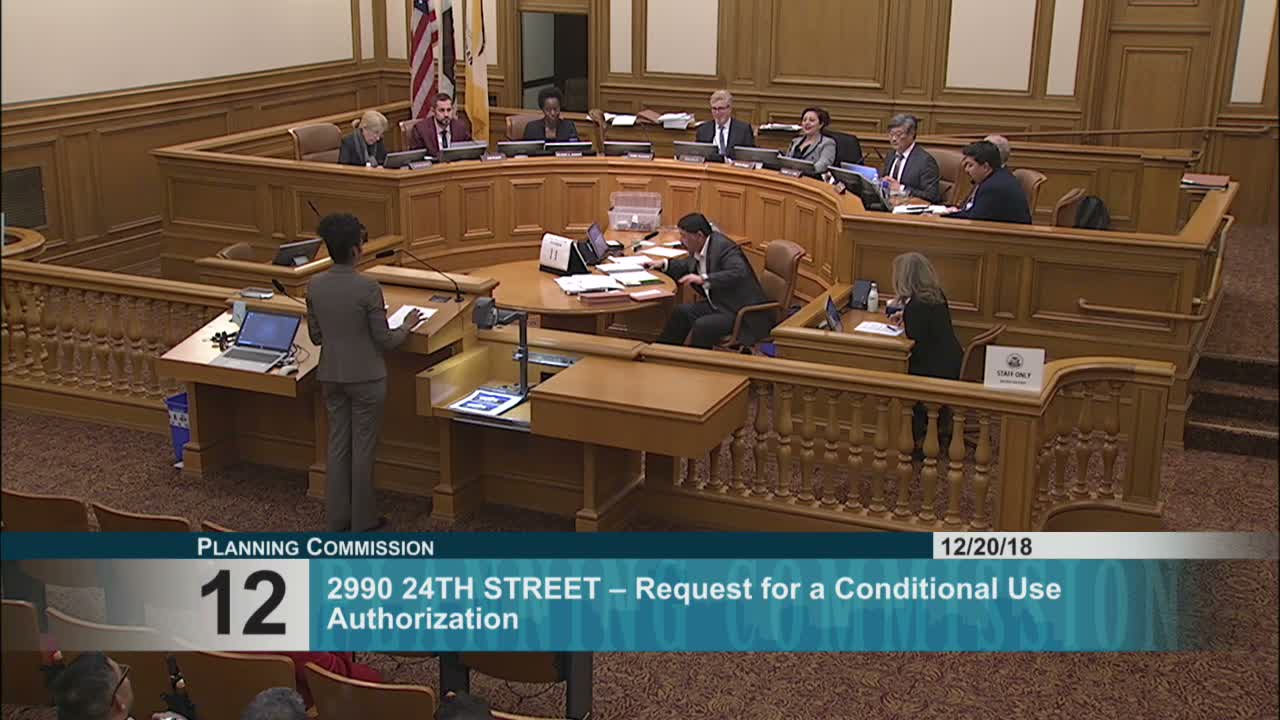
Planning Commission backs community‑led compromise: AT&T allowed 9 antennas in community design alternative at 2990 Fourth Street
Summary
After months of negotiation between AT&T, planning staff and neighbors, the commission approved a conditional use authorization authorizing a community‑preferred design alternative for a telecommunication facility at 2990 Fourth Street with nine antennas to meet technical requirements.
The Planning Commission approved a conditional use authorization for a wireless installation at 2990 Fourth Street after an extended hearing in which staff, AT&T and neighborhood groups negotiated design alternatives intended to balance coverage needs and neighborhood character.
Planning staff presented five designs for the rooftop site and noted that a facade‑mounted option could trigger federal preemption for later co‑location by other carriers. AT&T representatives said they had reduced the original proposal from 12 antennas to nine and that the number of antennas was dictated by the number of frequencies and FCC authorizations they must support.
Neighborhood representatives, led by Miguel Bustos and other local groups, said community meetings produced a preferred configuration they found less visually intrusive. AT&T’s engineer explained why nine antennas are required to serve the frequencies the carrier is authorized to transmit.
Commission debate addressed trade‑offs: some commissioners worried that accepting a façade‑mounted approach could allow other carriers to add more unscreened antennas in the future under federal rules; others emphasized the value of community negotiation and sought to honor the neighborhood’s consensus design. On a motion that approved the community design alternative number 2 with nine antennas, the commission voted to approve the application and the conditional use authorization with conditions.
Commissioners and staff asked that the record reflect the range of design alternatives and the outreach that preceded the vote; conditions include the final, approved design drawings and the standard permitting and building‑permit requirements.