Get Full Government Meeting Transcripts, Videos, & Alerts Forever!
Get email alerts on the Community Development topic
No spam. Unsubscribe anytime.
Dogpatch neighbors press for reuse of Old Potrero Police Station as community center
Summary
Friends of the Dogpatch Hub and neighborhood residents urged the Planning Commission to support adaptive reuse of the long‑vacant Old Potrero Police Station (2300 Third Street) as a community center, outlining fundraising and a $10M estimated rebuild cost and asking for official support as the city prepares an RFP.
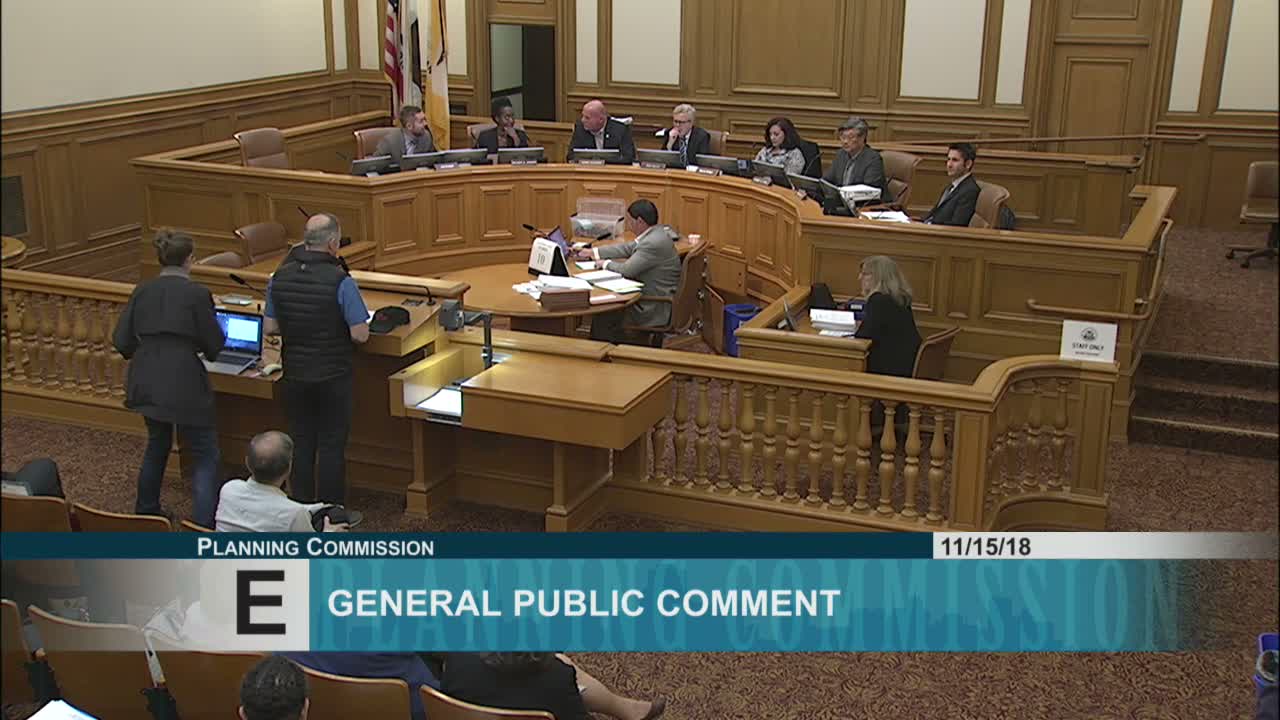
Several Dogpatch residents and organizers testified during general public comment about a multi‑year effort to reuse the Old Potrero Police Station at 2300 Third Street as a neighborhood community center.
Mark Dwight, a Dogpatch homeowner and Friends of the Dogpatch Hub board member, described the site’s physical decline and community interest. “We believe that the long abandoned Old Potrero Police Station is an ideal location for our community center,” he said, summarizing the building’s vacancy since 1998 and its deterioration from vandalism and fires.
JR Eppler, also a board member, recounted the group’s organizing timeline: since 2016 the neighbors formed a nonprofit, completed design predevelopment with architects and raised early funds. He said an adaptive‑reuse “bare bones” estimate was about $10,000,000 and that Friends of the Dogpatch had secured early commitments including a $4,200,000 leadership grant from UCSF and $2,500,000 from Pier 70/Port of San Francisco; Supervisor Malia Cohen secured $250,000 to stabilize the buildings temporarily.
Catherine Demaney, board chair, discussed an OEWD neighborhood asset activation (NAA) process and outreach that produced programming and predevelopment funding of roughly $54,000. She said the community is preparing for an expected city RFP and that in May 2018 SFPD indicated it might consider some reuse options but had not completed a feasibility study.
Speakers asked the commission to support reuse that preserves historic fabric while delivering a publicly accessible community facility for a rapidly growing neighborhood that currently lacks such a resource.
What the commission heard: staff did not present an action item for the site at this hearing; public comment served to inform commissioners and record community interest should the city proceed with an RFP or surplus‑property process.