Get Full Government Meeting Transcripts, Videos, & Alerts Forever!
Get email alerts on the Childcare Policy topic
No spam. Unsubscribe anytime.
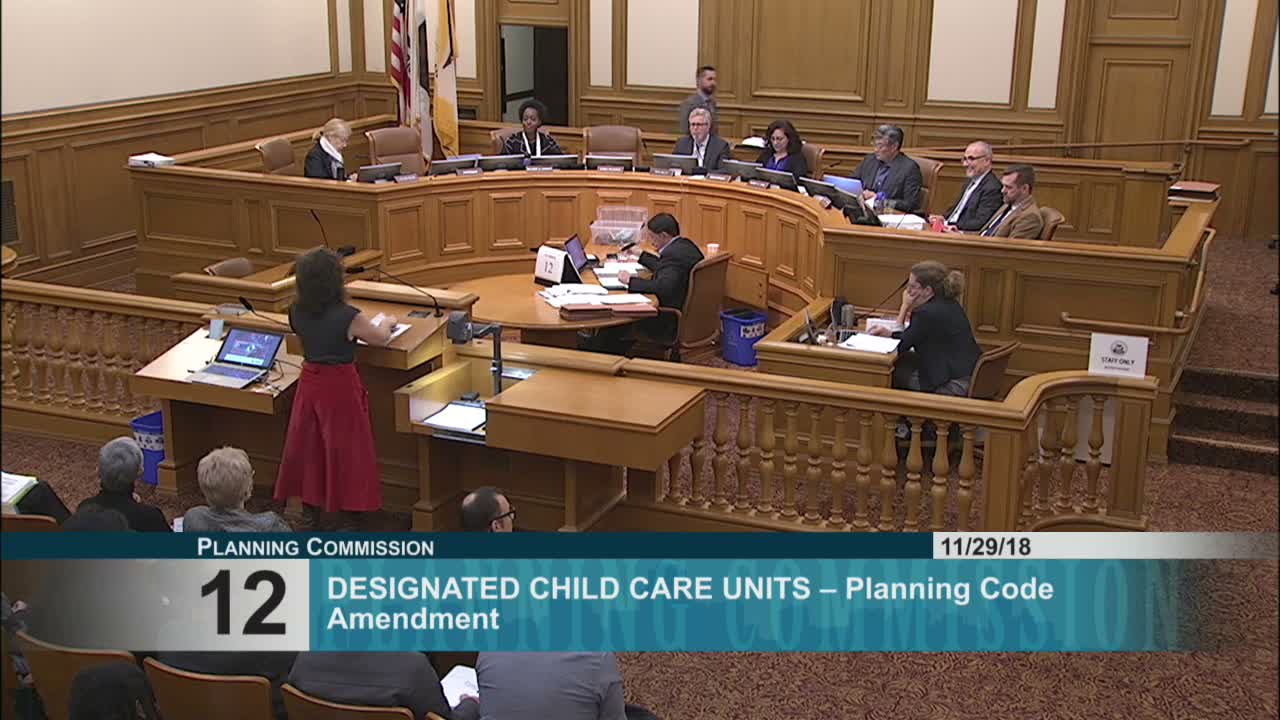
Planning commission backs code change to create permanently affordable childcare units for family providers
Summary
The commission approved a planning-code amendment to allow one permanently affordable designated childcare unit (BMR DCCU) per project to house licensed family childcare providers at 80% AMI, with program rules to be developed by the Office of Early Care and Education and MOHCD; supporters said it will stabilize small family childcare homes; commissioners asked staff to define implementation and monitoring details.
The Planning Commission on Thursday approved a planning‑code amendment designed to preserve and expand family childcare by encouraging developers to create permanently affordable units reserved for licensed family childcare providers.
Planning staff presented the proposal as a market‑driven incentive: a project could designate a permanently affordable housing unit at 80% of area median income as a designated childcare unit (BMR DCCU) in exchange for developer fee reductions and other incentives. Sheila Michalopoulos of the Planning Department said the change responds to a gap in infant childcare in San Francisco and the instability providers face amid rising housing costs. “Family childcare homes are being impacted by the housing crisis,” she said, noting that there are childcare spots for only about 15% of the city’s infants.
Supervisor Yee’s office and the mayor’s housing and early‑care staff described operational details the commission asked to be clarified. Staff said the Office of Early Care and Education would generate an eligible‑tenant pool of licensed providers and the mayor’s office of housing and community development (MOHCD) would manage tenancy and income eligibility; the commission pressed staff on whether referral or lottery systems would be used and requested a reporting requirement to measure uptake.
Public supporters and neighborhood groups urged approval. Amy Chan of MOHCD said the program would use a referral system modeled on supportive‑housing referrals rather than a blind lottery, prioritizing licensed providers and those displaced from prior childcare roles. Advocates emphasized that the units would protect both childcare access and the provider’s housing. “This is market‑driven; it’s an option for developers,” said a representative of Supervisor Yee’s office, who described outreach to developers and child‑care providers.
Commissioners asked for clear implementation rules, including how the pool of eligible providers will be verified, what happens if a tenant stops offering childcare, and how the city will market the program to property owners. Staff said they will develop program guidelines with the Office of Early Care and Education and MOHCD; the commission requested that a reporting requirement and an early look‑back be specified so the ordinance’s effectiveness can be evaluated.
The commission approved the code amendment with the department’s recommended conditions. Supporters say the change could increase options for infants and toddlers and help stabilize an industry dominated by women and providers of color; critics urged careful monitoring to ensure the units produce operating childcare rather than just affordable housing for unrelated tenants. The planning department and sponsor offices will return with implementation details and performance measures.