Get Full Government Meeting Transcripts, Videos, & Alerts Forever!
Get email alerts on the Employee Cafeterias topic
No spam. Unsubscribe anytime.
Planning Commission urges alternatives to proposed ban on private office cafeterias
Summary
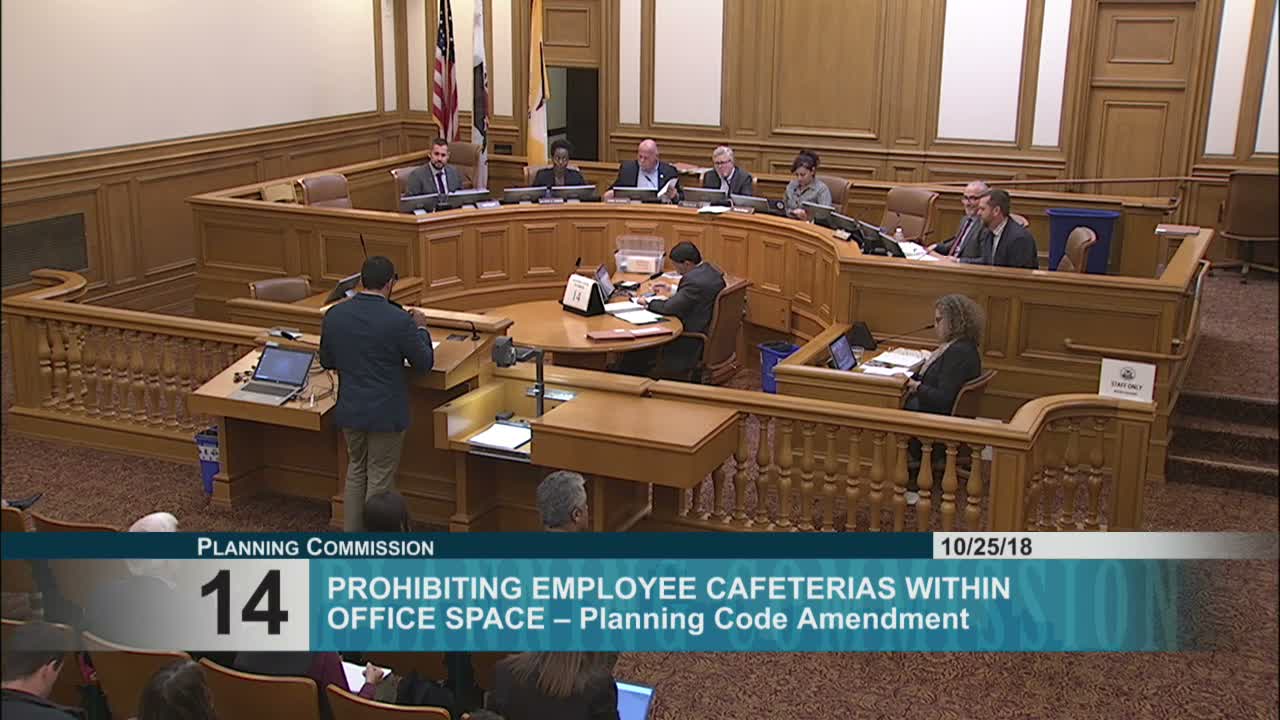
The San Francisco Planning Commission on Oct. 25 recommended disapproval of a proposal to ban new private office cafeterias, directing staff to explore incentives and alternatives after testimony from unionized cafeteria workers, vendors and tech firms highlighted job and vendor impacts.
San Francisco — The Planning Commission voted unanimously on Oct. 25 to recommend disapproval of a proposed ordinance that would ban new full‑service employee cafeterias inside office buildings, instead asking staff to pursue alternative measures to revitalize ground‑floor retail and support small businesses.
Supervisor Aaron Peskin and Supervisor Matt Han (co‑sponsor Supervisor Safaie presented the item to the commission) introduced the legislation to push developers and employers to consider public access and street‑level activation. Planning staff presented a set of alternatives including incentives, changes to office allocation rules, and health‑code clarifications distinguishing full‑service cafeterias from kitchens used mainly for catering.
Supporters of the ban argued it could help reactivate sidewalks and give local restaurants more customers. Supervisor Safaie said, “If we're going to attract thousands of employees to be there, at the same time, we wanna think about the ground floor retail, and how we're going to activate the retail, and how we're going to get people out on the street” and acknowledged the proposal “is a bit blunt” while inviting continued discussion.
But the bulk of public comment focused on employment and local vendor impacts. Workers and union representatives told the commission that corporate cafeterias provide stable, unionized jobs with predictable schedules, benefits and paid holidays. Dante Ballard, vice president of UAW Local 2501, said the cafeterias created “good paying jobs” and cited $19.50 an hour as a typical entry wage for many cafeteria positions; Unite Here members described improved health benefits and predictable schedules after organizing. A unionized cafeteria worker, Alejandra Abonze, asked the commission directly: “Please vote no on this proposed law.”
Local vendors and small businesses also warned of broad downstream effects. Matt Middlebrook of Airbnb said the company already employs unionized kitchen staff and was planning additional staff for a pending office expansion; he told commissioners Airbnb spent about $7,000,000 last year on food from Bay Area suppliers, about $2,000,000 of which went to businesses based in San Francisco. Tea and food suppliers, including Todd Rubin of Republic of Tea and Jason Creech of 5 Mountains Organic Tea, said a large share of their revenue comes from contracts with corporate cafeterias.
Planning commissioners echoed a desire to balance neighborhood vitality and job quality. Commissioner Richards and others said staff recommendations — such as requiring public access, vouchers for employees to spend at neighborhood restaurants, or better linkage between cafeterias and local vendors — deserve more development than an outright ban. Commissioner Richards said he would favor a “carrot, not a stick” approach.
The Commission’s motion recommended disapproval of the ban and directed the planning department to return with alternatives and additional analysis. Commissioners stressed they want to preserve the potential for unionized, higher‑wage cafeteria jobs while pursuing measures to encourage employees to patronize nearby businesses.
What happens next: Staff will incorporate the commission’s direction and explore incentive options, public‑access conditions and health‑code clarifications. The commission’s action is a recommendation to the Board of Supervisors and does not itself change law.