Get Full Government Meeting Transcripts, Videos, & Alerts Forever!
Get email alerts on the Patient Safety Transition topic
No spam. Unsubscribe anytime.
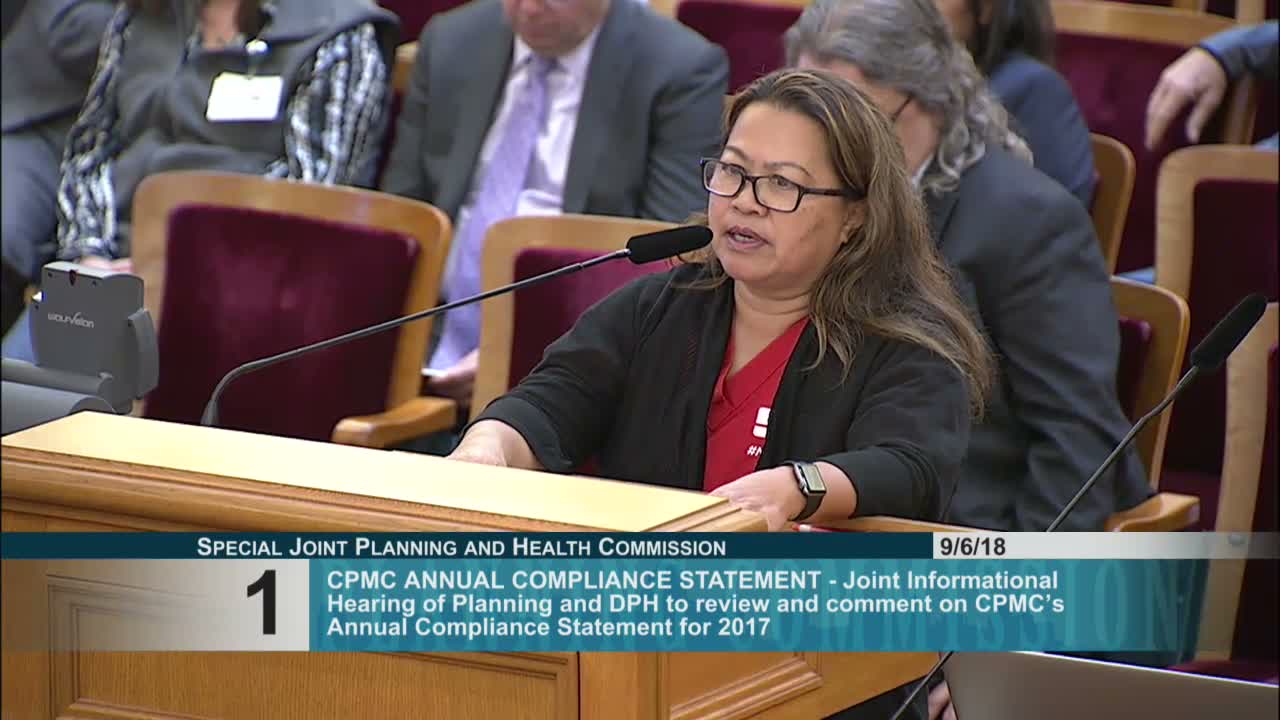
Nurses and community members urge special review of patient safety, subacute closures and language access after Mission Bernal opening
Summary
Multiple nurses and community advocates told the joint commission that the Mission Bernal (St. Luke's) opening left staffing plans unclear, training rushed, traveling nurses used in place of regular staff, and language services insufficient; speakers called for a focused hearing on patient safety and continuity of subacute care.
Dozens of nurses, clinicians and community members described a turbulent transition to the new Mission Bernal campus and said the city should scrutinize patient safety, staffing and language-access outcomes as part of the CPMC compliance review.
Jane Sandoval, a staff nurse who has worked at St. Luke's for 33 years and serves on the California Nurses Association board, said the hospital had admitted "plans for the units were fluid and unknown up to the very moment of the opening," and urged a special commission meeting on transition-related patient-safety practices. "We ask that the commissioners hold a special meeting focused on the transitions to the new hospitals with a focus on patient safety practices including safe staffing for the transition period and beyond," she said.
Several nurses described traveler nurses being used while regular staff were sent home. Mary Micolucci, a 44-year veteran of St. Luke's nursing, said: "Regular staff nurses are told to stay home. The traveling nurses are working." She said the practice caused pay loss and undermined continuity.
Clinicians and advocates also raised concerns about the closure of St. Luke's subacute SNF unit and the resulting shortage of subacute beds in the city. Dr. Teresa Palmer, a geriatrician, said the shutdown left San Francisco without subacute SNF beds and that Sutter had not adequately resolved the shortage despite participating in studies. "Sutter is non compliant in its obligation to make a good faith effort on the subacute SNF shortage," she said.
Several commenters also highlighted language access at outpatient clinics such as the St. Luke's Diabetes Center. DPH staff said CPMC had hired a 0.8 FTE Spanish-speaking dietitian and begun Spanish-language classes, but community members asked for clearer metrics on whether monolingual Spanish speakers who previously used the service still have similar access.
Why it matters: testimony linked transition planning, staffing practices and service changes (including transfers of clinics to foundations) to potential harms for elderly and non-English-speaking patients. Commissioners said the written compliance checklist does not replace qualitative evidence from staff and patients and asked departments to collect outcome-level data.
Next steps: several commissioners and community groups requested a special meeting or an expanded analysis focused on transitions, staffing plans, language access and subacute-bed solutions.