Get Full Government Meeting Transcripts, Videos, & Alerts Forever!
Get email alerts on the Development Agreement Compliance topic
No spam. Unsubscribe anytime.
Staff recommends CPMC be found in compliance for 2017 while community raises outstanding concerns
Summary
City staff recommended directors find California Pacific Medical Center (CPMC) largely compliant with its 2017 development-agreement obligations — citing required payments, charity-care and innovation-fund targets met — but community groups and health workers pressed for deeper review of hiring, retention, cultural-language access and closures of subacute beds.
Planning Department staff concluded that Sutter Health's California Pacific Medical Center met the core obligations of its development agreement for the 2017 reporting year, but the Health Commission and dozens of community members told commissioners they still want more follow-up on several items.
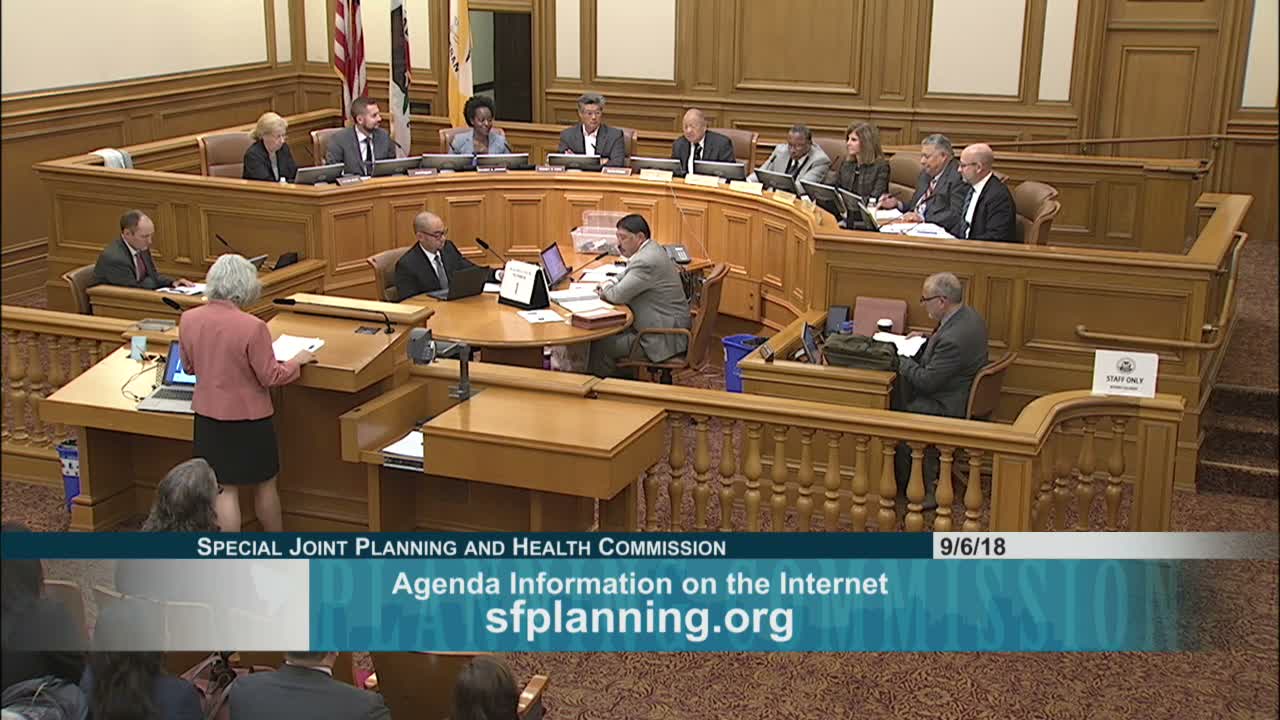
Elizabeth Pearl, Planning Department staff, opened the presentation by describing the process: "The item before you is an informational presentation on California Pacific Medical Center's compliance with their development agreement for the 2017 reporting period." She told commissioners the DA requires CPMC to submit an annual compliance report and that directors of planning and public health will make the formal compliance determination, followed by a third-party monitor review.
Department of Public Health staff presented the DA's health-care commitments and 2017 performance. "In 2017, CPMC cared for 39,569 unduplicated charity care or Medi Cal patients," DPH analyst Sneha Patel said, and staff reported that CPMC exceeded the DA's $8,000,000 community-benefit requirement by providing about $12,500,000 in unreimbursed community benefit. Patel also noted that the DA's innovation fund obligations were complete after CPMC made the final $1,125,000 payment in 2017 to finish the $8,600,000 commitment.
Mitchell Griggs of the San Francisco Health Service System said the consultant Milliman found CPMC satisfied the DA's cap on annual fee increases (no more than 5%) for the years reviewed; Milliman awaits additional claims data to finalize certain year-to-year comparisons. Staff's formal recommendation to the directors was "to find CPMC in compliance for the 2017 reporting year." (The directors of Public Health and Planning — not the commissions — will issue the compliance determination.)
Sutter Health representatives emphasized project milestones and community outreach. Jim (Sutter Health external affairs) noted the Mission Bernal campus opened Aug. 25 and said the Van Ness hospital and medical office building remain on track for early 2019 openings. He highlighted community events and said the project's economic impact has surpassed $300 million.
At the same time, public commenters urged the commissions to use the compliance review to probe deeper into data and outcomes. Escania Piaemelli, who represented the Coalition of San Franciscans for Healthcare, Housing, Jobs and Justice, asked commissioners to pursue seven areas for further examination, including why charity-care counts fluctuate year to year and why detailed breakdowns (by campus, service intensity and zip code) are not provided. "We encourage you to use this public process to insist that CPMC and city departments answer some important questions outlined in the Coalition's written comments," she said.
Why it matters: the DA is a multi-year public-private agreement that ties construction and service changes to community benefits, and the directors's compliance finding will influence monitoring and any follow-up demands by the Board of Supervisors. Staff recommended compliance based on payments and verified metrics, but the hearing made clear the city and community expect further investigation into access, language services and continuity of subacute care.
What comes next: the Planning and Health directors will prepare a formal compliance finding and a third-party monitor will review that determination before it goes to the Board of Supervisors. Community groups and several commissioners said they expect the directors and departments to provide additional breakdowns (for example, charity-care by campus and zip code) and to report back on unresolved items such as Tenderloin Medi-Cal enrollment and cultural/linguistic access.