Get Full Government Meeting Transcripts, Videos, & Alerts Forever!
Get email alerts on the Rail Infrastructure topic
No spam. Unsubscribe anytime.
Staff recommends Pennsylvania Avenue tunnel alignment for rail into Salesforce Transit Center
Summary
After a multi-year study the planning department identified an extended tunnel under Pennsylvania Avenue as its preliminary preferred alternative to carry Caltrain and high-speed rail into the Salesforce Transit Center, citing better connectivity, fewer surface disruptions, and more favorable ridership capture compared with trenching or a deep Mission Bay alignment.
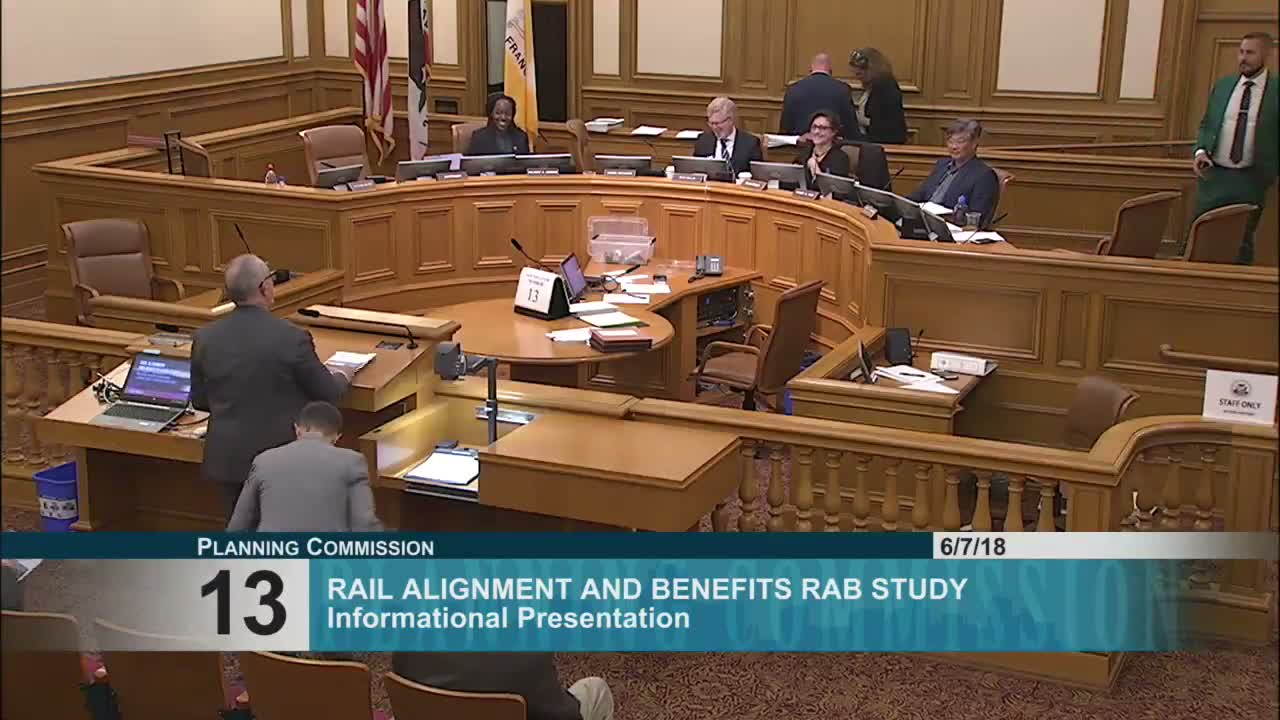
City planning staff on June 7 presented the Rail Alignment & Benefits (RAB) study and recommended the Pennsylvania Avenue extended-tunnel alternative as the commission—s preliminary preferred alignment to bring Caltrain and future high-speed rail into the Salesforce Transit Center.
The study compared three general approaches: (1) a "future with surface rail" scenario that builds the downtown rail extension (DTX) and trenches key intersections (significant surface disruption); (2) a Pennsylvania Avenue alignment that constructs the DTX and extends a tunnel further south under city streets to avoid trenching; and (3) a Mission Bay alignment that diverts the rail east and tunnels under Mission Bay. The staff analysis weighed capital cost, schedule, ridership capture and urban-design impacts and concluded the Pennsylvania Avenue alignment best balances constructability, earlier service, lower long-term surface impacts and better city-level connectivity.
Susan Gagee, the study manager, and Planning Director John Ram said the Pennsylvania Avenue alignment adds roughly a year to the DTX schedule but avoids repeated surface trenching at major intersections and creates more opportunities to restore the street grid, reduce rail noise and open land for new housing and open space if rail operations and storage are reconfigured. The Mission Bay option was found to be more costly, deeper, technically riskier (soils and a larger tunnel bore), and to provide less ridership capture in the downtown core; staff estimated a substantially higher cost and a significantly later delivery date for the Mission Bay option.
Staff emphasized the next steps: seek feedback from partner agencies, refine engineering and operations coordination with Caltrain and the state High Speed Rail Authority, and pursue a joint city resolution endorsing Pennsylvania Avenue as a preliminary preferred approach to inform regional planning and grant funding discussions. Commissioners and members of the public expressed broad interest and support for a tunnel option that minimizes surface disruption near Mission Bay and the waterfront. Planning staff noted that the study does not require removal of I-280 and that many coordination pieces remain across agencies.