Get Full Government Meeting Transcripts, Videos, & Alerts Forever!
Get email alerts on the Housing Balance Report topic
No spam. Unsubscribe anytime.
Planning department says net affordable housing stock ~10,282 units; projected balance 16%
Summary
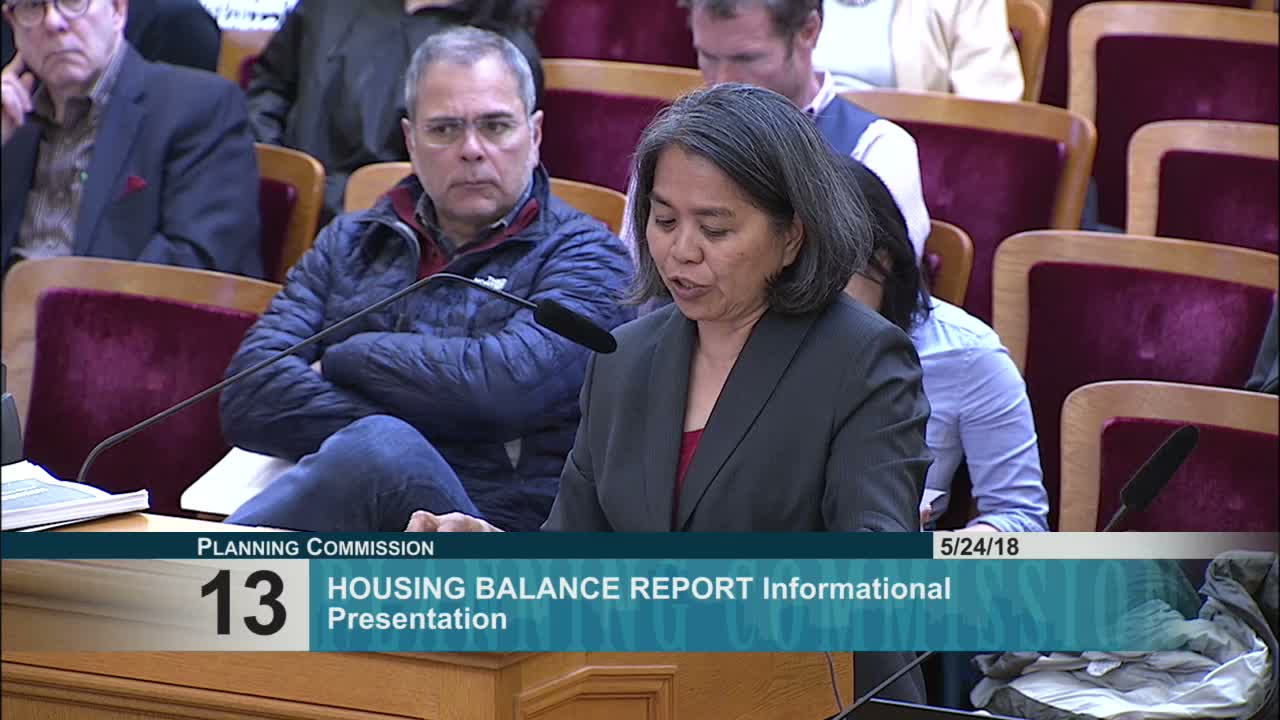
Principal Planner Teresa Ojeda presented the sixth Housing Balance Report, finding roughly 10,282 net affordable units over the 10‑year reporting period (about 25% of net new units), with a projected housing balance of 16% for entitled but not permitted projects and a Board hearing scheduled for July 16.
Principal Planner Teresa Ojeda told the Planning Commission on May 24 that the city’s Housing Balance Report No. 6 estimates the net affordable housing stock at about 10,282 units over the 10‑year reporting period, which represents roughly 25% of net new housing in that period.
Ojeda explained that the housing balance calculation includes new production, acquisitions and rehabs, the Small Sites program, Rental Assistance Demonstration (RAD) replacement, and accounts for units removed from protected status (Ellis Act, condo conversions, owner move‑ins). She reported a projected housing balance of 16% for entitled projects not yet permitted and estimated that remaining phases of large entitled projects could yield about 22,000 net new units of which roughly 22% would be affordable.
The ordinance that created the reporting requirement (Ordinance 53‑15) requires biannual reporting and a mandatory annual hearing before the Board of Supervisors; staff said the board hearing for this report is scheduled for July 16. The report also breaks results down by supervisorial and planning districts; several districts show negative balances driven by units removed from protected status.
During public comment and commissioner discussion, speakers and commissioners emphasized geographic imbalances — neighborhoods that are losing rent‑controlled units while affordable production concentrates elsewhere — and urged a link between the data and policy responses such as targeted upzoning, preservation strategies, and improved tracking of units converted or removed from protection.
Next steps: staff will present the report to the Board of Supervisors on July 16 and continue coordination with the mayor’s housing office and other agencies to identify policy responses.