Get Full Government Meeting Transcripts, Videos, & Alerts Forever!
Get email alerts on the Land Use Parking topic
No spam. Unsubscribe anytime.
Planning Commission rejects code change to let Glen Park parking lot operate by-right
Summary
The commission voted to recommend disapproval of a planning code amendment that would make a privately owned Glen Park parking lot a by-right use, arguing it would hinder future housing development across from the Glen Park BART station.
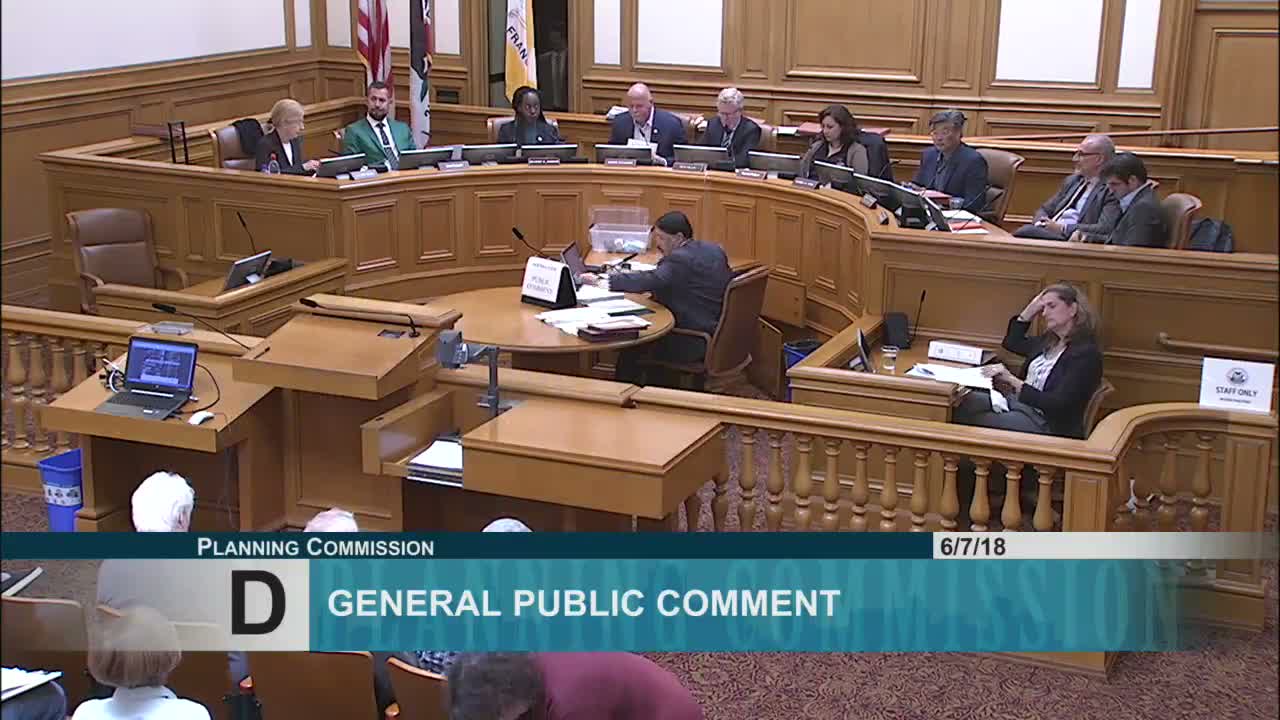
The commission voted unanimously on June 7 to recommend that the Board of Supervisors not adopt a proposed planning-code change that would allow a private parking lot adjacent to the Glen Park BART station to be operated as a public parking lot "as a right" in perpetuity.
Sharon Johnson, representing Supervisor Sheehy—s office, told the commission the owner of the lot wants to continue using it to raise funds while planning for housing in the future. Planning staff and numerous neighbors said that while temporary parking as an interim use is understandable, embedding a permanent, by-right public parking use at such a transit-rich site would be a poor long-term outcome for housing near transit.
Dan Snyder (Planning) said the parcel spans multiple zoning districts and that, under current rules, only the NCT portion could host a temporary parking lot and only by conditional use. The proposed ordinance would permit an "as of right" parking lot on the entire parcel in perpetuity, which staff and some commissioners said could disincentivize higher-density housing on a prime transit site. Community commenters were split: some supported upzoning the parcel to NCT and a temporary conditional-use parking authorization; others urged strict limits to prevent a permanent parking use.
Commissioner Moore moved to disapprove the ordinance; the motion passed without dissent. The commission recorded the vote as disapproval and moved on to subsequent agenda items.