Get Full Government Meeting Transcripts, Videos, & Alerts Forever!
Get email alerts on the 1600 Jackson WholeFoods topic
No spam. Unsubscribe anytime.
Planning Commission continues Whole Foods 365 proposal at 1600 Jackson amid housing and small-business concerns
Summary
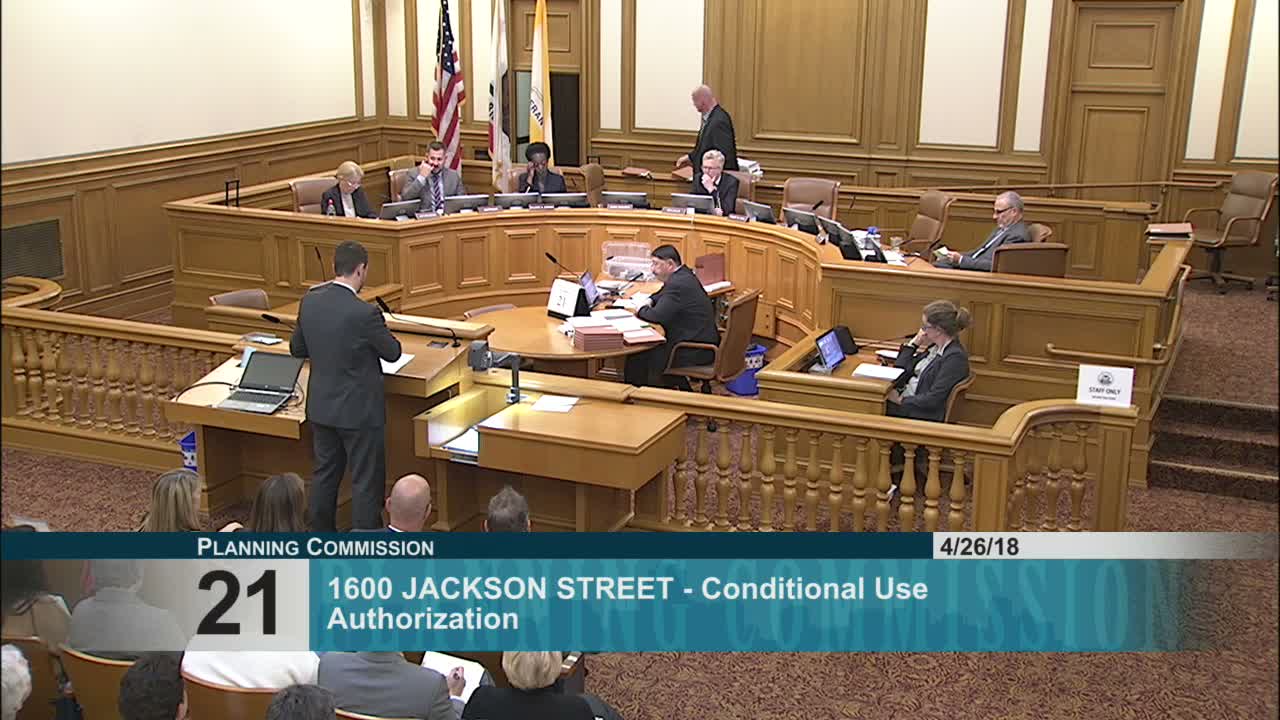
After hours of public testimony both for and against a proposed Whole Foods 365 at 1600 Jackson Street, the San Francisco Planning Commission voted 4–2 to continue the item 90 days for the owner and applicant to explore whether housing or other mixed-use options can be folded into the plan.
The San Francisco Planning Commission on Thursday put off a decision on a proposed Whole Foods 365 grocery at 1600 Jackson Street, continuing the matter 90 days after a contentious public hearing that pitched neighborhood grocery needs against concerns about lost housing opportunities and impacts on small merchants.
Planning staff recommended approval of a Conditional Use Authorization for a single-tenant grocery in the vacant former Lombardi Sports building, noting the project would reactivate a long-empty corner, add roughly 100 jobs and include a transportation management plan and a one‑year operations report-back. Jody Knight, counsel for the property owner, said the sponsor and the grocer had tightened plans after community meetings and would implement measures in the TMP to manage deliveries and curbside activity.
Rob Twyman, regional president for Whole Foods Market Northern California, described a multi-year community outreach effort and said the 365 concept is intended as a smaller-format, lower-cost grocery. “We began this journey over 2.5 years ago,” Twyman said, adding that the company had met repeatedly with local merchants and residents and offered to host neighborhood meetings and community space. The owner, Rob Isaacson of Village Properties, told the commission that the building is an existing, functional retail structure that could be occupied quickly compared with a demolition-and-rebuild housing project.
Opposition centered on two lines of argument: first, long-time merchants, neighborhood associations and labor groups argued the lot is a prime site for new housing and that a national-format grocer could accelerate vacancies among independent stores. Chris Gambinski, chair of the Middle Polk Neighborhood Association, urged the commission to prioritize housing over a single big-box tenant. “This project is counter to Mayor Ed Lee’s housing initiative,” he said. The United Food and Commercial Workers Local 4648 also opposed the permit, arguing the location is better suited for housing and warning of impacts to small grocers.
Second, opponents raised traffic, loading and safety concerns. Several neighborhood merchants and residents described narrow Polk Street traffic conditions, the nearby bus and bike lanes, and said the store’s on‑street loading plan could create conflict points. Plaintiffs and traffic analysts at the hearing questioned portions of the applicant’s loading analysis and whether large delivery trucks could safely execute all maneuvers in the proposed routes.
Supporters — including many nearby residents, the Russian Hill Neighbors organization, the Union Square Business Improvement District and several residential associations — urged the commission to allow the grocery. Supporters said the neighborhood lacks a full-service, walkable grocery and that the long-vacant site is an eyesore. “We need a full-service grocery,” said Peter Faller, a board member at 1591 Jackson, which is diagonally opposite the site. Multiple residents said they would walk to a grocery and that activating the storefront would improve safety through increased daytime foot traffic.
After lengthy questioning about whether a mixed-use solution (grocery plus housing above) could be developed, and whether the landlord and grocer could reconfigure the lease to permit housing on upper floors, the commission voted to continue the item 90 days. Commissioner Fong moved to continue; the motion passed 4–2 (Fong, Johnson, Coppell and President Hillis voting aye; Moore and Richards dissenting). The commission asked the applicant and property owner to study whether housing can be incorporated into the existing structure or added in a feasible way while preserving needed retail and parking arrangements, and to report back on technical feasibility and timelines.
Next steps: the commission set a return date approximately 90 days out; staff and the applicants are expected to confer with structural and economic consultants and with neighborhood stakeholders to determine whether a workable mixed-use alternative can be developed and returned to the commission for consideration.