Get Full Government Meeting Transcripts, Videos, & Alerts Forever!
Get email alerts on the Entertainment Noise topic
No spam. Unsubscribe anytime.
Commission approves May’s Oyster House request to permit amplified entertainment with conditions
Summary
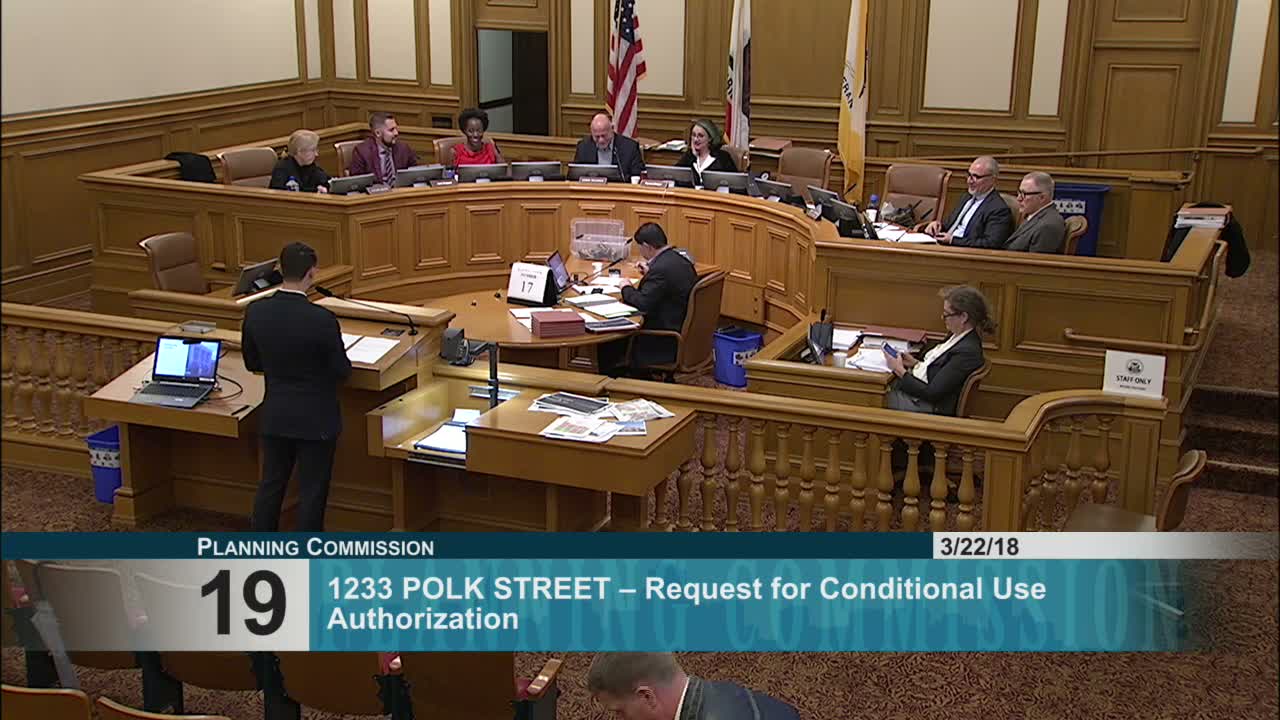
After acoustical testing and physical mitigation, the Planning Commission granted May’s Oyster House a conditional‑use authorization to allow amplified entertainment to 2 a.m., contingent on operational measures and a six‑month oversight condition tied to Entertainment Commission citations.
The Planning Commission approved a conditional‑use authorization on March 22 for May’s Oyster House (1233 Polk Street) to permit amplified nighttime entertainment beyond the prior restriction, following a year of acoustical testing and a package of mitigation measures.
Background and evidence: The business previously held a conditional authorization that limited amplified sound to Friday and Saturday nights until midnight; enforcement staff found the operator in violation and the owner sought a broader authorization to operate amplified entertainment up to 2:00 a.m. daily. The operator engaged acoustical consultant Salter Associates to measure sound transmission and recommend improvements. Salter reported that door upgrades, interior changes and a sound‑limiter would noticeably improve sound isolation; the consultant provided before‑and‑after testing to support mitigation claims.
Public response and conditions: Staff received a mix of letters and testimony. Lower Polk Neighbors moved from opposition to conditional support after the operator implemented recommended measures and committed to additional operational changes; their support is conditional on a six‑month review triggered if the Entertainment Commission issues two or more citations in that period. Many immediate neighbors and nearby businesses testified both in opposition and in support; adjacent business owners (including MacTigue Saloon) spoke in favor, describing cooperative sidewalk‑cleaning and security coordination.
Why it matters: The decision balances neighborhood livability with the vitality of a mixed nightlife corridor. Commissioners emphasized the Entertainment Commission’s role in noise monitoring and pointed out that enforcement includes on‑site noise measurements taken at the time of complaints. The permit includes conditions from staff and the noise consultant and allows the Entertainment Commission’s enforcement program to verify compliance.
Outcome and next steps: The Commission approved the conditional use with the recommended acoustic mitigation conditions and continued enforcement monitoring; staff and neighbors agreed a rehearing mechanism tied to citations will provide a near‑term compliance check.