Get Full Government Meeting Transcripts, Videos, & Alerts Forever!
Get email alerts on the State Housing Bill SB827 topic
No spam. Unsubscribe anytime.
Planning staff outlines scope and risks of SB 827 as hundreds of San Franciscans weigh in
Summary
Planning staff briefed the San Francisco Planning Commission on California Senate Bill 827 — a statewide transit‑adjacent upzoning proposal — and commissioners heard hours of public testimony from neighborhood groups, labor, environmental advocates and development proponents about displacement, local control and value capture.
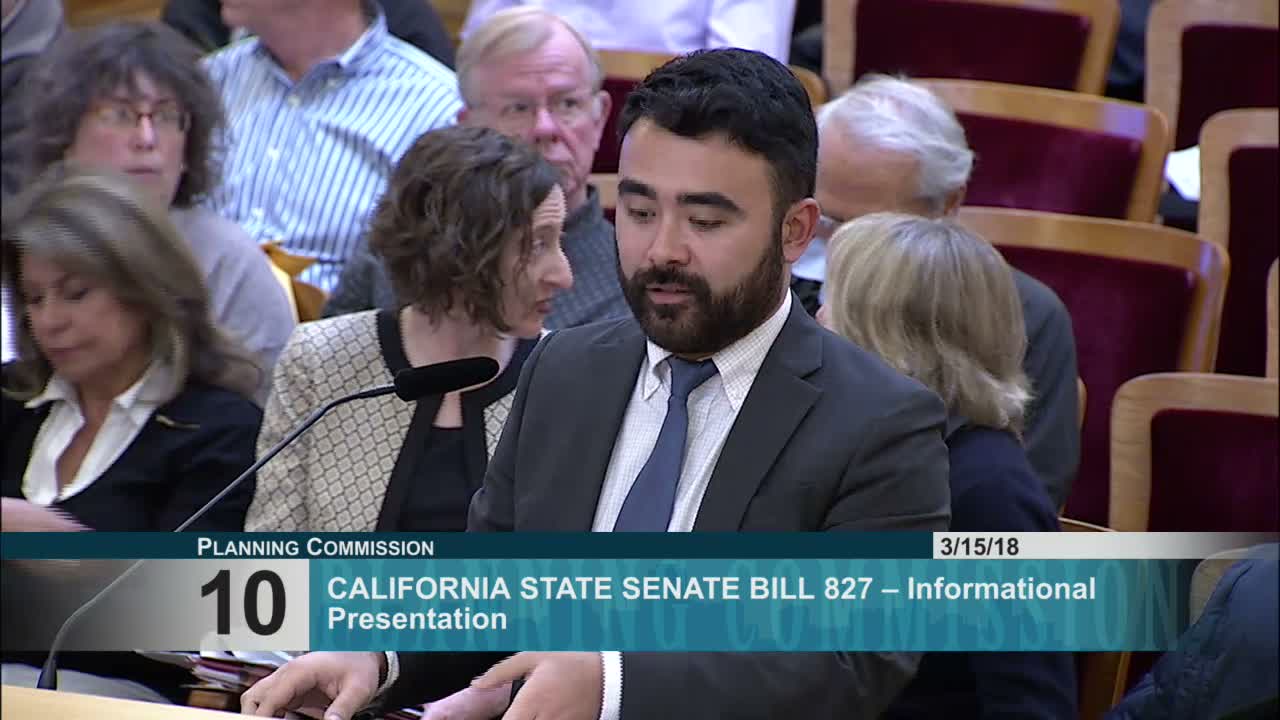
San Francisco planning staff presented an informational analysis of California Senate Bill 827 to the Planning Commission and a packed room of residents and stakeholders on March 15, describing a statewide effort to increase housing near transit while flagging unanswered questions about local discretion, value capture and mitigation timing.
"Broadly, the bill's intent is to increase the amount of housing built statewide near transit stations and stops," Planning Department staffer Paulo E. Quizoy told the commission. He outlined the bill's core mechanism: a “transit‑rich bonus” that would lift local density, parking and some height limits within specified radii of frequent transit, setting baseline height tiers of about 85, 55 or 45 feet depending on street width and distance from a major stop.
Quizoy also emphasized March amendments that add tenant protections — including a right of first refusal and relocation benefits for displaced tenants — and that prohibit use of the bonus on parcels with rent‑controlled units unless a city passes a resolution allowing demolition. But he and other staff repeatedly told commissioners there is still uncertainty over how much discretion cities will retain when projects meet the bill’s threshold and how local mitigation programs (for transit, parks or on‑site affordability) could be timed so they are effective.
The public record filled with testimony on both sides. Several neighborhood groups and tenant‑rights advocates told the commission SB 827 would displace low‑income and rent‑controlled households. "SB 827 kills local control," said Rose Hilson of the Coalition for San Francisco Neighborhoods. Community organizations and speakers from Chinatown, the Mission and the Tenderloin argued the bill’s approach risks accelerating displacement without guaranteed value capture or enforcement resources.
Environmental and community groups urged strong CEQA protections and stronger, enforceable affordability guarantees. "CEQA protects public health and environmental justice," said Catherine Howard of Sierra Club California, urging opposition to SB 827 as drafted because it could reduce environmental review and public participation.
Others urged the commission and the Board of Supervisors to engage Sacramento. Planning staff noted Supervisors had already opened a Land Use Committee discussion and that the city was preparing recommended amendments. Supervisor Peskin’s committee sought language urging amendments rather than wholesale opposition and asked the Planning Commission to weigh in with suggested modifications, staff said.
Proponents and some data analysts said the bill could spur additional housing production in areas where local rules now limit scale. Stephen Boss of Mission YIMBY highlighted modeling that shows widespread upzoning in the city, while others urged that the Peninsula and inner suburbs also accept greater housing responsibilities to avoid concentrating impacts in a few cities.
Commissioners pressed staff on the bill’s interactions with existing state laws (SB 35 and the state density bonus), Home SF incentives, and the Housing Accountability Act. Staff said many interactions will depend on final language and that they will continue to update the commission and Board of Supervisors as amendments are filed. Commissioners repeatedly raised the need for value capture — ways to recover some of the added land value for public benefits such as transit and affordability — and suggested the commission prepare a list of recommended amendments for the Board.
The commission did not vote on a formal position. Commissioners asked staff to continue analysis (including parcel‑level mapping of street widths and transit layers) and to return with suggested, locally tailored amendments the Board of Supervisors and the city’s legislative delegation could pursue.
What happens next: Staff said it will refine parcel‑level analysis and return with recommended language; the Board of Supervisors was already briefing an amended resolution at its Land Use Committee. The Planning Commission encouraged public comment to continue as the bill moves through Sacramento.