Get Full Government Meeting Transcripts, Videos, & Alerts Forever!
Get email alerts on the Central Soma topic
No spam. Unsubscribe anytime.
Planning staff pitches denser Central SoMa with trade-offs over jobs and benefits
Summary
Planning Department staff told the Planning Commission that the Central SoMa plan would deliver roughly 7,100 housing units (with options to raise capacity to about 8,300) while retaining major office capacity and funding a $2.2 billion public‑benefits package; public commenters urged stronger affordable‑housing, anti‑displacement measures and local hiring guarantees.
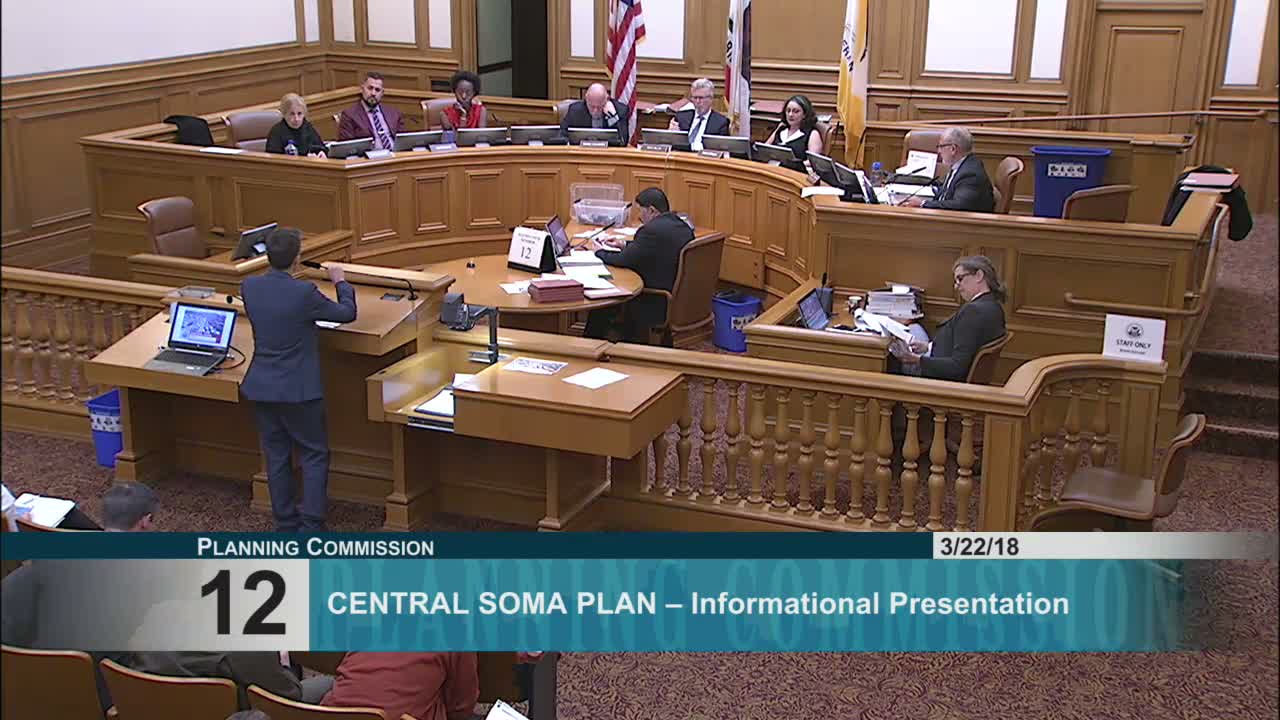
Planning Department staff presented the Central SoMa area plan to the Planning Commission on March 22, outlining how the 17‑block plan would accommodate both substantial office development and new housing while providing a package of public benefits.
At the hearing, Anne Marie Rogers, planning staff, said the plan “would likely produce about 7,100 new housing units” under the environmental review and noted staff estimates that the EIR studied a maximum of about 8,320 units, giving a cushion that the commission could use to increase housing within the EIR’s scope. Steve Wertheim, the project manager, outlined two principal strategies to add housing without redoing the EIR: raising the commercial‑orientation threshold from 30,000 to 40,000 square feet so some large lots could choose housing, and rezonings that would convert limited office zoning (WMUO) to a mixed‑use (CMUO) designation. Together those changes could add roughly 1,240 units and bring the plan close to the 8,300 figure the EIR could support.
Wertheim also described the plan’s proposed public‑benefits program and how staff would use discretionary revenues. He offered a preliminary allocation for about $70 million of supplemental revenue: $25 million for arts and social programming over 25 years, $15 million for parks and maintenance, a $50 million capital reserve for Yerba Buena Gardens (to be adjusted if other funds are found), neighborhood cleaning and funding to support Bessie Carmichael Elementary, among other items. He said staff also proposes changes intended to help make rental housing feasible, such as removing a proposed Community Facilities District (CFD) charge on rental projects; that step would reduce the public‑benefit yield modestly and staff asked the commission to weigh trade‑offs.
Why it matters: Commissioners and the public framed Central SoMa as a high‑stakes trade‑off between jobs, housing and community protection. Several speakers from the We Are SoMa coalition, labor unions and neighborhood groups urged stronger, earlier anti‑displacement measures, more deeply affordable units (some asked for a much higher affordable set‑aside), and enforceable local hiring or labor standards for the many new commercial jobs the plan would create. Housing officials with the Mayor’s Office of Housing and Community Development and staff described existing tools—small‑sites acquisition, in‑lieu fee allocations and a neighborhood preference mechanism for affordable units—but told the commission that some protection measures would require legislative action by the Board of Supervisors or the mayor’s office, not only planning code changes.
Timing and next steps: Rogers and Wertheim said staff will return to the commission with specific ordinance language. They flagged AB 73 (a state bill on housing sustainability districts) as a potential tool to speed up housing approvals and to require prevailing‑wage or labor standards in exchange for streamlining; staff said a “use it or lose it” provision could be explored with the city attorney and Sacramento partners. Commissioners asked staff to produce visual models of tower separation and to work with neighborhood groups to price proposals such as small‑site acquisition and other anti‑displacement ideas so policymakers can weigh the trade‑offs.
The commission did not take a final vote on plan adoption during the March 22 hearing but signaled support for exploring the two primary housing strategies described by staff and requested further modeling, neighborhood engagement and clarity on funding priorities and timing.