Get Full Government Meeting Transcripts, Videos, & Alerts Forever!
Get email alerts on the Historic Preservation topic
No spam. Unsubscribe anytime.
Community members urge stronger preservation and mitigation as Planning Commission reviews Draft EIR for 150 Eureka Street
Summary
At a Jan. 18 public hearing the Planning Department presented a draft EIR finding the proposed demolition at 150 Eureka Street would have a significant and unavoidable impact to the historic Metropolitan Community Church; church members and preservationists urged plaque, relocation or replication of the Rainbow Walk bricks and other mitigations while commissioners pressed for alternative analyses and clarified the EIR process.
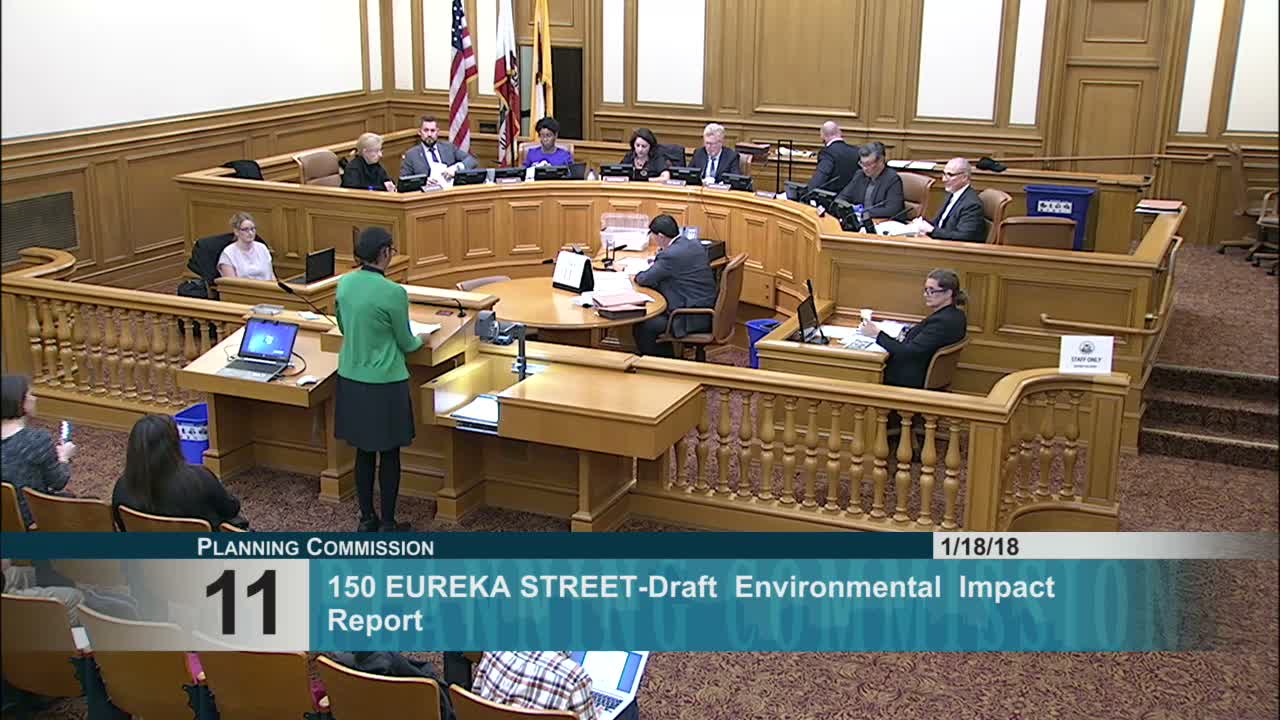
The Planning Department on Thursday presented the Draft Environmental Impact Report for 150 Eureka Street, concluding the proposed project would demolish the Metropolitan Community Church (a recognized historic resource) and that the demolition constitutes a ‘‘significant and unavoidable’’ impact on historic architectural resources.
Jenny Delumo, the department’s EIR coordinator, told the commission the project would subdivide the site and construct two four‑story residential buildings totaling four dwelling units and eight parking spaces; the Draft EIR found project‑level significant impacts to the historic resource that could not be fully mitigated. The Historic Preservation Commission previously reviewed the Draft EIR and concurred with the finding of significant and unavoidable impact while recommending more practical mitigation measures in lieu of a full walking tour interpretation program.
Members and historians connected to the Metropolitan Community Church urged the commission to pursue stronger and practicable mitigations. Lynn Jordan, a founding member and church historian, said the site represents decades of LGBTQ history and urged mitigation that ‘‘recognizes and honors the history that was given life and fulfillment within the walls of 150 Eureka.’’ Christine Poggioli and other MCC representatives asked for a plaque, recreation or relocation of the yellow brick road memorial and donation of reusable brick fragments to local historic sites.
Commissioners raised questions about alternatives and the EIR’s scope. Commissioner Richards asked whether the preservation alternatives and project objectives—such as reasonable return and open‑space objectives—were fully analyzed. Commissioners Moore and Johnson pressed staff on whether the EIR could incorporate policy‑driven alternatives such as higher density or a development agreement, and on the adequacy of the structural reports relied on in the analysis. Staff and environmental planning officials responded that the draft phase allows parties to change the project description and that the comments will be incorporated in the responses and the final EIR as appropriate.
What’s next: Written comments on the Draft EIR will be accepted until 5 p.m. on Jan. 23, 2018; staff anticipates publishing the draft comments and responses in late spring and returning with a final EIR and certification hearing in summer 2018.
Representative quote: "For 35 years, we who were the church were the many names of inclusion and transformation," Lynn Jordan said, asking the commission to preserve the site's stories.
Ending: The commission limited public comments (one minute each, given the item had been previously heard), collected additional written input and directed staff that comments and suggested alternatives be addressed in the final EIR and in the comments‑and‑responses document.