Get Full Government Meeting Transcripts, Videos, & Alerts Forever!
Get email alerts on the Neighborhood Impacts topic
No spam. Unsubscribe anytime.
Commission approves 2918 Mission Street project after contentious hearing; mandates school‑focused construction mitigation and scheduled progress review
Summary
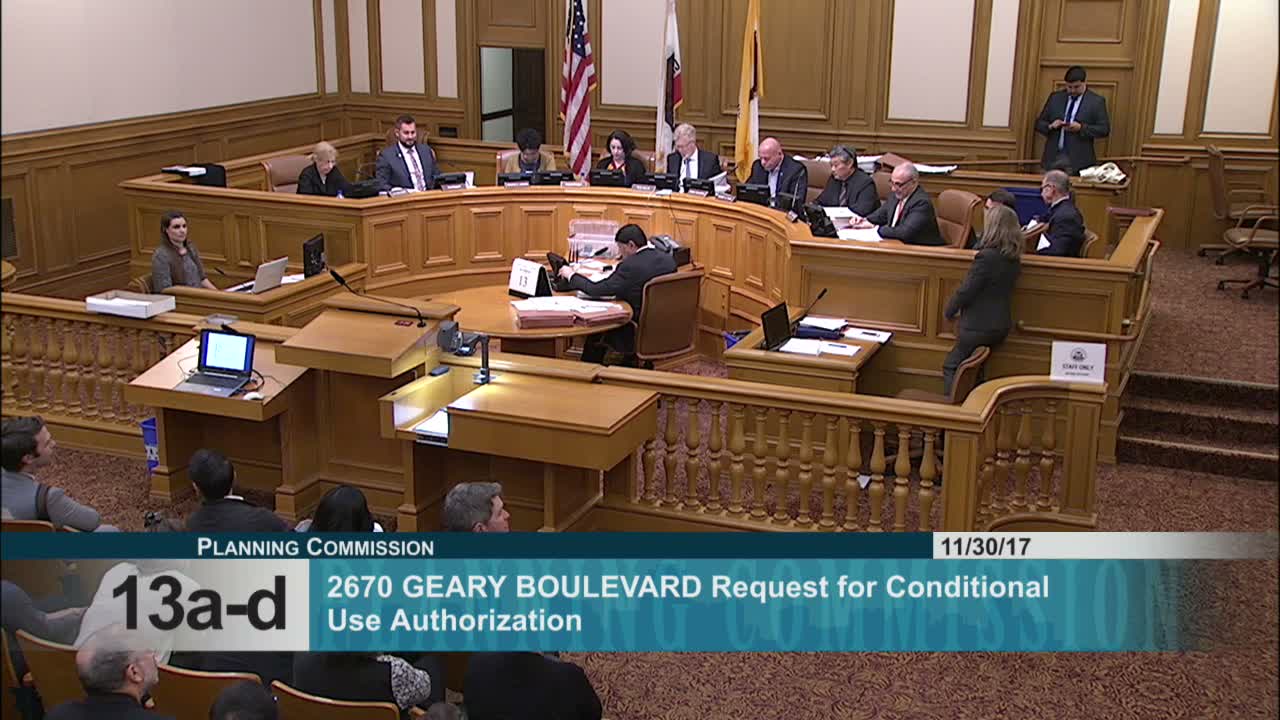
After hours of testimony from parents, educators and neighbors, the Planning Commission narrowly approved a conditional use for the 2918 Mission Street project Nov. 30, 2017, 4‑2. The decision includes a required construction mitigation program developed with the adjacent preschool and a scheduled Commission review to consider revocation if the project fails to show timely progress.
The Planning Commission approved the conditional use authorization for the 2918 Mission Street redevelopment on Nov. 30, voting 4‑2 to advance the project with specific mitigation and tracking requirements after a lengthy and sometimes emotional public hearing.
Project sponsor Bob Tillman and his design team presented a revised massing and façade scheme intended to reduce visual bulk and lessen shading on neighboring properties. Planning staff said the project underwent a Community Plan Exemption analysis under CEQA and that the proposal included 75 residential units, revised massing and mitigation measures derived from the Eastern Neighborhoods program. The sponsor emphasized outreach and a commitment to mitigate construction impacts.
Opposition centered on immediate neighborhood impacts: Dr. Thor Boucher, principal of the Zaida T. Rodriguez preschool directly across Osage Alley, urged the commission to reject or require substantial new protections, warning that prolonged construction “would expose children … to construction for countless years” and could affect developing lungs and nap time. Community groups, preservation advocates and neighborhood residents raised additional concerns about shadows on playgrounds, air quality and displacement in an area experiencing rapid development. The Animal Legal Defense Fund and other commenters urged further environmental review on health grounds; others supported the project as transit‑adjacent housing.
The commission amended the project’s conditions to require that the sponsor and staff craft a construction mitigation program in consultation with the school and public‑health staff; the program must address noise attenuation, dust and air‑quality controls, safe egress and access during construction and enhanced monitoring and notification measures. The commission also revised the entitlement’s validity and renewal language so the commission will hold a public hearing to review the project’s progress within a defined period (the motion specified a Commission review date to consider revocation if the developer has not demonstrated substantial progress). Chair and staff advised that the Commission may consider extensions but that the new hearing provides a formal check if a project stalls.
Supporters of the approval argued the site is transit‑served and that denial would not produce affordable housing or buildable alternatives. Opponents argued that the project’s CEQA treatment (community plan exemption) and the use of state density rules produced a project with less on‑site affordability than some neighborhood advocates want; speakers asked for stronger mitigation, more affordable units or a full EIR. The commission’s motion requires staff to deliver the construction mitigation framework and to monitor progress for the mandated Commission review.
What happens next: The project sponsor must work with staff and the school to finalize the construction‑phase mitigation plan. Staff will schedule the Commission’s review date per the motion’s procedural language to consider revocation or further extension depending on progress.
Why it matters: The hearing highlighted tensions between adding much‑needed housing near transit and the immediate impacts of tall, dense development on sensitive local uses such as preschools and family‑serving institutions. The Commission’s added construction protections and scheduled progress review reflect an attempt to balance the applicant’s right to pursue entitlements and the neighborhood’s documented public‑safety and health concerns.
Votes and next steps: The motion to approve passed 4‑2. The new conditions require a construction mitigation plan in consultation with the preschool and a Commission review of the project’s progress; staff will draft the exact schedule and associated milestones.