Get Full Government Meeting Transcripts, Videos, & Alerts Forever!
Get email alerts on the Housing Directive topic
No spam. Unsubscribe anytime.
Planning Department outlines fast-track plan to meet mayor's housing directive, seeks code and process changes
Summary
Planning Department staff told the commission the mayor's directive sets firm deadlines—six months for non‑CEQA projects and up to 22 months for projects with an EIR—and presented an early action plan to speed applications, strengthen interagency coordination and reduce discretionary reviews.
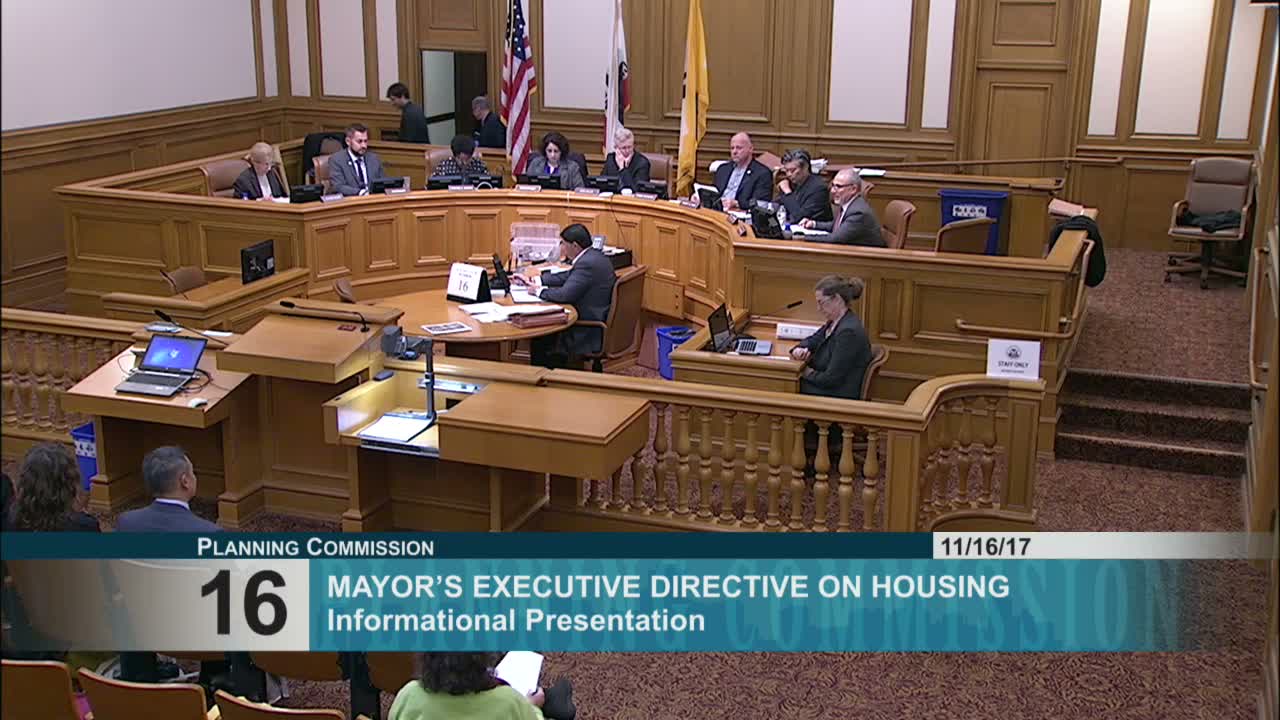
The San Francisco Planning Department presented a detailed plan to the Planning Commission on Nov. 16 in response to the mayor's executive directive aimed at accelerating housing approvals.
John Ram, director of the Planning Department, said the directive sets approval timeframes tied to environmental review: six months for projects not subject to CEQA and up to 22 months for complex EIRs. The directive also calls for a one‑year goal to produce construction documents after entitlement for projects that reach that stage.
Jacob Bintliff, who is coordinating the department's response, told commissioners staff would organize the effort into several work streams: clarifying application requirements, consolidating preliminary applications, pushing more routine cases to over‑the‑counter review, standardizing environmental and design review mitigations where possible, and technology improvements such as electronic document review. "Anything worth doing is worth doing well," Bintliff said, describing a listening tour with staff and stakeholders to identify bottlenecks.
Architects and designers from the Design Advocacy Group and the American Institute of Architects' San Francisco chapter urged the department to expand the set of projects that can be processed administratively. Christopher Roach of Studio VAR told the commission many infill items and small alterations could be approved "as‑of‑right" or over the counter, freeing staff to focus on major projects.
Staff said the program will require code clarifications and, in some cases, planning code amendments. Bintliff described short‑term steps the department will take before a formal plan is filed with the mayor on Dec. 1 and longer‑term changes to be considered in 2018, including quarterly reporting to the Mayor's Office of Economic and Workforce Development and regular updates to the Planning Commission.
The presentation also emphasized interagency coordination: the directive names the Department of Building Inspection, Public Works, SFMTA, the Fire Department, Rec & Park and others, and proposes appointing senior managers in each to speed post‑entitlement permitting. The department plans a phased rollout of process changes and quarterly reviews to measure results.
The commission welcomed the plan and asked staff to return with specific proposals and measurable targets. Several commissioners emphasized the need to protect existing housing and to avoid rushing changes that could worsen displacement or create downstream problems. Bintliff said the Dec. 1 plan will be an initial, iterative step rather than a final policy.