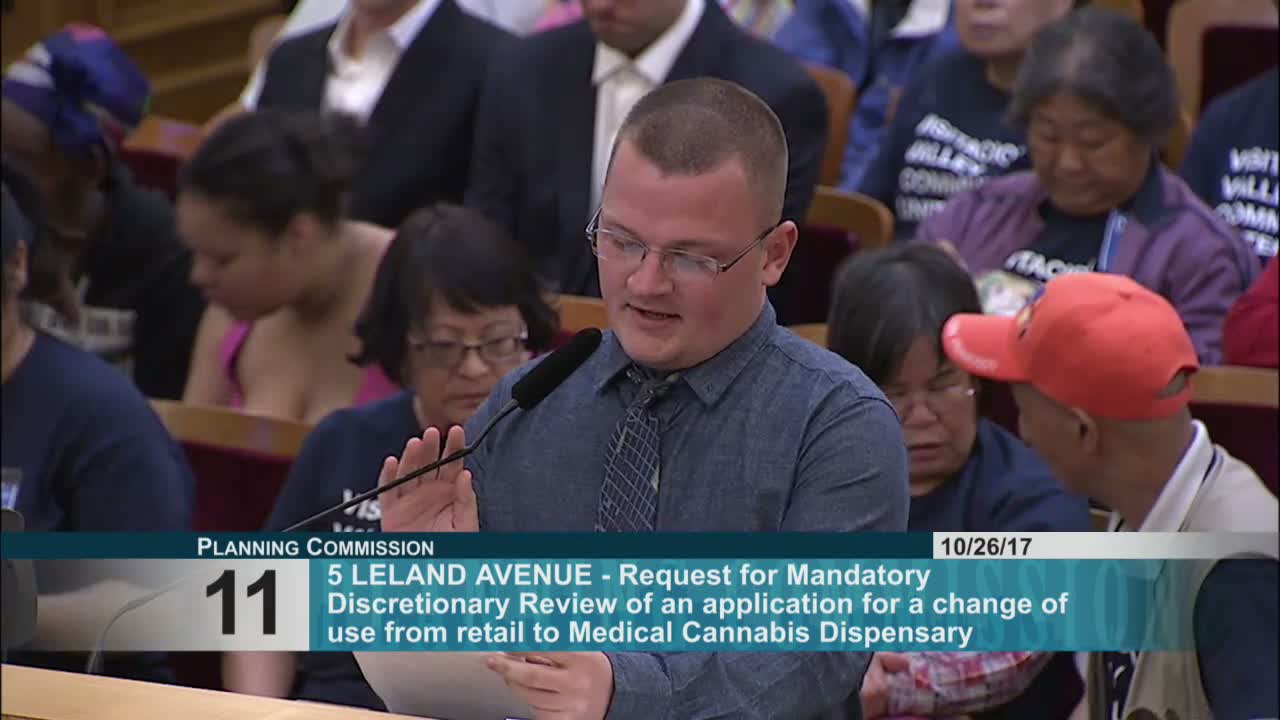
Contested Visitation Valley dispensary: Connected SF hearing continued to Feb. 1 after weeks of passionate testimony
Loading...
Summary
The commission heard hours of organized opposition and support for Connected SF’s proposed medical dispensary at 5 Leland, focused on clustering, traffic, and youth‑protection concerns. After extended testimony from neighborhood groups, the chair continued the item to Feb. 1, 2018 for more operational data and to let the Bayshore entitlement go further into permitting.
The Planning Commission reopened mandatory discretionary review of Connected SF’s proposed medical cannabis dispensary at 5 Leland Avenue on Oct. 26, drawing one of the largest turnouts of the day. Supporters argued the operator would bring jobs, community investment and patient access to a neighborhood lacking a dispensary. Opponents — including the Visitation Valley Asian Alliance, the Chinese American Democratic Club and parents of local children — cited proximity to youth programs, clustering on a small commercial corridor and potential traffic and public‑safety impacts.
Sponsor representatives said they had conducted extensive outreach, promised a community benefits fund ($51,000 annually for five years) and pledged to hire locally, adopt professional security plans and use community liaisons. Luke Coleman, an operator with prior dispensary experience, emphasized training, local hiring and compliance with proposed planning conditions.
Organized opposition pointed to several nearby youth and community facilities and argued that the corridor already lacked the infrastructure to absorb another dispensary. Supervisor Malia Cohen’s legislative aide, Yo Yo Chan, told the commission the supervisor opposed approval without further study. Captain Jack Hart of the Ingleside Police Station highlighted narrow sidewalks, dense bus stops and on‑street parking constraints as law‑enforcement concerns.
After deliberation commissioners focused on two questions: (1) whether an already‑entitled Bayshore dispensary (2442 Bayshore) would be operating soon enough to provide real operational data about traffic and loafing/loitering impacts in the area and (2) whether granting a second dispensary on a short commercial block would create problematic clustering. Several commissioners said they wanted to see the first project open and operate before deciding whether to intensify the corridor; others emphasized equity and job creation as reasons to move forward.
The commission voted 3–2 to continue the hearing to Feb. 1, 2018 to allow staff and the chair to gather operational information on the entitled Bayshore location and to let additional municipal regulatory work progress. Commissioner Koppel and President Hillis voted against the continuance.
Next steps: The commission will reconvene on Feb. 1, 2018 (or an earlier date if new information is available) with additional testimony and operational data about the nearby Bayshore entitlement and more specificity about traffic/parking mitigation and community benefits.