Get Full Government Meeting Transcripts, Videos, & Alerts Forever!
Get email alerts on the Cannabis Regulation topic
No spam. Unsubscribe anytime.
Planning Commission backs package of cannabis land‑use changes, keeps 1,000‑foot school buffer
Summary
The San Francisco Planning Commission on Oct. 19 advanced a package of planning‑code changes to implement Proposition 64, voting to transmit an ordinance to the Board of Supervisors that keeps a 1,000‑foot school buffer, adopts an 'orbit' clustering approach and includes limited local exceptions while ordering further work on equity and conversions.
The San Francisco Planning Commission on Oct. 19 voted to forward a staff‑led ordinance implementing Proposition 64 to the Board of Supervisors, approving a set of land‑use rules that will govern adult‑use cannabis retail, conversion of existing medical cannabis storefronts and where on‑site consumption may occur.
Planning Department manager Aaron Starr told the commission the draft ordinance creates definitions and a conversion process for existing medical cannabis dispensaries (MCDs), sets a 600‑foot state default buffer around K‑12 schools but left the local decision to the commission, and proposed three alternatives for preventing clustering of retail cannabis businesses: a district concentration cap, a conditional‑use finding approach and an 'orbit' option that limits the number of retailers within a moving 1,000‑foot radius.
Why it matters: The ordinance determines where dozens of retail outlets and 42 pre‑existing medical marijuana clubs may operate as the state moves to legal adult sales starting Jan. 1, 2018. It also ties local land‑use controls to an equity and registration program the city is still preparing.
What commissioners decided: After hours of public comment and commission deliberations, the body approved a package that departs from the staff recommendation in three key ways. The commission voted to keep a 1,000‑foot school buffer rather than adopting the staff‑recommended 600‑foot distance (motion passed 4–2). The commission chose the orbit clustering alternative — allowing a capped number of retail sites within a 1,000‑foot orbit and triggering conditional‑use authorization if new locations would exceed that cap — over staff’s stricter 300‑foot anti‑clustering rule (motion passed 5–1). The commission also approved an exception to allow NC‑1 neighborhood commercial districts in Supervisorial District 4 to host cannabis retail (motion passed 5–1). The full package, with clerical amendments, was forwarded to the Board of Supervisors (final package motion passed 5–1).
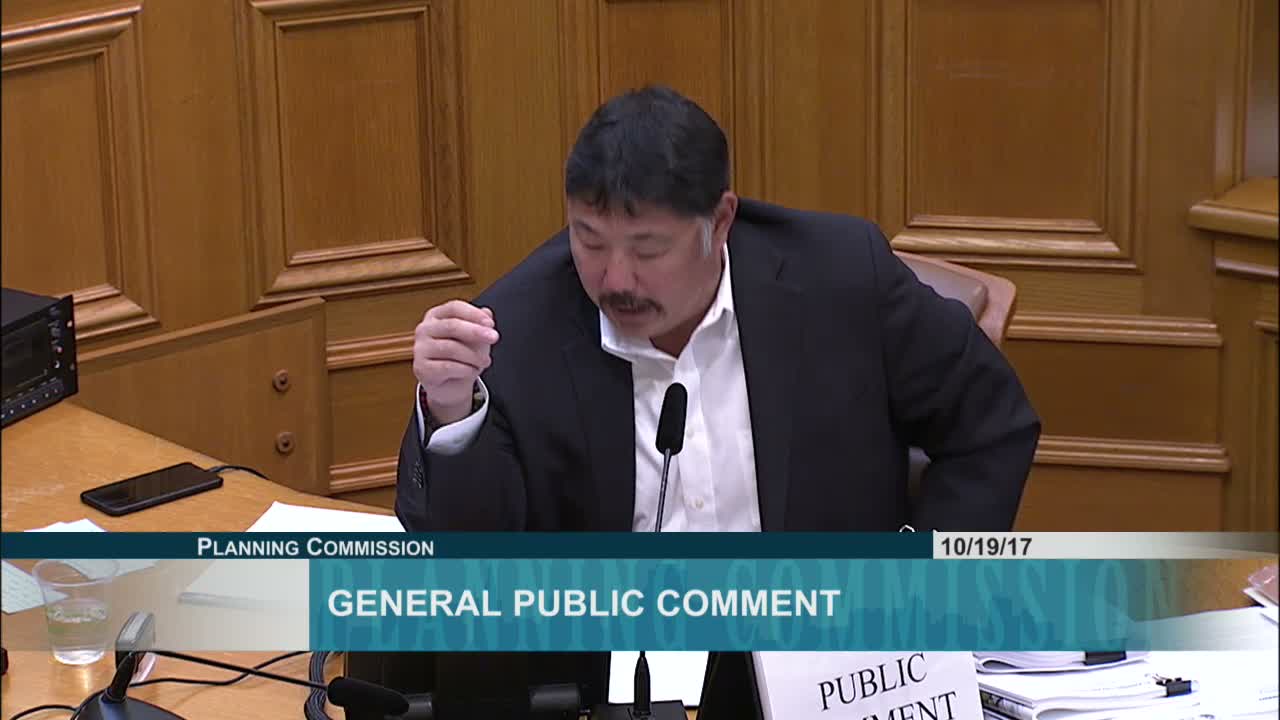
Public testimony: The item drew a large turnout, with patients’ advocates, operators and neighborhood merchants making competing arguments. Industry groups including the San Francisco Cannabis Retailers Alliance and the Chamber of Commerce asked for fast, simple conversion paths for existing MCDs, broader allowances for on‑site consumption, and a smaller school buffer. Opponents — parents, teachers and many residents from neighborhoods such as Visitation Valley and Sunset — asked the commission to keep strong school protections, impose local caps in certain commercial corridors and require more neighborhood notice. Patient advocates also warned that overly restrictive conversion rules could displace longstanding medical providers and argued for safeguards to preserve retail access to low‑income patients. Several speakers urged the commission to require on‑site consumption venues so tourists and residents do not consume in public.
Votes and next steps: The commission’s votes were recorded on the transcript and will be transmitted as recommendations to the Board of Supervisors, which must adopt any final ordinance. The Office of Cannabis and the Human Rights Commission were noted as preparing the city’s equity program and a November equity report that staff said would inform implementation and registration. The city’s Department of Public Health and Office of Cannabis will continue work on operational and health questions including indoor air and on‑site consumption rules.
Attribution: Direct quotes and attributions in this report are taken from the October 19, 2017 San Francisco Planning Commission transcript and staff presentations. The Planning Commission vote on the 1,000‑foot buffer is recorded in the transcript (vote recorded during the discussion at the end of the cannabis hearing). The staff presentation and public comments are likewise documented in the commission record.
What’s next: The Board of Supervisors will hold hearings on the ordinance. Staff indicated that any changes to conversion rules, equity program design and operational controls (including on‑site consumption) will be addressed in implementing legislation and administrative rules that follow the Board’s action.