Get Full Government Meeting Transcripts, Videos, & Alerts Forever!
Get email alerts on the Housing Tenant Protections topic
No spam. Unsubscribe anytime.
Planning commission presses staff for relocation plans as it considers moving dozens of discretionary hearings
Summary
Commissioners heard extensive public testimony from veterans and tenants opposing earlier hearing dates for several discretionary reviews, pressed staff and the mayor’s office for a concrete relocation plan, and reserved judgment on advancing multiple permit‑to‑cure hearings until more housing‑relocation detail is provided.
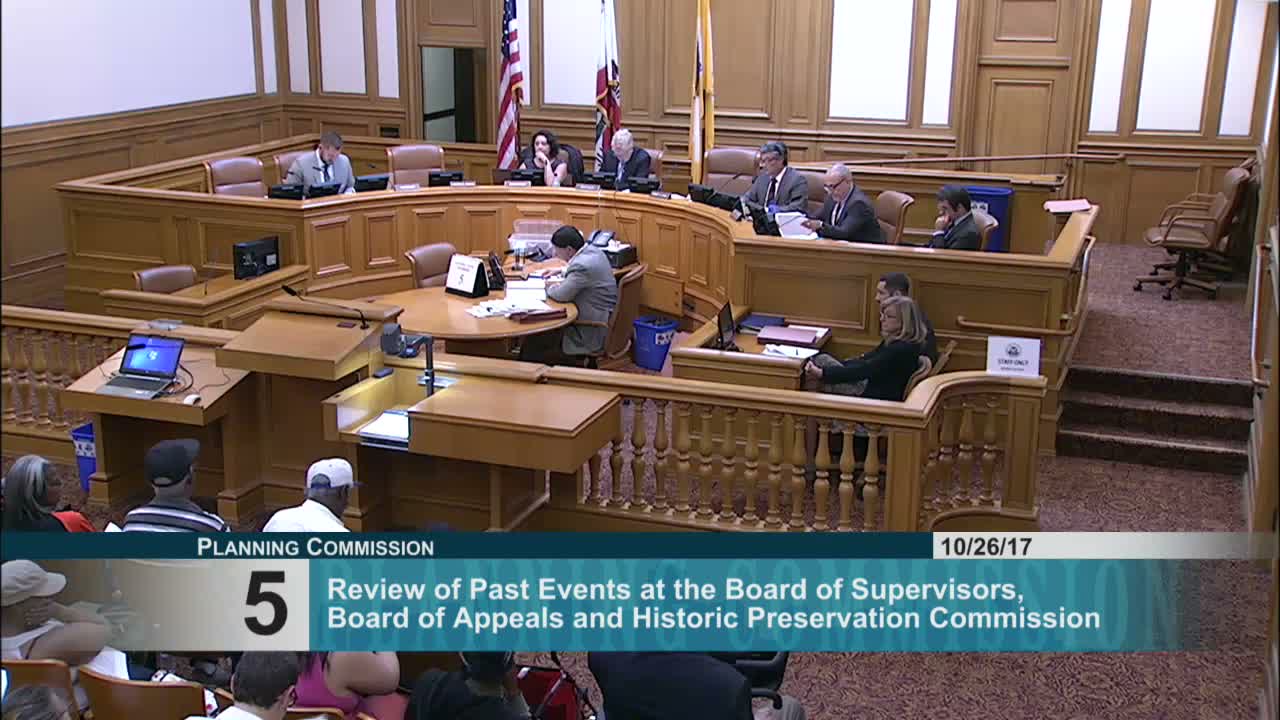
Commissioners on the San Francisco Planning Commission spent a large portion of their Oct. 26 meeting weighing a staff recommendation — backed by the city attorney’s office — to reschedule several discretionary review hearings from Dec. 21 to Nov. 16 so city departments could address pending litigation sooner.
The most sustained public comment came from residents of affected properties, many identifying themselves as veterans. John Brown, a veteran who said he has lived at 1351 Revere Avenue for six years, pleaded with the commission not to support any action that would leave residents without comparable housing. “Do not let the mayor’s office or the city attorney pressure you into evicting us,” Brown said during public comment.
The commission repeatedly pressed the mayor’s office and planning staff for specifics. Jeff Buckley, senior advisor to Mayor Ed Lee, told commissioners the mayor’s office and the homeless department have been working on a relocation plan and that “nobody is going to be displaced until we have a unit for them to move into.” Buckley said the city has identified resources and coordinated with HSH and community‑based organizations to search for comparable housing for residents who would exceed occupancy limits if units are legalized.
Commissioners expressed skepticism that verbal assurances alone would prevent premature evictions by property owners under enforcement pressure. Commissioner Johnson said she could not see a reason for moving hearing dates up unless staff could show “compelling answers” and a clear plan for current residents; Commissioner Koppel echoed that displacement and homelessness were the commission’s top priorities.
Planning staff and the city attorney reiterated several procedural points: a commission action on a discretionary review (a D.R.) begins a relocation planning process but does not itself issue building permits, which require additional review and are appealable to the Board of Appeals. Staff also noted there is routinely a gap between the number of illegally converted units and the number that can be legalized under current code, meaning some units may not be legalizable without further legislative change.
Next steps: commissioners did not adopt any blanket schedule change at the meeting; they signaled they would consider earlier hearing dates only if staff provides a written relocation plan that addresses where affected tenants would be moved, evidence of available comparable units, and a timeline tying relocation steps to any enforcement calendar.