Get Full Government Meeting Transcripts, Videos, & Alerts Forever!
Get email alerts on the Swindells Subacute Capacity topic
No spam. Unsubscribe anytime.
Families and health advocates urge city to stop Swindells closure, address shrinking subacute care
Summary
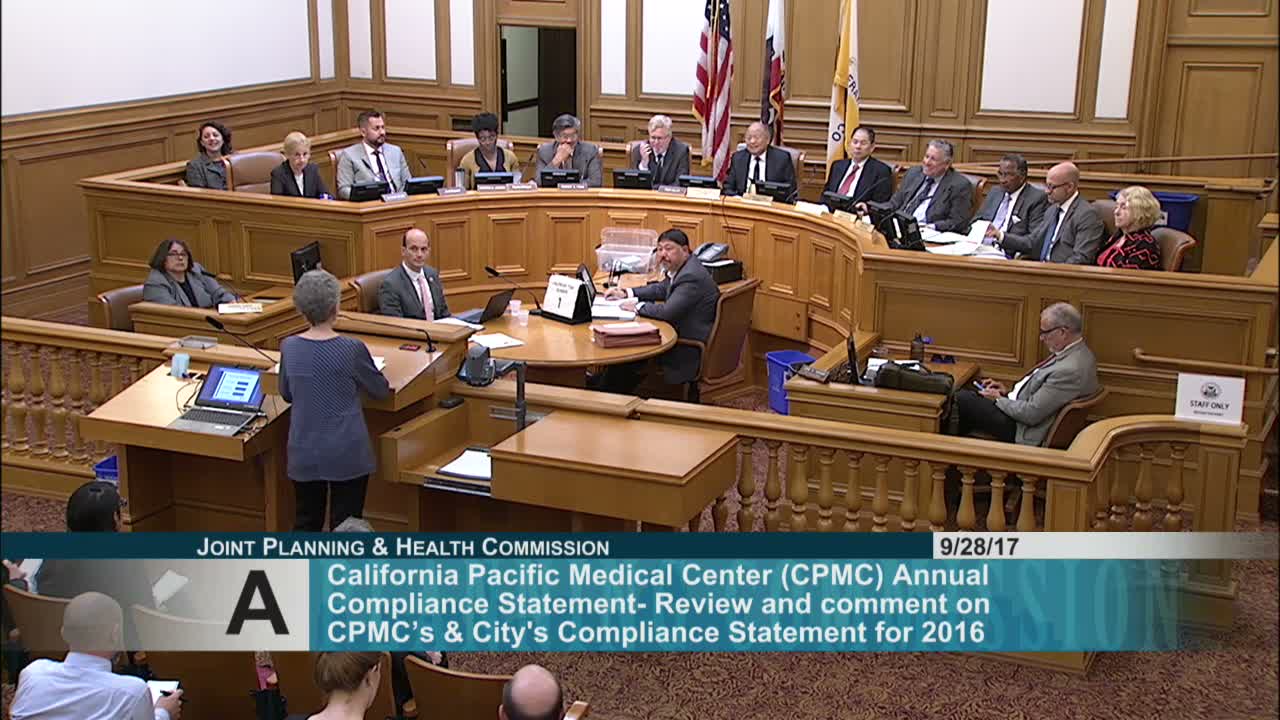
At a joint Planning and Health Commission hearing, multiple family members, clinicians and community organizations urged the city and CPMC to reverse plans that would close Swindells Alzheimer's residential care and to develop concrete solutions for declining subacute and skilled-nursing capacity in San Francisco.
Dozens of public commenters at a joint Planning and Health Commission hearing delivered emotional testimony opposing CPMC'proposed reductions in residential and post-acute care capacity and urged commissioners to use the compliance review to pursue concrete solutions.
Family members of residents at Swindells Alzheimer's Residential Care Unit said they learned in August that CPMC intends to close the 20'year facility and that the move would displace as many as 22'24 medically vulnerable residents. Ann Ludwig, representing the Swindells Family Council, said moving residents would be "medically contraindicated" and urged the city to ensure comparable placements and preserve that community benefit.
Doctors, nurses and advocacy groups pressed for more transparency on how CPMC counts charity-care patients, how the city will reach the DA'target of 1,500 Tenderloin beneficiaries through the NEMS/St. Anthony's MSO partnership, and for better data on staffing and retention in subacute units. Dr. Teresa Palmer requested detailed breakdowns behind the 43,370 unduplicated patients figure and warned that the loss of hospital-based post'acute beds contributes to a citywide crisis.
Union and coalition representatives (California Nurses Association, National Union of Healthcare Workers, Jobs with Justice and others) asked commissioners to hold CPMC accountable beyond checkbox compliance: they want commitments that units remain open and accept new subacute patients, increased transportation support for Tenderloin patients, better outreach for Medi'Cal enrollment, and improved cultural and language access at clinics such as St. Luke's diabetes program.
CPMC responded that it had informed families about a planned Swindells transition tied to the Cal campus closure, that staff are meeting with families individually and collectively to develop an acceptable transition plan and that projected timing for closure discussions was late 2018. CPMC said it is engaging other providers about placements and noted that Swindells is licensed as a residential care unit (Department of Social Services) rather than a hospital'based nursing unit; formal closure would follow Prop Q notification and regulatory processes.
Commissioners and DPH reiterated that subacute and SNF capacity is a cross'sector problem requiring citywide planning. The Health Commission and city staff said a post'acute care task force and further reports are expected; commissioners asked staff to track retention of first'source hires and to provide more granular outcome data on language access and enrollment work in the Tenderloin.
Next steps: the commissions requested follow'up reports and said they would press for collaborative answers to preserve subacute capacity and culturally competent services; any formal closure of Swindells would trigger Prop Q notification and a prompt public hearing.