Get Full Government Meeting Transcripts, Videos, & Alerts Forever!
Get email alerts on the Transportation Policy topic
No spam. Unsubscribe anytime.
Planning department outlines Connect SF long‑range vision and updates CEQA transportation guidelines
Summary
Planning staff briefed commissioners on Connect SF, a 50‑year transportation and land‑use vision, and presented proposed updates to the city’s CEQA transportation impact analysis to emphasize safety and reflect changes in travel behavior, including the role of ride‑share services.
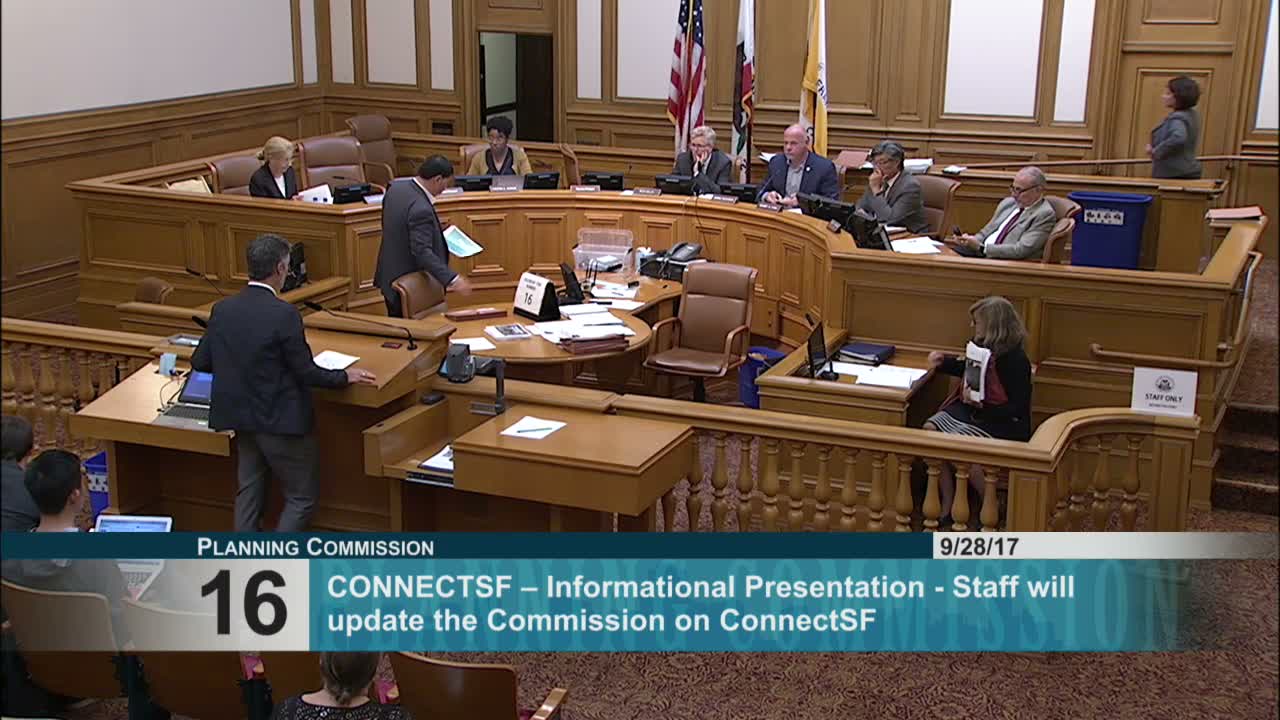
At the Sept. 28 meeting, Planning Department staff presented two linked transportation topics: the Connect SF long‑range scenario planning initiative and proposed updates to the city’s CEQA transportation impact analysis guidelines.
Doug Johnson described Connect SF as a 50‑year vision intended to align land use, regional and city transportation investments, and policy choices across multiple agencies. The process uses scenario planning to test policy tradeoffs and relies on broad public engagement (surveys, focus groups and a task force with regional representation). Commissioners asked about including school transportation and coordination with BART, MTC and other regional actors.
Separately, Lisa Gibson and Wade Whitgriff of Environmental Review explained proposed revisions to CEQA transportation guidelines. Staff said the department has removed automobile delay as a CEQA metric and will emphasize safety in line with Vision Zero goals. Preliminary empirical site sampling at newer residential developments indicates fewer automobile trips and more walking than older modeling assumptions, suggesting current CEQA trip estimates may be conservative for some development types. Staff proposed issuing a series of memos over the next year to update methodology, and requested commissioners’ input on presenting improved, more accessible analyses for decision‑makers.
Commissioners highlighted the need for better data-sharing with TNC providers, clearer cumulative analysis, and ongoing updates so project reviews do not rely on outdated travel assumptions. The department invited written feedback and will integrate responses into the guideline memo series.