Get Full Government Meeting Transcripts, Videos, & Alerts Forever!
Get email alerts on the Cannabis Regulation topic
No spam. Unsubscribe anytime.
City staff unveils draft rules for commercial cannabis, including equity program and phased permitting
Summary
Planning staff and the newly created Office of Cannabis presented a draft ordinance to implement statewide cannabis legalization, proposing phased temporary permits, an equity program for affected communities, zoning buffers and an open permitting approach while seeking public input on clustering, consumption and enforcement.
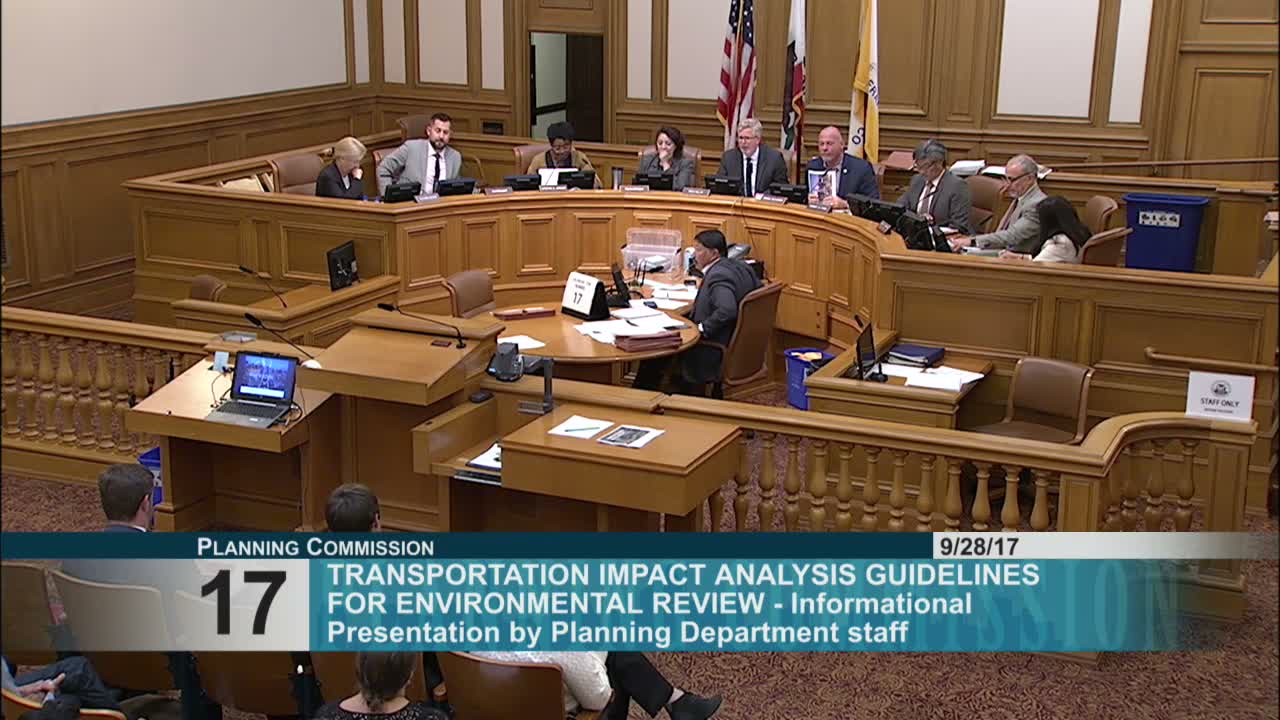
San Francisco planning staff and the Office of Cannabis on Sept. 28 presented a draft local regulatory framework designed to implement California’s recent adult‑use cannabis laws while prioritizing public health, youth protection and equity.
Nicole Elliott, the city’s newly appointed director of the Office of Cannabis, told the Planning Commission the ordinance is a starting point that would set a phased timetable for permitting and require an equity program to prioritize applicants who were harmed by past enforcement and applicants from disadvantaged communities. The proposal would require registration of existing operators so they could be eligible for temporary local permits beginning in early 2018 and then for the state’s temporary licensing process, Elliott said.
The draft identifies a set of permit types — including cultivation, manufacturing (volatile and non‑volatile), testing, distribution, microbusinesses, and medical and adult‑use retail — and would default PDR‑style (production, distribution, repair) land uses to existing PDR rules. Retail operations would face a 600‑foot buffer from schools (matching the current state threshold) and a proposed 300‑foot anti‑clustering rule between retailers, staff said. Conversion rules would allow medical cannabis dispensaries (MCDs) to convert to adult‑use retail through an expedited path, with neighborhood notice and existing appeal processes still available.
Several members of the public urged the city to move quickly and to ensure the equity program addresses real barriers, including access to affordable real estate and capital. Supporters from equity‑focused groups and small business owners urged a robust technical‑assistance program so smaller operators can compete. Opponents and community advocates pressed for stronger controls on consumption and questioned whether the planned buffers and the proposed 300‑foot spacing would prevent clustering in busy commercial corridors.
Staff said some details — notably how consumption will be regulated and whether certain uses are capped — will be refined as state emergency regulations are released and as the city receives public comment. The Board of Supervisors has also asked the Office of Cannabis, the Human Rights Commission and the Controller to produce a report analyzing disparities and recommending measures to promote equitable participation in the industry.
A key feature of the draft is its emphasis on a phased approach: temporary permits and a registration window to capture existing operators, a later permanent permit phase tied to an equity program, and ongoing data collection to inform future policy adjustments. The Office of Cannabis is budgeted initially at three staffers, Elliott said, and enforcement would remain a shared responsibility across existing agencies while the Office of Cannabis provides an added regulatory layer.
The Planning Commission and staff invited written comments and said they will bring revised drafts back to the Commission and to other city bodies as state rules crystallize. The city’s registration period and schedule for the temporary‑to‑permanent permitting phases were included in the staff timeline but may change in response to state action and local input.