Get Full Government Meeting Transcripts, Videos, & Alerts Forever!
Get email alerts on the Pier70 topic
No spam. Unsubscribe anytime.
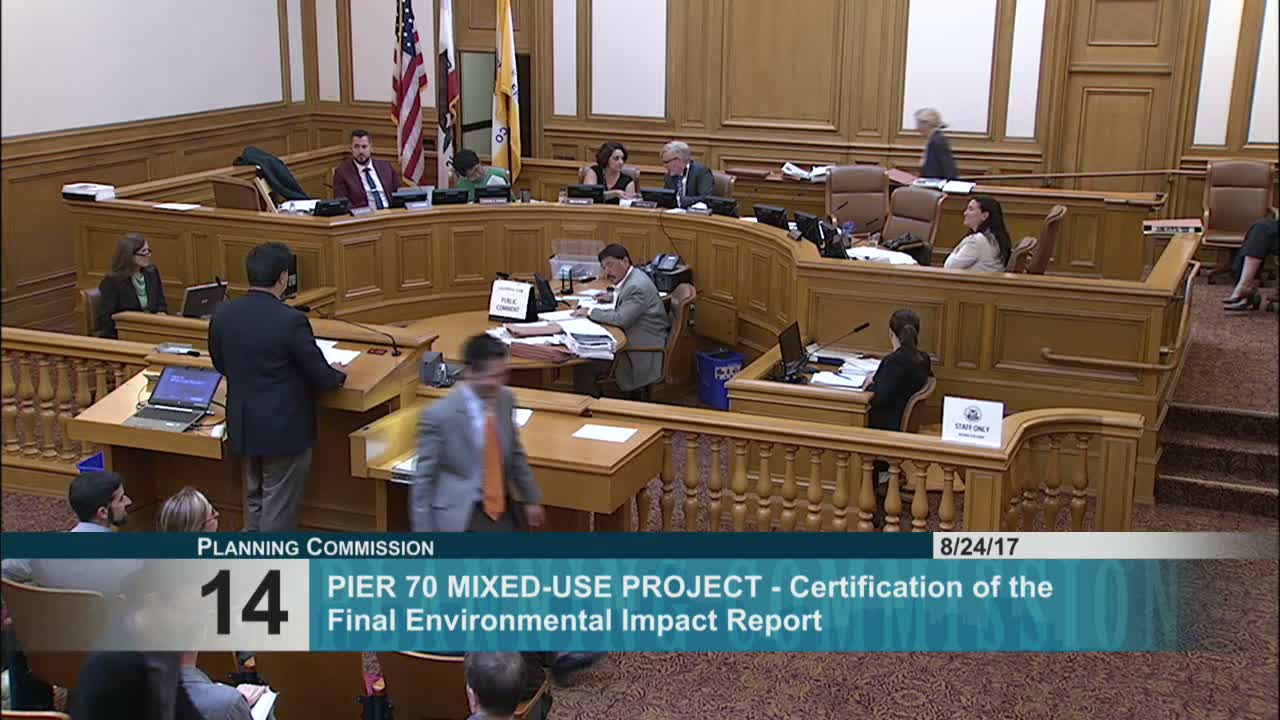
Planning commission certifies Pier 70 EIR, urges board to favor housing and set office threshold
Summary
The San Francisco Planning Commission unanimously certified the final EIR for the Pier 70 mixed‑use project and forwarded the rezoning, design‑for‑development and development agreement to the Board of Supervisors and Port, asking them to bias approvals toward housing, preserve public benefits and add an SUD rule that would trigger conditional review for office above a set threshold.
The San Francisco Planning Commission on Aug. 24 certified the final environmental impact report for the 35‑acre Pier 70 mixed‑use project and recommended the Board of Supervisors and Port adopt the rezoning, design‑for‑development and development agreement that would guide the long‑term redevelopment of the site.
The EIR, presented by Melinda Hu of the Planning Department’s Environmental Planning Division, concluded that “implementation of the proposed project would result in significant and unavoidable project specific and cumulative environmental impacts relating to transit, noise, and air quality,” while identifying mitigation measures and a broad public‑benefits package that includes 30 percent of new units as affordable and roughly nine acres of new public open space.
Commissioners and staff described the Pier 70 plan as a major job‑housing and shoreline‑resilience investment for the Southern Bayfront. Jack Sylvan of Forest City said the plan has been shaped by a decade of outreach and that voters previously backed a related package: “73% of voters voted to support this package for Pier 70,” he told the commission.
The project team and city staff told commissioners the package includes a suite of commitments: on‑site affordable housing and inclusionary units, an arts facility and permanent replacement studio space, workforce programs with local‑hire targets, transportation demand‑management measures designed to cut project trips by 20 percent, and a funding strategy intended to contribute to long‑term sea‑level‑rise adaptations. Staff cited an initial $45 million in local transportation commitments tied to the project and related developments, and described ongoing work to refine mitigation and monitoring.
After extended questions and testimony from neighborhood groups and labor, the commission voted unanimously to certify the EIR and to forward the zoning and development actions to the Board of Supervisors and Port. Alongside certification, the commission included two explicit policy recommendations: first, that the public benefits and affordable‑housing commitments be prioritized and the board encourage the project toward the “maximum residential” outcome where feasible; and second, that the Special Use District language adopt a provision requiring further public conditional‑use review for any proposal to exceed a reasonable, to‑be‑set office threshold in a later phase, so the commission and public can review an exceptionally large increase in office use once site conditions and remediation questions are clearer.
What’s next: certification sends the EIR and the package to the Board of Supervisors and Port Commission for final action. Staff and the commission said subsequent phase approvals will be reviewed against the D4D and that discrete development phases will be subject to port and planning review and the agreed monitoring program.
Votes and procedural outcome: The Planning Commission certified the EIR and adopted its recommendations unanimously (6–0).