Get Full Government Meeting Transcripts, Videos, & Alerts Forever!
Get email alerts on the Environment topic
No spam. Unsubscribe anytime.
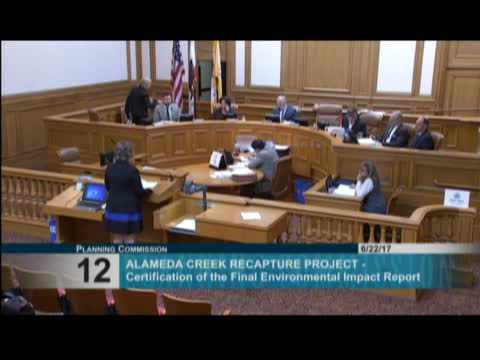
Planning Commission certifies final EIR for Alameda Creek recapture project over ACWD objections
Summary
The Planning Commission certified the final EIR for the Alameda Creek Recapture Project on June 22, 2017, following detailed technical exchanges with the Alameda County Water District, which argued the EIR analysis was inadequate. Planning and SFPUC staff defended the modeling and recommended certification; the motion passed unanimously 5–0.
The San Francisco Planning Commission on June 22 certified the Final Environmental Impact Report (EIR) for the Alameda Creek Recapture Project, part of the San Francisco Public Utilities Commission’s Water System Improvement Program.
Planning staff (Chelsea Fordham and Chris Kern) and Ellen Levin of the SFPUC described the EIR process, modeling approach, and the conclusion that mitigation measures would reduce project impacts to less‑than‑significant levels except for program-level WSIP effects that the SFPUC would address through a statement of overriding considerations if it adopts the project. The planning department presented the Response to Comments (RTC) published June 7 and said the analysis used the same hydrologic model relied on during federal permitting.
The Alameda County Water District (ACWD) objected in a written letter and in person through General Manager Robert Shaver, asserting three principal concerns: an alleged mathematical/modeling flaw in watershed operations, a need for daily rather than monthly flow analysis to assess steelhead impacts, and potential water‑rights consequences arising from changed operations. ACWD asked the commission to delay certification until further analysis could be completed.
Planning and SFPUC technical staff responded in depth: the modeling includes daily flow analyses (supplied in appendices), uses data consistent with the National Marine Fisheries Service permitting work, and bases groundwater/surface water interaction analysis on a decade of monitoring well data. Staff maintained the EIR meets CEQA’s adequacy standard and reflected a good‑faith, evidence‑based analysis.
After technical discussion and questions from commissioners, Commissioner Moore moved to adopt findings to certify the Final EIR; the motion passed unanimously, 5–0.
Provenance: initial staff presentation begins at SEG 2406 and the certification vote is recorded at SEG 2869–2870.