Get Full Government Meeting Transcripts, Videos, & Alerts Forever!
Get email alerts on the Inclusionary Housing topic
No spam. Unsubscribe anytime.
Planning Commission backs supervisors'compromise on inclusionary housing but flags fee study
Summary
The Planning Commission voted to endorse a compromise inclusionary-housing ordinance that starts on-site requirements at 18% and raises some off-site fees above TAC feasibility levels, while asking for a technical study and clarifications on grandfathering, unit mix and minimum sizes.
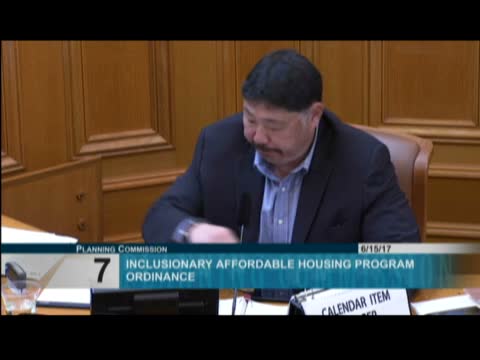
The San Francisco Planning Commission on June 15 recommended approval of a revised inclusionary-housing ordinance that reconciles recommendations from the commission, a technical advisory committee and a compromise ordinance introduced at the Board of Supervisors.
Planning Department staff and Supervisor Ahsha Safaie told the commission the compromise keeps on-site requirements at 18% for rentals (20% for condominiums), phases in annual increases and retains a three-tier AMI structure to target low-, middle- and moderate-income households. Staff emphasized the ordinance needs technical clarifications on grandfathering, rounding rules for the three tiers and references to statewide minimum unit sizes.
The board-level compromise calls for an on-site emphasis and an in-lieu fee structure (identified in the ordinance as 30—3%) that staff and advocates warned may exceed the maximum economically feasible fee the Technical Advisory Committee (TAC) had recommended. Planning staff proposed two options: set the fee at the TAC-feasible rate or adopt the higher rate while directing a controller-led study to update the methodology before the fee becomes binding.
Supporters including labor and affordable-housing advocates praised the measure'for restoring a dynamic inclusionary policy and adding unit-mix and family-size targets. Critics, including some affordability groups and YIMBY representatives, urged caution about raising in-lieu fees above TAC recommendations, saying higher fees could reduce funds available to the Mayor's Office of Housing and put some pipeline projects at risk.
Planning recommended several implementation changes: reference state TCAC minimum unit sizes rather than locking outdated square-foot numbers into code; clarify that replacement of demolished rent-protected units should be counted within, not on top of, the inclusionary requirement where doing otherwise would exceed feasibility; and add a clear trigger point for when an entitlement'rate is re-set (the staff suggested first construction document after 30 months). The planning director also recommended revising neighborhood-mapping references to use the American Community Survey neighborhood profile boundaries for demographic analyses.
Commissioner Richards moved a package of staff recommendations with a targeted exception: commissioners declined to support adding replacement rent-controlled units above the inclusionary requirement (i.e., the commission removed staff recommendation #4). The motion passed 5—to— with Commissioner Moore voting no.
Next steps: the commission's recommendations will go to the Board of Supervisors, which must adopt the ordinance and resolve pending technical questions including the affordable-housing fee methodology and any area-specific rates for neighborhoods such as the Mission or Tenderloin.
Quotes: "We wanted to drive as much affordable housing on-site," Supervisor Safaie said, calling the compromise the result of months of negotiation. "We also have to be mindful of feasibility," Planning staff said, urging a follow-up TAC study on fee methodology.
The commission's action includes technical directions to staff and asks the board to adopt clarifying language on grandfathering and fee-study timing.