Get Full Government Meeting Transcripts, Videos, & Alerts Forever!
Get email alerts on the Short Term Rentals topic
No spam. Unsubscribe anytime.
San Francisco and platforms reach settlement forcing registration and verification for short‑term rentals
Summary
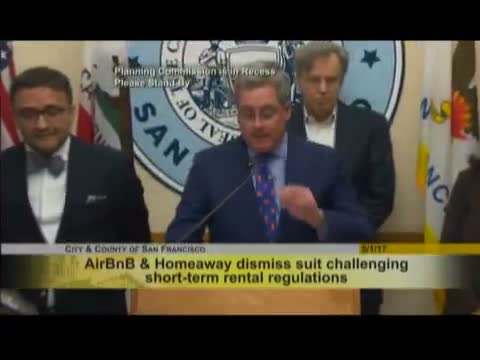
The city attorney announced a settlement with Airbnb and HomeAway that will require pass‑through host registration, monthly data sharing with the city, deactivation of invalid listings and a 240‑day phase‑in; enforcement will prioritize suspected bad actors and the court will retain jurisdiction over implementation.
San Francisco officials announced on May 11 that the city and the two largest short‑term rental platforms, Airbnb and HomeAway, had agreed to a settlement spelling out technical and enforcement steps to bring platform listings into compliance with local registration rules.
Under the agreement, platforms will enable a pass‑through registration mechanism so hosts can submit required city registration applications via their booking pages and will provide the city monthly datasets of listings for verification. Listings must include the host's city registration number (or pending application status) and platforms will deactivate listings flagged as invalid by the city, including listings linked to suspected bad actors prioritized for enforcement (for example where tenants were evicted and units converted).
The settlement also requires platforms to implement a phase‑in process over 120 days of technical work and a total 240‑day phase‑in for host registration and compliance, and it preserves civil remedies including fines and penalties (up to $1,000 per violation as in local law) if platforms fail to police listings. The U.S. District Court will retain jurisdiction during implementation to resolve disputes quickly.
City officials described the settlement as a major enforcement advance, giving municipal agencies data and shutdown mechanisms that the city had lacked. Community advocates and some legislators said the agreement strengthened the city's ability to protect long‑term housing stock and enforce rules against bad actors. The agreement does not foreclose future local legislation; officials said the Board of Supervisors remains able to propose additional rules.
The settlement follows prior litigation in federal court by the platforms seeking to block San Francisco's registration and platform‑liability rules. City officials said the negotiated outcome preserves the city's core regulatory structure while making compliance easier for law‑abiding hosts.