Get Full Government Meeting Transcripts, Videos, & Alerts Forever!
Get email alerts on the Housing Inclusionary topic
No spam. Unsubscribe anytime.
Supervisors, advocates clash at Planning hearing over competing inclusionary housing proposals
Summary
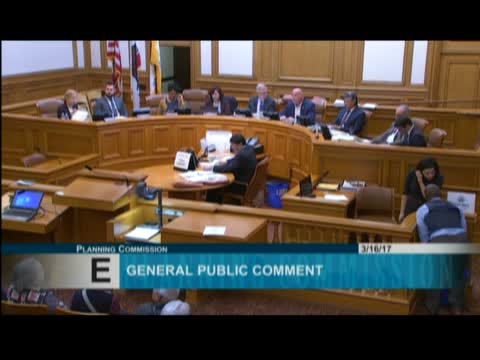
Four supervisors and dozens of community speakers appeared before the Planning Commission on March 16, 2017 to debate two competing proposals to revise San Francisco’s inclusionary housing rules. Supporters of a higher, on‑site requirement say it will protect low‑income households; backers of a workforce/middle‑income approach say it fills a growing ‘‘missing middle.’’
San Francisco’s Planning Commission spent the bulk of its March 16 hearing on dueling proposals to change the city’s inclusionary housing rules, hearing long presentations from supervisors and an extended public‑comment period in which unions, tenant groups and neighborhood advocates made opposing cases.
Supervisor Asha Safai and Board President London Breed argued for a proposal that prioritizes so‑called workforce housing and raises average AMI targets for some projects, saying the city is failing teachers, janitors and other working families who can’t afford to stay. ‘‘The best way to ensure workforce housing actually gets built is to incorporate it in privately funded inclusionary housing,’’ Breed said, describing the policy as a way to keep the city’s workforce from being pushed out.
By contrast, Supervisor Jane Kim and Supervisor Aaron Peskin presented a rival ordinance—branded ‘‘Inclusionary Housing for All’’—that would set higher on‑site requirements aimed at preserving units for lower‑income households. Kim and Peskin said the controller’s technical feasibility study supports a higher ceiling when the state density incentive is used; Kim warned that lowering low‑income targets would ‘‘rob Peter to pay Paul’’ and reduce the number of units available to the city’s most vulnerable residents.
Staff from the Mayor’s Office of Housing and the city controller briefed commissioners on a months‑long technical analysis required by Proposition C. The controller’s study concluded that typical San Francisco projects could sustain on‑site inclusionary rates roughly in the controller’s ranges—about 14‑18% for rentals and 17‑20% for ownership—depending on whether a project accepts state density bonus incentives. Planning staff noted the two legislative packages handle the density bonus, unit mix and fee calculations differently and that those technical details matter to whether a project remains financially feasible.
Public comment stretched for hours. Labor unions and many community groups urged the commission and supervisors to preserve or increase low‑income set‑asides; others—including unionized construction workers and advocates for middle‑income households—pressed for policies that produce housing for teachers, nurses and building trades. Several speakers urged the supervisors to merge the two approaches or negotiate to avoid a divisive ballot fight.
Commissioners asked staff for further modeling—three‑, five‑ and ten‑year projections of production, yield and neighborhood impacts—and pressed legislative sponsors on assumptions in their proposals, especially how often projects would use the state density bonus and at what bonus level. Several commissioners said they wanted clearer implementation language on unit mix (2‑ and 3‑bedroom requirements), fee methodologies, and how fees would be spent if developers choose to pay in lieu of building on‑site units.
The Planning Commission did not vote on either ordinance. Staff said the matter will move through the Board of Supervisors; commissioners signaled they will request further economic modeling and clearer implementation details before recommending adoption.
What’s next: supervisors continue to negotiate in public and with stakeholders; staff will return to the commission with additional analysis and modeling ahead of votes at the Board of Supervisors.