Get Full Government Meeting Transcripts, Videos, & Alerts Forever!
Get email alerts on the Housing Density Bonus topic
No spam. Unsubscribe anytime.
Board upholds planning determination that four lots are not state-density-bonus eligible as presented
Summary
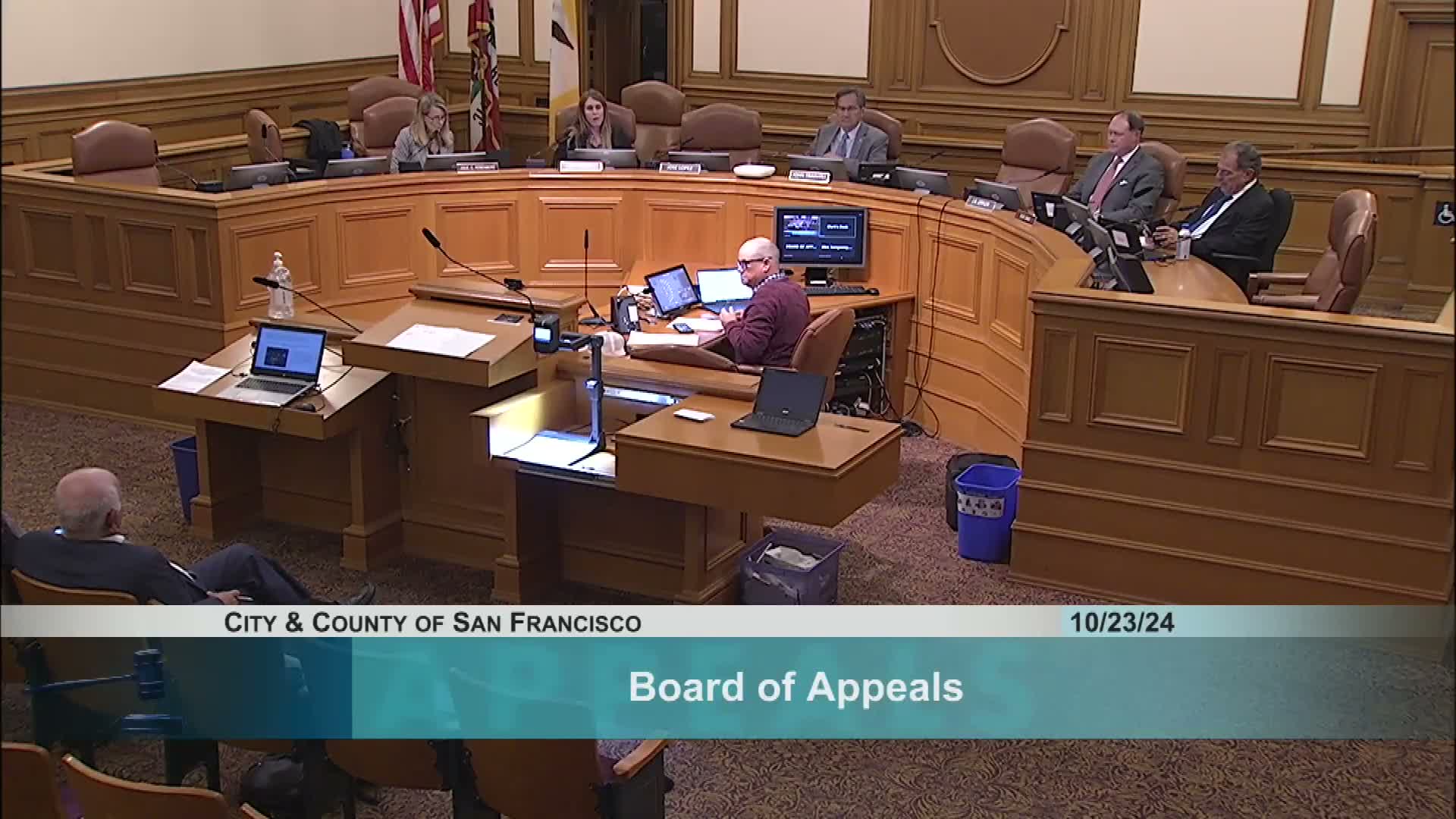
The Board of Appeals denied an appeal by a property owner seeking to treat four contiguous Alemany Boulevard lots as a single development for state density-bonus purposes; the board concluded the zoning administrator did not err in his technical interpretation and denied the appeal 3–0.
The San Francisco Board of Appeals on Oct. 23 denied an appeal asking whether four contiguous lots at 316–328 Alemany Boulevard could be treated as a single development application for purposes of California Government Code §65915 (the density-bonus law). The board voted 3–0 to uphold the zoning administrator’s Letter of Determination.
Appellant counsel Andrew Zacks argued the state statute explicitly allows counting units on contiguous sites that are the subject of one development application and said prior case and statutory language require a liberal construction in favor of creating affordable housing. Counsel requested that the zoning administrator’s technical reading, which treated the four assessor parcels as separate for purposes of calculating net new density, be overturned so the project could reach the five-unit threshold that triggers density-bonus benefits.
Planning staff, represented by Zoning Administrator Corey Teague, recounted a complex enforcement history: planning and city departments had found 17 unauthorized dwelling units across the four properties, the city pursued litigation, and the parties reached court-ordered resolutions and civil penalties earlier in 2024. Teague said the core question for the board was whether the zoning administrator erred or abused discretion in his technical responses; he pointed to local code provisions and longstanding interpretations about when contiguous lots under single ownership can be treated as a single lot or project and when merger is required.
Commissioners debated the technical accounting: whether existing legal or unauthorized units count toward the “net new” calculation for a density-bonus project, whether merging lots is required when treating contiguous parcels as a single development, and what legalization pathways are available for unauthorized units (some legalization programs allow limited credit, while other conversions require discretionary waivers and do not automatically count as permitted density). Teague explained that the planning code treats net-new density differently from simply adding previously existing unauthorized units and that some local legalization routes provide objective credit but others do not.
After discussion, Commissioner Swigg moved to deny the appeal and uphold the zoning administrator’s technical determination. The board voted 3–0 to deny the appeal. Planning staff and the appellant were advised of available administrative paths for legalization and for filing a state density-bonus application that complies with local and state objective rules; counsel signaled possible judicial review as a next step.