Get Full Government Meeting Transcripts, Videos, & Alerts Forever!
Get email alerts on the Cannabis Permitting topic
No spam. Unsubscribe anytime.
Board upholds zoning administrator’s determination on cannabis 600-foot rule
Summary
The Board of Appeals upheld a zoning-administrator Letter of Determination clarifying how planning and Office of Cannabis rules interact with the 600-foot buffer for cannabis retail permits, denying Chris Calloway’s appeal 3–0 after extensive testimony from equity applicants, planning, DBI and public commenters.
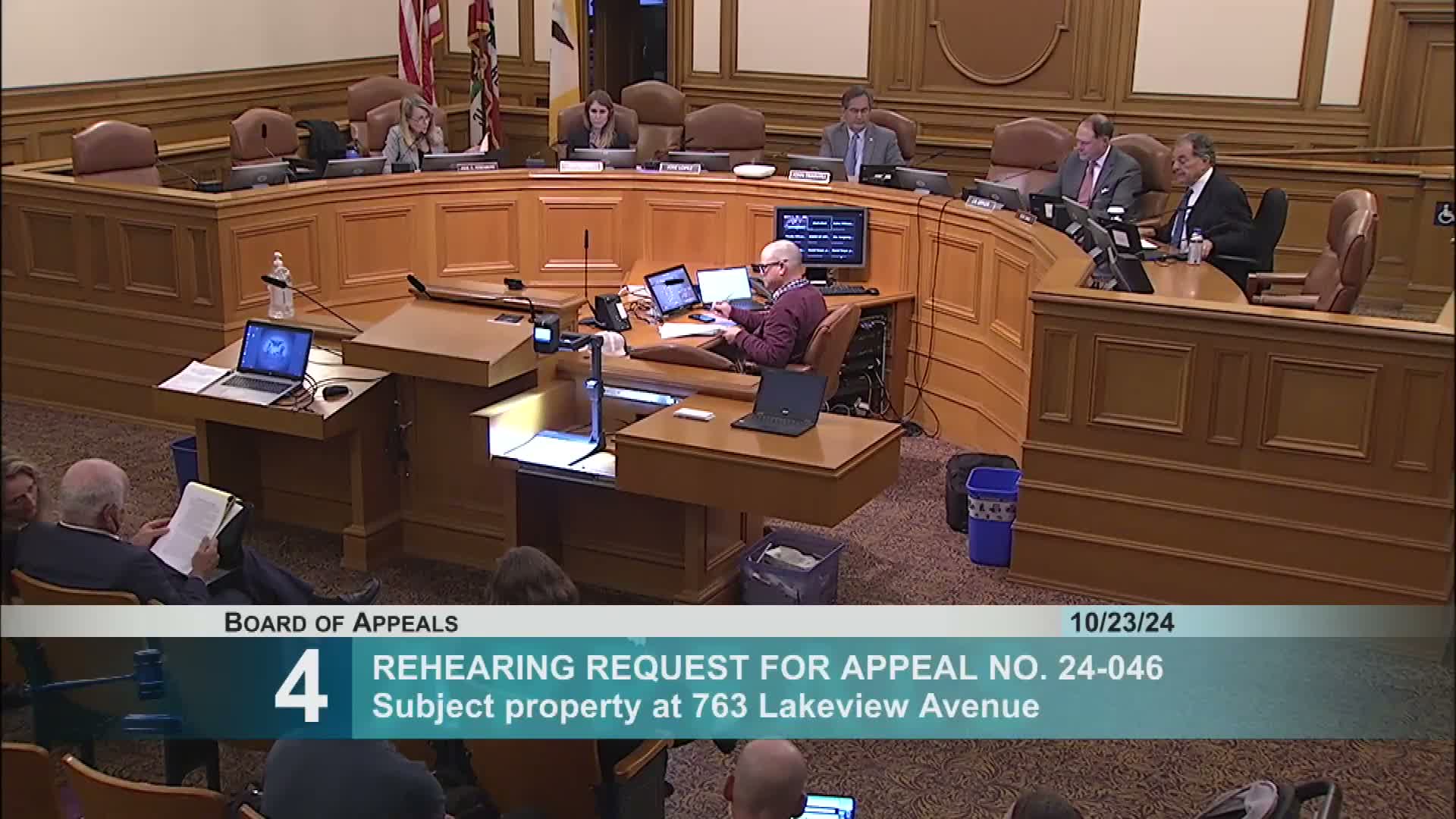
The San Francisco Board of Appeals on Oct. 23 upheld a zoning-administrator Letter of Determination interpreting how planning and Office of Cannabis (OOC) procedures interact with the city’s 600-foot proximity rules for cannabis retail conditional-use authorizations. The board denied the appeal filed by equity applicant Chris Calloway, voting 3–0 to uphold the determination.
Calloway and counsel argued the zoning administrator’s Letter of Determination (LOD) failed to answer the narrow planning-code question they had posed and improperly relied on OOC processing rules. They said nothing in the planning code prohibits two conditional-use (CU) approvals within 600 feet of each other where no valid OOC permit has been issued, and they presented email evidence that OOC had informally referred their application to planning for zoning review.
Planning staff, represented by Zoning Administrator Corey Teague, explained the city’s regulatory framework is distributed across planning code, police code and OOC rules. Teague said the LOD addressed the context and mechanics of referrals between OOC and planning, and described why OOC’s referral practices and the existence of an active CU at 500 Laguna had the practical effect of preventing parallel processing of competing CU applications within a 600-foot radius. DBI staff and the San Francisco Fire Department materials were also referenced for technical review points.
Several equity applicants and small-business owners spoke during public comment, urging clarity and more predictable pathways for equity applicants. Rebecca Fox, a local small-business owner, told commissioners that vacant storefronts and prolonged permitting delay are harming local commerce. Another speaker, identified as an equity applicant, asked the board to consider leniency and stronger oversight of processes so equity applicants are not left in limbo.
Commissioners questioned staff about the mechanics to “clear the decks” when an initial CU is not moving forward, and about whether merge or revocation processes are options for property owners or planning. Teague explained that conditional-use authorizations run with the land, are frequently valid for a three-year window, and that revocation or an extension decision rests with the Planning Commission. He said OOC rules and the informal referral practice were created during rulemaking to avoid multiple simultaneous CU applicants wasting resources when only one can ultimately proceed.
After deliberation, Commissioner Eppler moved to deny the appeal and uphold the zoning administrator’s determination on the grounds that the zoning administrator had not erred nor abused discretion; the board voted 3–0 to deny the appeal. The board’s decision leaves the technical interpretation in place; affected applicants are directed to existing planning and OOC processes for next steps, and the Planning Commission remains the forum for any future extension or revocation related to 500 Laguna.
The ruling clarifies the current administrative interpretation but does not preclude applicants from pursuing additional administrative or judicial remedies.